The Unfinished Swan - Tech Demo 9/2008 from Ian Dallas on Vimeo.
Showing posts with label video. Show all posts
Showing posts with label video. Show all posts
Thursday, 30 October 2008


Friday, 10 October 2008
believing real
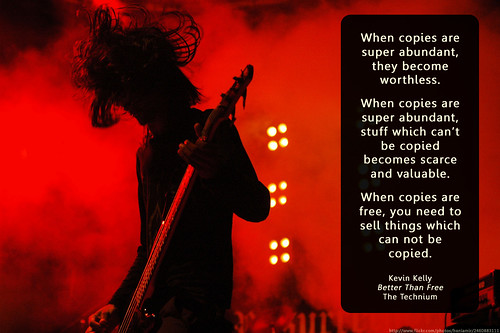 One of the first things I think when I see something online, and one of the first things that gets banded about on comment lists, is whether or not something is genuine, rather than set-up, faked, CGed etc. If it's genuine, interest soars; if not, interest dwindles (usually).
With this in mind here's a variation on Kelly's idea:
When content is faked, it becomes emotionally worthless.
When content is faked, stuff which isn't fake becomes scarce and valuable.
When content is faked, you need to show people things which are not faked.
I'd add on that some stuff that's great is faked (e.g. Cadbury's Gorilla; clearly that's not a real ape drumming away). It's when stuff is faked and needn't have been (or could have been done for real) that the emotional bottom drops out.
Wednesday, 13 August 2008
Sunday, 10 August 2008
Thursday, 7 August 2008
mixin
Two things.
One. Vodafone should be doing something like this.
They could have a whole arsenal of apps to turn their positioning - make the most of now - into a something valuable for people and link it up in lovely ways to mobile and social platforms.
Two. It's so helpful when you come across a new site not to have to explain it in your blog but just embed the code for a video they provide, which does the job for you, thank you very much.
One. Vodafone should be doing something like this.
They could have a whole arsenal of apps to turn their positioning - make the most of now - into a something valuable for people and link it up in lovely ways to mobile and social platforms.
Two. It's so helpful when you come across a new site not to have to explain it in your blog but just embed the code for a video they provide, which does the job for you, thank you very much.
Monday, 28 July 2008
pulse
According to the blurb, "pulse is a live visualisation of the recent emotional expressions written on the private weblogs of blogger.com". It's interesting because stuff online is being used to create art offline.
It's kind of a mashup of Julius Popp's intriguing Bit.Fall (below) and and also the 'feel map' that I blogged about here.
Also reminds me a bit of the plant in E.T. which seems to respond to E.T.'s health.
I really, really want time and location to be factored into these things, especially as mining the emotions gets better. It would be such an interesting insight into people's expressed emotions as news stories ripple through a population or more generally what a particular population is feeling in a year.
It's kind of a mashup of Julius Popp's intriguing Bit.Fall (below) and and also the 'feel map' that I blogged about here.
Also reminds me a bit of the plant in E.T. which seems to respond to E.T.'s health.
I really, really want time and location to be factored into these things, especially as mining the emotions gets better. It would be such an interesting insight into people's expressed emotions as news stories ripple through a population or more generally what a particular population is feeling in a year.
Sunday, 27 July 2008
Saturday, 26 July 2008
more radioheadness
Just discovered this beautiful little baby created by flight404 and midwifed by the Radiohead/Aniboom video competition. Everywhere I look Radiohead is innovating, which includes getting other people to be innovative for you. Check out the high res version here.
Thursday, 24 July 2008
the future is streaming, not downloading

The news that major ISPs in the UK have agreed to smack the wrists of hardcore file-sharers is, ultimately, not really news.
This is because film, tv and music - the most popular shared content - is increasingly available in streamable form obviating the need to download at all. It's all going to be in the cloud.
The likes of LastFM and Pandora could take care of the music. iPlayer is already taking care of the BBC's output phenomenally well. Other places like TV Shack, Videostic and, legally, Hulu, are providing the rest.
It does tickle me a bit that just as the industry catches up, the ways in which we can consume music has moved on. Instead of owning content - and all the problems that brings if you have acquired it illegally - you just own links to that content and get served with ads or pay a small subscription fee for it.
This shouldn't be a new problem for the entertainment industry, it's a better solution.
Thursday, 24 April 2008
Friday, 11 April 2008
BBC Penguins
Seriously good work from RKCR Y&R (ergh, so many letters and, quick aside, who still has an entry page on their website?) and Passion Pictures for promotion of the Beeb's iPlayer. David Bainbridge, BBC head of marketing communications and audiences for future media and technology (his business card must comes as roll) said on BR: "It is also hoped that this creative device will not only celebrate what BBC iPlayer can deliver, but will also say something quite profound about the BBC's overall appetite for creative risk-taking and innovation." It does. (Although strictly speaking the innovation was out-sourced).
Monday, 31 March 2008
Blowtorch

How do you produce quality in new media and all the participation it offers without suffering the rubbish that is most user-generated content. One answer might be Blowtorch. It's co-create with high standards exclusively for 18-24 year olds. That is, audiences get a say in the creative output - the soundtrack, the editing, the cinematography etc. I can see this sort of thing being eminently attractive to certain people.
Set up by a satisfying mix of entertainment, technology and advertising pros, this gets me excited because it's progressive. Unlike the rest of Hollywood whose nerves about damaging their precious DVD sales have meant congealment, Blowtorch's new rules of participation and using all the different media pipes to engage is new and needed.
Thursday, 27 March 2008
Medium-rare ads

Media companies or algorithms decide how we get our ads served up. Hulu, one of the most promising legit video-on-demand sites, is giving its users more of a say in how they get their ads.

Its inevitable that all TV viewing will be done online in the future because the choice is better (although something will need to be done about choice paralysis) and time and space are no longer constraining factors.
Time is irrelevant because shows can be called up on-demand, making the 'old' system of programming look as silly as everyone being served up with the exact same meal in a restaurant. Space - or location - is irrelevant because although TVs are stationary, screens are mobile. Content can be picked up anywhere as long as you have access to the cloud.
Online TV also has the chance to be interactive. People are already using traditional TV and online together to enhance the experience (and here). Online TV will just remove the space between laptop and TV, packing it down into one device.
Because of this inevitability, the move by Hulu to exploit the interactivity of the medium is a good thing.
If online TV is going to be free, it's going to have to be ad supported. It could be charged but when you have free vs paid, free will win out as long as the 'costs of free' aren't too great.
The 'cost of free' being advertising and the 'too great' bit being when the ads subtract significantly from the experience by being intrusive and/or irrelevant.
By adding choice to the ad serving process the costs are lessened because people will feel they have some choice in the matter and - now going beyond what is happening at Hulu - choice might improve relevance, the nirvana of advertising that has allowed Google to make billions.
I've got a few ideas about how more choice can be added into the mix to make people feel more in control and to give them better (more relevant) ads.
The first thing to note is the gulf between products on a show and buying them. The Internet could close this gap to a few centimeters. Take for example House's leather jacket, something that keeps him both "warm and cool" and something that was probably just chosen by the show's wardrobe people rather than any money changing hands for its use.

Yet, there is demand for his jacket; people are asking where to buy one. It would be fairly simple to have an overlay with a tagging system similar to Facebook's (below), except rather than being static, it would be dynamic; hypervideo. The tags would be put in place by the production team or automatically once the technology gets good enough at object recognition.
 The lovely Kate, tagged on Facebook
Everything in a show becomes a clickable object. Links out to products could be collected on a little 'shelf' which you could sift through at the end of the show. The transient nature of things in video becomes irrelevant. Clothes worn, gadgets used, songs played could all be put on the 'shelf' for later inspection and possible purchase. People could chose a specific type of ad (like clothing, gadgets or music) depending on their whim. I would find this much more useful than interupting messages or even a pre-show ad.
For some, this might seem rather unpleasant because of the risk of corrupting artistic output. This is as naïve as the idea of the sentimentalist idea of the noble savage because creativity has always used the oxygen of commerce. John Hegarty, BBH's creative supremo, uses Titian's The Annunciation as an example: "In the bottom right-hand corner you will see a decanter. Why? Well, the Venetians had developed clear glass and they wanted it in there as an advert. So the connection between culture and commerce is hundreds of years old." (source)
 Titian's The Annunciation (click to enlarge)
Second, I agree with Hegarty's other point that the only problem with such placement is when it is done badly, when it is perpendicular to the story. It reminds me of the deliberately obtuse faux product placement in the Truman Show by Truman's synthetic wife:
 In this situation both show and brand come off looking bad. As Hegarty says, "It doesn't satisfy the viewer, so it doesn't work for the advertiser" (also see this paper by Nigel Hollis, Chief Global Analyst at Millward Brown for more on this). Put differently, corrupting artistic output is not in the interests of either the people making the shows or the advertisers.
I would much rather have something like this, where I get to chose the ads in a more ecologically valid environment than have my viewing experience lacerated by the tyranny of jingles and over-enthusiastic voice overs. And with the long tail this could be very profitable for shows and films.
Advertising is here to stay. The more useful we can make it the better it will be for all involved. And one way to do this is let people have more choice about the ads they consume.
Time is irrelevant because shows can be called up on-demand, making the 'old' system of programming look as silly as everyone being served up with the exact same meal in a restaurant. Space - or location - is irrelevant because although TVs are stationary, screens are mobile. Content can be picked up anywhere as long as you have access to the cloud.
Online TV also has the chance to be interactive. People are already using traditional TV and online together to enhance the experience (and here). Online TV will just remove the space between laptop and TV, packing it down into one device.
Because of this inevitability, the move by Hulu to exploit the interactivity of the medium is a good thing.
If online TV is going to be free, it's going to have to be ad supported. It could be charged but when you have free vs paid, free will win out as long as the 'costs of free' aren't too great.
The 'cost of free' being advertising and the 'too great' bit being when the ads subtract significantly from the experience by being intrusive and/or irrelevant.
By adding choice to the ad serving process the costs are lessened because people will feel they have some choice in the matter and - now going beyond what is happening at Hulu - choice might improve relevance, the nirvana of advertising that has allowed Google to make billions.
I've got a few ideas about how more choice can be added into the mix to make people feel more in control and to give them better (more relevant) ads.
The first thing to note is the gulf between products on a show and buying them. The Internet could close this gap to a few centimeters. Take for example House's leather jacket, something that keeps him both "warm and cool" and something that was probably just chosen by the show's wardrobe people rather than any money changing hands for its use.

Yet, there is demand for his jacket; people are asking where to buy one. It would be fairly simple to have an overlay with a tagging system similar to Facebook's (below), except rather than being static, it would be dynamic; hypervideo. The tags would be put in place by the production team or automatically once the technology gets good enough at object recognition.
 The lovely Kate, tagged on Facebook
Everything in a show becomes a clickable object. Links out to products could be collected on a little 'shelf' which you could sift through at the end of the show. The transient nature of things in video becomes irrelevant. Clothes worn, gadgets used, songs played could all be put on the 'shelf' for later inspection and possible purchase. People could chose a specific type of ad (like clothing, gadgets or music) depending on their whim. I would find this much more useful than interupting messages or even a pre-show ad.
For some, this might seem rather unpleasant because of the risk of corrupting artistic output. This is as naïve as the idea of the sentimentalist idea of the noble savage because creativity has always used the oxygen of commerce. John Hegarty, BBH's creative supremo, uses Titian's The Annunciation as an example: "In the bottom right-hand corner you will see a decanter. Why? Well, the Venetians had developed clear glass and they wanted it in there as an advert. So the connection between culture and commerce is hundreds of years old." (source)
Titian's The Annunciation (click to enlarge)Second, I agree with Hegarty's other point that the only problem with such placement is when it is done badly, when it is perpendicular to the story. It reminds me of the deliberately obtuse faux product placement in the Truman Show by Truman's synthetic wife:
 In this situation both show and brand come off looking bad. As Hegarty says, "It doesn't satisfy the viewer, so it doesn't work for the advertiser" (also see this paper by Nigel Hollis, Chief Global Analyst at Millward Brown for more on this). Put differently, corrupting artistic output is not in the interests of either the people making the shows or the advertisers.
I would much rather have something like this, where I get to chose the ads in a more ecologically valid environment than have my viewing experience lacerated by the tyranny of jingles and over-enthusiastic voice overs. And with the long tail this could be very profitable for shows and films.
Advertising is here to stay. The more useful we can make it the better it will be for all involved. And one way to do this is let people have more choice about the ads they consume.
Friday, 22 February 2008
Great opening credits
Often the opening credits get forgotten, what with the focus on the show's content. Yet the best have a way of immediately transporting you into the show's world. Here are a few of my favourites, in no particular order...
House
Beautiful mix of Da Vinci-style medical drawings, flyovers and human body CG set against Massive Attack's brilliant Teardrop.
Dexter
The morning routine suffused with graphic and chilling homicide allusions.
Weeds
Suburban conformity set against Malvina Reynold's Little Boxes (after Season One each new episode uses a different cover).
Six Feet Under
I have no idea what the proper name for that first musical 'strike' is, but it alone can take me into the world of one of the best shows in history. This opening sequence is just beautiful.
Darkplace
Few people have heard of Darkplace. Even fewer get it. But this opening sequence is the paragon of parody and a great snapshot of the deluded, troubled genius that is Garth Marenghi.
Carnivale
The sweeping and unusual epic that should never have been axed.
The Office (UK)
Grey Slough.
Scrubs
Just like the show and its characters this sequence is eminently likeable and upbeat.
Nip/Tuck
Plastic and sterile visuals coupled with The Engine Room's icy A Perfect Lie.
24
So this isn't the full sequence but the frazzled visuals and screechy, electronic sound are great.
House
Beautiful mix of Da Vinci-style medical drawings, flyovers and human body CG set against Massive Attack's brilliant Teardrop.
Dexter
The morning routine suffused with graphic and chilling homicide allusions.
Weeds
Suburban conformity set against Malvina Reynold's Little Boxes (after Season One each new episode uses a different cover).
Six Feet Under
I have no idea what the proper name for that first musical 'strike' is, but it alone can take me into the world of one of the best shows in history. This opening sequence is just beautiful.
Darkplace
Few people have heard of Darkplace. Even fewer get it. But this opening sequence is the paragon of parody and a great snapshot of the deluded, troubled genius that is Garth Marenghi.
Carnivale
The sweeping and unusual epic that should never have been axed.
The Office (UK)
Grey Slough.
Scrubs
Just like the show and its characters this sequence is eminently likeable and upbeat.
Nip/Tuck
Plastic and sterile visuals coupled with The Engine Room's icy A Perfect Lie.
24
So this isn't the full sequence but the frazzled visuals and screechy, electronic sound are great.
Saturday, 9 February 2008
Ants and Colour
Went to the Tate Modern today and was surprised at how unexciting the work was. Standing out in the mediocrity was this sweet little video called Quarta-Feira de Cinzas/Epilogue by filmmaker Cao Guimaraes and artist Rivane Neuenschwander. Following the Carnival, the colourful confetti become the ants' treasure and we can watch them as they go about their labour (a little help was needed to get them excited by soaking the paper in either pork-fat or honey). There is also some nice tinkling added to the soundtrack.
Tuesday, 29 January 2008
Crash
The film Crash may be rather pessimistic and over-wrought at times. It may also have rather too many ribbons of serendipitous connectedness running through it, tying everything and everyone neatly together. It looked like one of those hyperlink TV shows (like Lost, 24, Prison Break etc) squashed into a film. But I loved it.
Here is a scene, which I love for packing a weighty dramatic punch. Thandie Newton and Matt Dillon's acting in both the earlier encounter (which sets up the tension for this scene) and this scene is brilliant. This is combined with Mark Isham's emollient score (the piece here is called 'Flames') and Paul Haggis' direction to create this mini-masterpiece:
Wonderfully, it's expanding out into the TV series it looked liked it had been squashed into. Leaving off from where the film finished it will go beyond the film's focus on ethnic relations and promises to reprise the original cast.
Here is a scene, which I love for packing a weighty dramatic punch. Thandie Newton and Matt Dillon's acting in both the earlier encounter (which sets up the tension for this scene) and this scene is brilliant. This is combined with Mark Isham's emollient score (the piece here is called 'Flames') and Paul Haggis' direction to create this mini-masterpiece:
Subscribe to:
Posts (Atom)