Showing posts with label digital. Show all posts

Thursday, 15 January 2009

quality adwords

(click to enlarge)

and generally quality campaign: TV, site, facebook & twitter.

Thursday, 8 January 2009

like glowing ants


This is global air traffic in a 24 hour period as captured by satellite (and they all seem to be going to London.)

Wednesday, 7 January 2009

google new year

The genius of Google’s advertising is that it doesn’t look like advertising while probably doing a better job than most advertising. It’s so functional, so straight-up. It doesn’t even feel like false altruism where you know that your wallet will have to appear at some point. It’s just lovely, simple and it perpetuates the use of Google.
Thursday, 11 December 2008

what's digital and why you should apply

Something I did for the folks over at AdGrads.


100 percent digital

It might be overstated (there’s probably always going to be the “‘bed, bog, bath’ element”) but Mr Billingsley’s comment is almost certainly right: we’re going to be digital advertisers because the world is now digital, and getting more so.

What does all this digital malarkey mean for people looking to get into the communications business and, before we look at that, what does digital mean anyway?

One of the lovely insights of Dare’s grad video – where the parents of Dare folk gloriously fail to define what their children do – is that pinning it down is tricky.

Part of its slipperiness is that things just keep shifting. Facebook was born in 2004, YouTube in 2005, Twitter in 2006, the App Store in 2008 etc. The only constant is change.

The other thing about ‘digital’ is that it’s polysemous – it has multiple meanings. 

It’s used to refer to electronic media (web, screens, mobiles, ipods, nike+ shoes etc) but also, and more importantly, the behaviours those media have unleashed and fed: interaction.

There’s an important difference there that Jeremy Bullmore expressed perfectly in Campaign when he said,

all about interactivity

There are two important things there for grads trying to get into the industry. The first is, “whose roof”?

Most of you will have been concentrating on the big above-the-line ones. That’s a good bet for a digital future as long as that ATL agency gets digital, which means they aren’t just talking about it, they’re doing it  (hmm, a black sheep has just popped into my head.)

On the other hand, another good bet are the agencies whose best is yet to come: the digital ones, primed as they are to thrive in the coming digital ecosystem.  

And now for the second important bit of Mr Bullmore’s quote: if you’re worried about applying to a digital agency because it’s got the word digital in it, don’t be: as he says, it’s not really about tech, it’s about interactivity.

And what's that? It's spreading the intelligence more evenly between people who make stuff and people who consume it. Sometimes it’s only a little, sometimes it’s a lot. 

This interactivity let’s you do a lot more than you can at your typical traditional ATL agency. Or to reunite that idea with its owner:
we are not an advertising agency

I think that's really exciting (and Mr Tait has 9 more great reasons digital is better for those interested). In digital you’re unshackled from just doing TV, print and radio to all sorts of exciting things like sites, applications, blogs, games, branded content, widgets, podcasts, social things and experimental stuff.  And a lot of this (not all) is actually useful to people; it's additive rather than interruptive. 

In my experience grads tend to think of digital as something on-the-sidey and techy. Maybe it once was. Now it ain’t. Technology is so ubiquitous, so ‘ready-to-hand’, that it’s becoming invisible and when that happens it gets socially interesting. In other words, technology and culture used to be separate, increasingly they are the same (look what you're doing now.)

It’s a brilliant time to get into an industry that’s only going to grow (even in these tough times) and that’s much more about interesting interactive ideas than it is about tech.

Go on, apply!

Obviously I am biased but this would be a good place to start...

(For those wanting more, I suggest you have a play in here, read this, canoe back up this and maybe watch this. That should be enough to be getting on with.)

Monday, 10 November 2008

a good, good guide


GoodGuide is great. It helps you find healthy, safe and green products. And - most importantly - it's now available on the iPhone. The fact that it's on the iPhone isn't the important bit. It's that it can be used at the point of purchase, which I'd imagine impinges much more on buying decisions than the memory of the site from home or work.

Saturday, 8 November 2008

50,000

Hit 50,000 hits today on Flickr for digitalbites and not much else happened so I thought it was worth a post. Good times.

Friday, 7 November 2008

getting creepy

New technologies can look like magic. That's Douglas Adams speaking.


But magic comes in two shades: black and white (which if the last posts are anything to go by seems to be a minor obsession at the moment).

The black stuff indicates some dark intention; the white stuff a benevolent effect.

New tech goes the same way. Phorm looks black. Genius looks white. But, in essence, they both do the same thing: use our data to sell more effectively.

And there's going to be a load more black technologies as the web breaks out and evolves into an Internet of Things.

Throw into the mix that data capture will get a whole lot smarter not only because of new ways of getting it (through GPS, RFID, accelerometers and the like [SPIME devices]) but because our increasing desire for personalisation means absolute transparency (that's Kelly), and you have some really quite creepy tech around the corner.

Stuff that knows about YOU. Where YOU are. What YOU like. Maybe even why YOU like it - and tense changes of all those. It's gonna get freaky.

The challenge is to tweak and present these technologies from having a perceived dark purpose (I don't really think Phorm does) to being understood as benevolent. We need to fuzz them up.

art from code


from here

Friday, 17 October 2008

turn left where the telephone box used to be


Thought it might be nice to record the Stage 1 IPA talks for selfish future referencing and for anyone else interested. They are a series of talks that aim to cover some of the essential truths of the communications industry. My posts will be pithy and I'll add bits in sometimes, esp. if there's a jump-off to psychology.

The first one was by industry legend Jeremy Bullmore. Here's his talk, triple-distilled:
  • A man asks for directions to a shop in a small town. The postman tells hims to go up the road and turn left where the telephone box used to be.

    Why has the postman failed in his communication? Because he makes the assumption that the listener knows what he knows. Or rather, he fails to appreciate the listener's knowledge is not the same as his. This lacks a word in English but it's something like empathy. Psychologists, however, do have a term for this faculty, theory of mind. Using clever methods - like the Sally/Anne task - it is possible to see this mental trick coming online around the age of four in developmentally typical children. Autistics never master this. The point: communicators need a theory of mind - or the ability to see events through the eyes of those they are communicating to - in order to be successful.

  • Passive audiences were never passive. Audiences have always actively understood communications, it's just that before digital they never had a way to express it; digital makes stuff that has always happened explicit.

  • There are no such things as messages. There are stimuli and responses. 

  • The best creativity elicits the best contribution from the receiver (the artist rules his subjects by turning them into accomplices)

  • There is no dichotomy between creativity and effectiveness in communications. Effectiveness is the end; creativity is the means.

  • Advertising creativity makes client's money go further. Anything outside of that definition is not creativity.

  • Brand body language is what people read. When the body language doesn't match the communication, there's a problem. 

  • Good brands make you feel safe, they release you from anxiety (mostly likely because of problems with information in market economies)

digital britian

"Our ambition is to see Digital Britain as the leading major economy for innovation, investment and quality in the digital and communications industries. We will seek to bring forward a unified framework to help maximise the UK's competitive advantage and the benefits to society." 
Stephen Carter, UK Minister for Communications, Technology and Broadcasting

Thursday, 16 October 2008

i love data layering


...especially if it's in 3D.

Friday, 10 October 2008

believing real

One of the first things I think when I see something online, and one of the first things that gets banded about on comment lists, is whether or not something is genuine, rather than set-up, faked, CGed etc. If it's genuine, interest soars; if not, interest dwindles (usually).

With this in mind here's a variation on Kelly's idea:
When content is faked, it becomes emotionally worthless.
When content is faked, stuff which isn't fake becomes scarce and valuable.
When content is faked, you need to show people things which are not faked.
I'd add on that some stuff that's great is faked (e.g. Cadbury's Gorilla; clearly that's not a real ape drumming away). It's when stuff is faked and needn't have been (or could have been done for real) that the emotional bottom drops out.

Wednesday, 17 September 2008

buy-product

thomashawk/flickr

The short version of this post is:

Selling on social networks can only be a by-product (hence the title 'buy-product'. Geddit? Oh dear, I am sorry) of the activities occurring on those sites, never a primary activity.

The long version is this:

In market economies there are two big problems with information: it's (occasionally)* inadequate and it's superabundant.

Why is information inadequate? Because you only know how good something is after you have bought it, so how do you choose between alternatives?

Why is there too much information? Because everyone wants a slice of the pie making those alternatives and the market gets flooded with products or services and thus information about those. (How do you choose between one-hundred types of olive oil? You don't for the most part. It's crippling. You move on.)

Add in the fact that this competition strips profits to the bone and you have three pretty good reasons for why brands should (and do so successfully) exist: to remove doubt about quality and ease the process of otherwise crippling choice for people who want to buy stuff, and pump scarcity (and thus juicer profits) back into things for people who want to sell stuff.

However, in the spirit of several recent books, solutions to the problem of inadequate and superabundant information can also be solved by [dramatic pause] other people. And more effectively because trust in other individuals is second only to personal experience itself.

Other people can literally 'test' products and services for you before you buy them yourself (by buying them themselves) and help narrow down the choice for you (by having had to narrow down the choice for themselves.)

People have probably been doing this since information in markets got to be doubly-dodgy. Nothing new in the behaviour. It even has a 5-syllable name: recommendation.

However, what might be new is that hitherto implicit recommendation could be made explicit and more useful with a dash of digital. Making stuff explicit seems to me to be the formula of the successful things in recent web (Facebook makes social relationships explicit, blogs records thoughts that would otherwise only exist in conversation or the mind, LastFM records the wake of your audio, StumbleUpon ossifies your digital discoveries etc.)

How would this work? Social networks would allow self-expression at a much finer level of detail allowing libraries of music, films, books, clothes**, etc that people have honed (not harvested automatically, which was the problem with Beacon). (Eventually content could be brought within such networks, so they operates as hubs of digital content.)

This in itself could present recommendations based on content (like iTunes Genuis) but also those made by other people in your group of friends. These recommendations wouldn't really be recommendations but comments/ratings tagged onto things by people. 'This track is awesome' could be really useful from someone who you (or your computer) knows you share taste with.

Picture time:

digital demographics

<span class=

One of the nice things about such a system is that it's lovely for people, providing stuff they might be interested in. However, there is also an opportunity here for social networks.

Another picture first:

untarnished social networks

And now I am going to quote myself, which is probably a bit wanky but here we go from a few posts back:
"When people use Google, they're looking for information. When they use Amazon, they're buying (or researching). The ads are working here because people want information, it's welcome if its good enough.

When they use Facebook (or any other social media) they're expressing, communicating and interacting with others (being social not being cognitive). The same ads aren't working here for the same reason you'd be a bit miffed if someone marched into the pub, dropped a sausage in your pint, yaddered on about how delicious they are and, by the way, how they are half-price at the moment."
The point is that in the social space clumsy selling (ads) is not welcome: the communication gets tarnished by it, so it's ignored and disliked. But, that is not to say that selling as a by-product is out of the question. Links to things - and charging the producers a little for those links - suits everyone.

* I put 'occasionally' in brackets because as soon as information is partially inadequate it gets perceived at wholly inadequate.
** Self-generated recommendations will probably work for clothes; other-generated recommendations won't work as well. People like their clothes to be different (but not too different) from their peers.

Thursday, 11 September 2008

negroponte's predictions

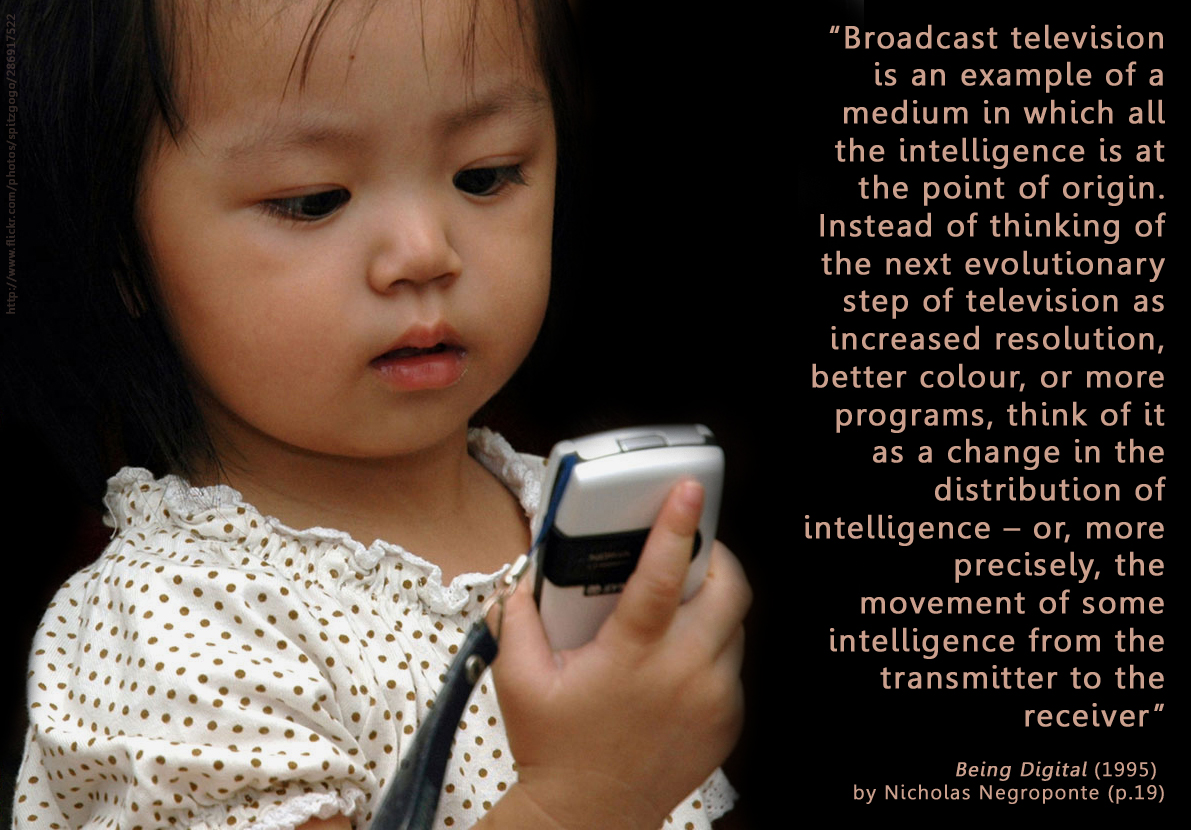
Prediction is usually a dubious business: things are way too uncertain and we just don't know what we're going to know in the future ('unknown unknowns' in NNT's terms). That's why Being Digital by Nicholas Negroponte, which came out in 1995, is all the more freakish in its prescience.

Here's a smattering of things I liked, with the occasional few words after each from the perspective of now.

moving intelligence through media
The tidiest way I have seen the 'receive -> interact' paradigm change articulated.

computing <span class=
Basically, Apple's strategy and success.

pulling bits
RSS, Google Reader...

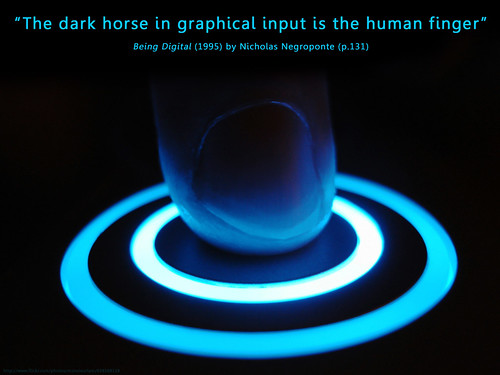
touch, the dark horse
Creeping in more and more. He also talked about "the tiny hole or two in plastic or metal, through which your voices access a small microphone" (p.159). This is still proving difficult.

digital demographics
Things like Google Reader's Top Recommendations, Amazon's recommend emails and iTunes' Genius represent this one quite nicely. Although still some way to go here.

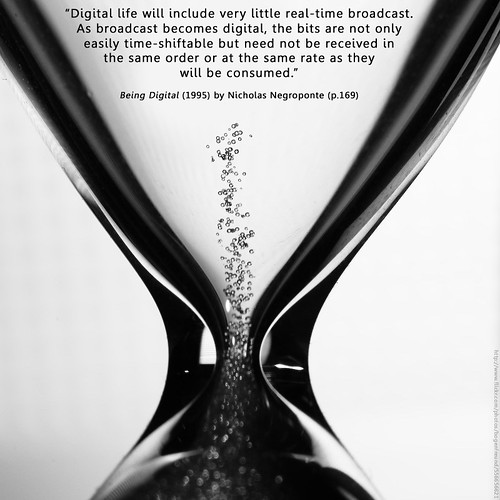
digital on-demand
Hulu, BBC iPlayer and all the underground antecedents to these.

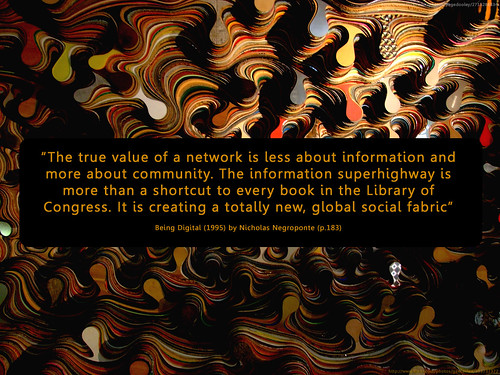
the global social fabric
This idea - communication as well as information - is rephrased a lot by pundits. What's impressive about this is that it saw the value of social online before it was made explicit with, sorry, nasty phrase coming up, Web 2.0.

the peeling boundary
Blogging seems the best example.

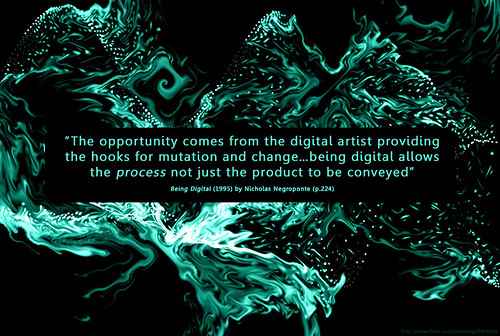
the process
Radiohead is my favorite example of this at the mo. (Also see here for what bitcasting - another of Negroponte's babies - is all about and how Radiohead's House of Cards 'video' is likely to have been the first example of this).

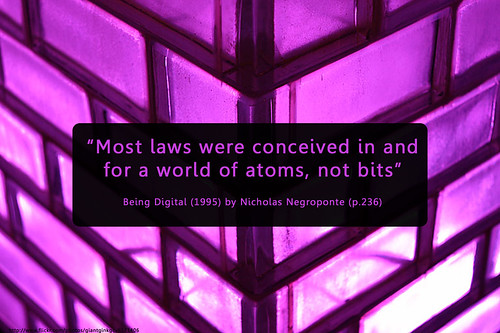
laws for atoms
Very broadly gets to the nub of all the legal issues bouncing around online.

And a few others that didn't make it into digital bites:
"Clipping bits is very different from clipping atoms" p.59
"On the net each person can be an unlicensed TV station" (p.176)
One word. YouTube
"...bits that describe other bits...will proliferate in digital broadcasting. These will be added by humans aided by machines, at the time of release...or later (by viewers and commentators). The result will be a stream with so much header information that your computer really can help you deal with the massive amount of content" (p.179)
tags, labels etc
"automobiles will enjoy another very particular benefit of being digital: they will know where they are" (p.216)
SatNav.
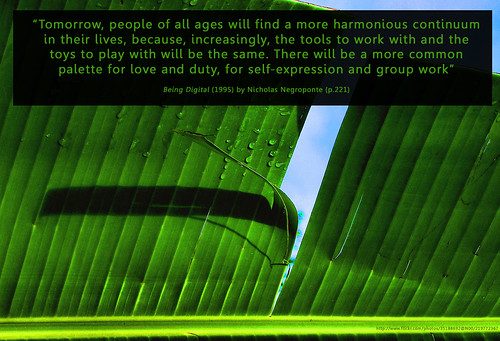
"The important point is to recognise that the future of digital devices can include some very different shapes and sizes from those that might naturally leap to mind from our current frames (sic) of reference. Computer retailing of equipment and supplies may not be limited to Radio Shack and Staples, but include the likes of Saks and stores that sell products from Nike, Levis and Banana Republic."
Basically, the web breaking out from behind screens, which I have thought about here. Nike+ is the golden example of this right now. A continuation of this idea:
"When this happens in a tiny format, all "things" can be digitally active. For example, every teacup, article of clothing, and (yes) book in your house can say where it is. In the future, the concept of being lost will be as unlikely as being "out of print"
I like the nod to long tail stuff at the end there with "as unlikely as being out of print"

(Skepticism: the book, being widely read, could have prompted people to work on the things Negroponte predicted ('invented'), giving the impression that the book is farsighted when it may have been prescriptive to future-makers)

Friday, 22 August 2008

digital uses more neurons

rizzato/flickr

There is a lot frothing up on how the Google Generation (which is actually a very misleading idea) is full of a bunch of cognitively myopic and depthless individuals just skimming from one digital distraction to another. And somewhere in that there is probably some truth for some people.

But the assumption that the endpoint of new web behaviours is neuromush is wrong. History teaches us that any new technology brings with it a grimly predictable cohort of detractors. It also teaches us that for every game-changing innovation - the alphabet, writing, printing - humans didn't end up mentally crippled but enriched, seriously enriched, in fact.

That's why - in the same spirit as Everything Bad is Good for You - it's nice amid all this gloom to know there are some historically alert digital optimists. Digital culture is such a massive improvement in many aspects to 'receive' culture*. As Don Tapscott and Anthony D. Williams put it in Wikinomics (p.47),
Rather than being passive recipients of mass consumer culture, the Net Gen spend time searching, reading, scrutinizing, authenticating, collaborating and organising.
So in that respect, Google is not really making us stupid. Perhaps, quite the opposite: all this new media may cause more cognitive sweat than the media before it.

Rewind ten years, people would read a book or an article and that was that. A few might make notes. Only a handful would write about it and publish, and typically on a professional basis. Back to today, and the same book or article generates way more thought than it would have done a decade earlier. Digital culture uses more neurons.

Added to that, what is also omitted from the view that the new represents a mental downgrade is that while we are outsourcing certain brain functions to silicon we are gaining literally superhuman abilities in the process. The critics focus on what is lost and ignore what is gained, like memory.

As Faris has neatly put it,
I think increasingly, our brains are less like databases and more like index servers
And it's better that way because actually I can store more, not less. My memory isn't atrophied by the internet, it's augmented. And that's the mark of some of the most transformational technologies: they extend our ability to keep information alive by outsourcing it.

*This is clumsy. Some digital stuff is obviously sit-back too.

Thursday, 21 August 2008

more fragments

blentley/flickr

Why is advertising in social media not really working out? Because of a silent assumption that got forgotten in the move from trad to new media.

You can deploy car and beer spots during football matches; ads for age-defying cream and Heat during How to Look Good Naked; stuff for DIY during Grand Designs...I could go on.

And this makes a lot of sense. By knowing what your audience is like you can be more selective and hope your ad is hitting a bigger group for whom it is more relevant, rather than just splattering it randomly across the schedule.

This model has been carried across to the Internet, with superb success for Google who worked out how to automate the process with AdSense.

However, one of the things the traditional model never had to worry about was what the audience were doing. It didn't have worry because it knew: they were listening to something, or watching a show, or standing on the Tube, or whatever.

Because the model had this silent assumption when it was transferred to the new medium it got forgotten. The hidden fragment got left behind.

What are the audience doing online?

When people use Google, they're looking for information. When they use Amazon, they're buying (or researching). The ads are working here because people want information, it's welcome if its good enough.

When they use Facebook (or any other social media) they're expressing, communicating and interacting with others (being social not being cognitive). The same ads aren't working here for the same reason you'd be a bit miffed if someone marched into the pub, dropped a sausage in your pint, yaddered on about how delicious they are and, by the way, how they are half-price at the moment.

So what people are doing online is probably as important for click-through rates as who they are.

I haven't thought about specific examples yet for social networks, but essentially companies selling in this space should assist with communication and expression, not clutter it.

The Internet isn't one medium, it's fragmented media - and not just by who, but why what.

Wednesday, 20 August 2008

smarter reviews

Once mobile internet gets properly off the ground, lots of shopping in the real world will change. It will change because prices and reviews - things normally all the way back at home - will suddenly be at your fingertips in stores. The buying decision is going to get another brain contributing.

But reviews have their problems.

Say I am swotting up on a new book I have heard is rather tasty or investigating a new camera so I don't have to mashup (read, lazily appropriate) others' photos on Flickr. I read a load of book reviews on various sites. For the camera, I come up against some sites wanting my money for their opinions, others with more reviews than I can possibly read and perhaps a couple of blog posts from some real keenos.


Here's my beef with all of this.

'Old' media stuff is dense and long but trustworthy and rich. It's also one person's view normally.


Customer reviews are helpful because they are likely to tell it like it is; they have no reason not to. Except some people can't tell it like it is even if they want to, making a chunk of customer reviews unhelpful by being unreadable, like this beauty from the BBC's gleefully entertaining Have Your Say (distilled here).


And even when people can get their thoughts in order, how do you know that what they like you are going to like? So you look at quite a few of these, try to average across opinion. That's a bit time-consuming. One quick way to do this is to look at things like the 5 stars on Amazon.


This is beautifully quick but often rather unhelpful: it doesn't tell you all that much. Added to that, fans swarm in and leave in their slaver pages of universally positive reviews. In its most extreme form this sort of review takes binary form.: thumbs up or down, cool or not, rotten or fresh. Essentially, the problem with taking lots of data and reducing them, is that it can only provide a dirty average.


Basically, the problems of reviews are that we have work hard to find them, when we do there is too much information overall and there is a poor summary of it. We need something that combines the best bits. Basically, something that is quick but rich:


So all the power of collaboration is used. All the time spent reading and cogitating is stripped away. The in-depth, expert stuff is there if you want it. And, most importantly, the reviews become a whole lot more powerful by taking into account who has left them.

This has probably been thought up somewhere before. All the same, I don't see this kind of thing anywhere. And it is the perfect sort of review system for mobile: lightweight, powerful, visual, personalised and genuinely useful.

Wednesday, 13 August 2008

transactive digital memories

kendrak/flickr
"Knowledge is of two kinds: we know a subject ourselves, or we know where we can find information upon it."
Samuel Johnson had the idea of transactive memory down before Wegner, Giuliano, and Hertel formally brought it to the table in 1985.

What it acknowledges is that there's memory in our heads, and memory that's elsewhere, usually other people's heads. Transactive memory is the smearing of a reality to a number of different minds to lighten the load on one.

Swap out the 'other people' in this arrangement and swap in the Internet. Feel familiar? As Clive Thompson said in Wired, "Almost without noticing it, we’ve outsourced important peripheral brain functions to the silicon around us."

Just as the nature of transactive memory in relationships or groups is only conspicuous by someone's absence, so it is when we are away from the Internet. Our memories are now neuronal and digital. Sounds rather cyborgish, doesn't it? But a hefty chunk of my memory - names, numbers, dates, addresses, quotations - are all outsourced.

Wegner and his mates should broaden their research to see what's going on with transactive digital memories.

Sunday, 10 August 2008

facebook and fireworks


Facebook: the social equivalent of watching the fireworks in the park on TV.


Saturday, 26 July 2008

the digital fitting room

the_moog/Flickr

What is the point of a fashion model? Aren't they there to help present clothes in their best aesthetic and proportions and ultimately elicit the reaction 'ooh, I would like that' or 'that brand'?

I think so.

After desire comes pragmatics. Does it fit? Does it look good?

If everyone were the same size as the models then all you would do is go and buy the item in that size.

But, of course, everyone isn't the size of a model. Dove niftily profited from that insight with their Campaign for Real Beauty.

Plus, it is one thing to see a model wearing something, another to imagine yourself in it and quite another still to see yourself in it.

It is for this reason fitting rooms exist: so people can test clothes in front of mirrors while trying to look effortlessly blasé about it all (this most bizarre of states is in desperate need of a label. Do the Germans have one, they normally have wonderful words for things like this?)

I would argue that if it weren't for the liberal return policies that e-retail sites have, (which are roughly double the shop rates) clothing would be no way near the second most purchased item online after books. The internet just turns people's homes into their fitting rooms.

Now, no digital experience can recreate the real thing, but I think clothing companies haven't quite got it right online yet.

Just from having a browse around the sites of H&M, Diesel and TopShop it is clear that their digital spaces are sparkly brochures, nothing more.

Even Uniquo's Grand Prix winning Uniqlock - as fresh and tasty as it is - doesn't add a whole lot of value on for their customers. It is not useful to actually buying clothes. Maybe it's not supposed to be. But I think it should.

What would be better? I reckon if people are interested in how clothes look and if they'll fit then all that's needed is a digitisation of the place this happens in: the fitting room.

The Digital Fitting Room can be online, on-phone or on-wall. It simply takes a high-res avatar of you based on either a scan or supplied key dimensions and matches it to the known dimension of clothes. I think the technology is good enough to do this and the demand is certainly there if virtual communities are anything to go by:
"I've also been fascinated to discover how important fashion is within virtual worlds, in which people can dress up their digital avatars and enjoy the benefits of a new outfit or hair-do at a fraction of the cost of the real thing. This is a kind of theatre of virtual consumption, which works in exactly the same way as consumption in the real world – people lust after objects, save up to buy them, and display them with the same pride they would an analogue object....trying on outfits and shopping is one of the great pleasures the world affords its residents, and one of the reasons why Second Life is used by so many women."
And it opens up whole new swathes of applications for things like the iPhone (e.g., point it at an item's bar/QR code in-store and see what it would look like on you) or gaming where you get to dress yourself digitally inside of an interesting little game.

The first steps don't have to be as grand as these. They just create engaging and useful interfaces for people to dress themselves and ride off the back off the the popularity of personalisation in the marketplace.

I'd find it useful anyway.