Showing posts with label mobile. Show all posts

Thursday, 11 December 2008

what's digital and why you should apply

Something I did for the folks over at AdGrads.


100 percent digital

It might be overstated (there’s probably always going to be the “‘bed, bog, bath’ element”) but Mr Billingsley’s comment is almost certainly right: we’re going to be digital advertisers because the world is now digital, and getting more so.

What does all this digital malarkey mean for people looking to get into the communications business and, before we look at that, what does digital mean anyway?

One of the lovely insights of Dare’s grad video – where the parents of Dare folk gloriously fail to define what their children do – is that pinning it down is tricky.

Part of its slipperiness is that things just keep shifting. Facebook was born in 2004, YouTube in 2005, Twitter in 2006, the App Store in 2008 etc. The only constant is change.

The other thing about ‘digital’ is that it’s polysemous – it has multiple meanings. 

It’s used to refer to electronic media (web, screens, mobiles, ipods, nike+ shoes etc) but also, and more importantly, the behaviours those media have unleashed and fed: interaction.

There’s an important difference there that Jeremy Bullmore expressed perfectly in Campaign when he said,

all about interactivity

There are two important things there for grads trying to get into the industry. The first is, “whose roof”?

Most of you will have been concentrating on the big above-the-line ones. That’s a good bet for a digital future as long as that ATL agency gets digital, which means they aren’t just talking about it, they’re doing it  (hmm, a black sheep has just popped into my head.)

On the other hand, another good bet are the agencies whose best is yet to come: the digital ones, primed as they are to thrive in the coming digital ecosystem.  

And now for the second important bit of Mr Bullmore’s quote: if you’re worried about applying to a digital agency because it’s got the word digital in it, don’t be: as he says, it’s not really about tech, it’s about interactivity.

And what's that? It's spreading the intelligence more evenly between people who make stuff and people who consume it. Sometimes it’s only a little, sometimes it’s a lot. 

This interactivity let’s you do a lot more than you can at your typical traditional ATL agency. Or to reunite that idea with its owner:
we are not an advertising agency

I think that's really exciting (and Mr Tait has 9 more great reasons digital is better for those interested). In digital you’re unshackled from just doing TV, print and radio to all sorts of exciting things like sites, applications, blogs, games, branded content, widgets, podcasts, social things and experimental stuff.  And a lot of this (not all) is actually useful to people; it's additive rather than interruptive. 

In my experience grads tend to think of digital as something on-the-sidey and techy. Maybe it once was. Now it ain’t. Technology is so ubiquitous, so ‘ready-to-hand’, that it’s becoming invisible and when that happens it gets socially interesting. In other words, technology and culture used to be separate, increasingly they are the same (look what you're doing now.)

It’s a brilliant time to get into an industry that’s only going to grow (even in these tough times) and that’s much more about interesting interactive ideas than it is about tech.

Go on, apply!

Obviously I am biased but this would be a good place to start...

(For those wanting more, I suggest you have a play in here, read this, canoe back up this and maybe watch this. That should be enough to be getting on with.)

Saturday, 8 November 2008

50,000

Hit 50,000 hits today on Flickr for digitalbites and not much else happened so I thought it was worth a post. Good times.

Thursday, 11 September 2008

negroponte's predictions

Prediction is usually a dubious business: things are way too uncertain and we just don't know what we're going to know in the future ('unknown unknowns' in NNT's terms). That's why Being Digital by Nicholas Negroponte, which came out in 1995, is all the more freakish in its prescience.

Here's a smattering of things I liked, with the occasional few words after each from the perspective of now.

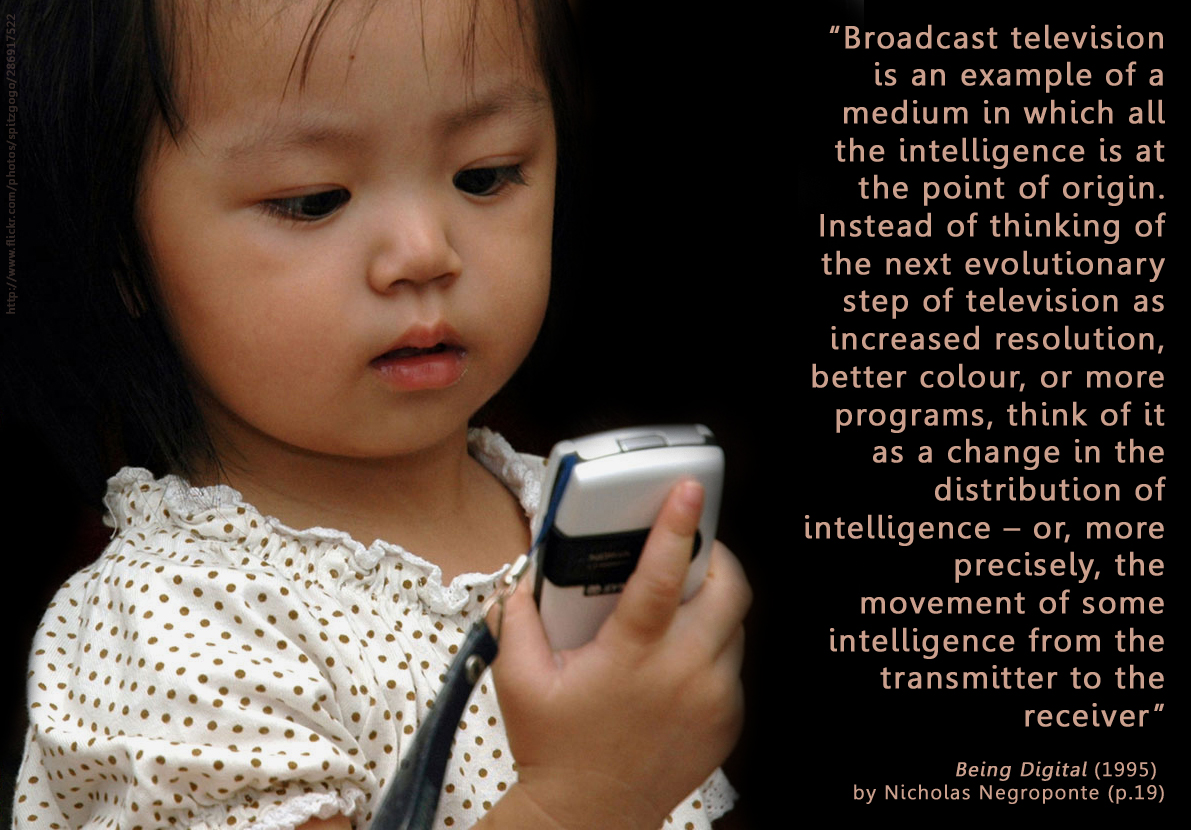
moving intelligence through media
The tidiest way I have seen the 'receive -> interact' paradigm change articulated.

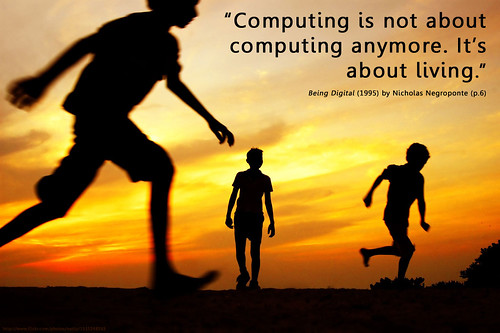
computing <span class=
Basically, Apple's strategy and success.

pulling bits
RSS, Google Reader...

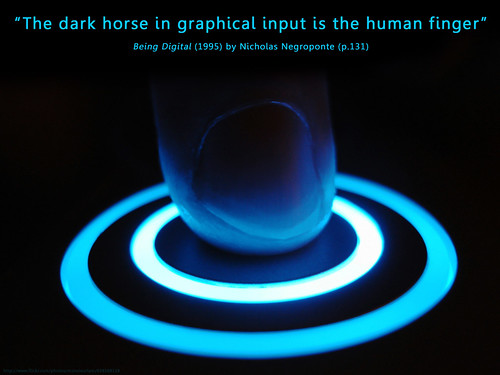
touch, the dark horse
Creeping in more and more. He also talked about "the tiny hole or two in plastic or metal, through which your voices access a small microphone" (p.159). This is still proving difficult.

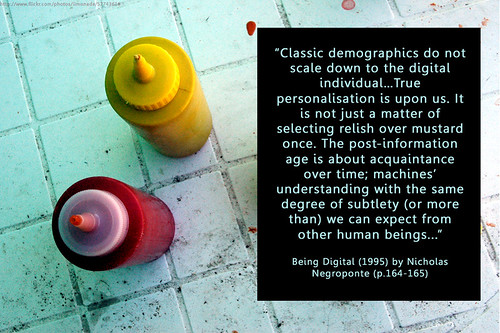
digital demographics
Things like Google Reader's Top Recommendations, Amazon's recommend emails and iTunes' Genius represent this one quite nicely. Although still some way to go here.

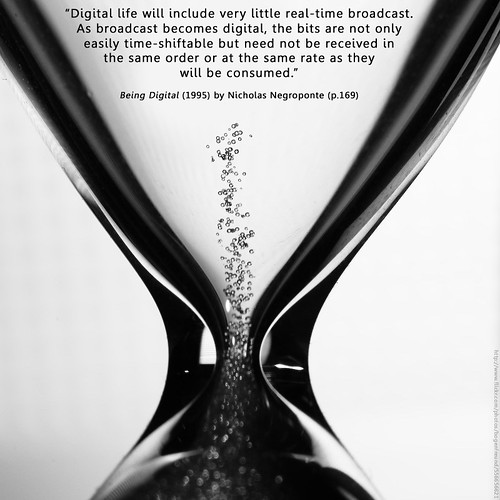
digital on-demand
Hulu, BBC iPlayer and all the underground antecedents to these.

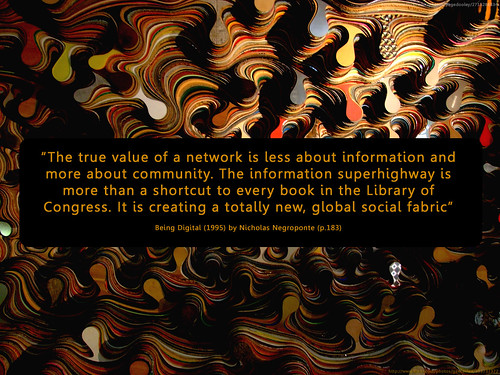
the global social fabric
This idea - communication as well as information - is rephrased a lot by pundits. What's impressive about this is that it saw the value of social online before it was made explicit with, sorry, nasty phrase coming up, Web 2.0.

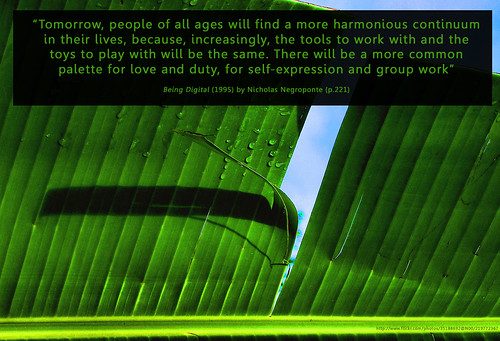
the peeling boundary
Blogging seems the best example.

the process
Radiohead is my favorite example of this at the mo. (Also see here for what bitcasting - another of Negroponte's babies - is all about and how Radiohead's House of Cards 'video' is likely to have been the first example of this).

laws for atoms
Very broadly gets to the nub of all the legal issues bouncing around online.

And a few others that didn't make it into digital bites:
"Clipping bits is very different from clipping atoms" p.59
"On the net each person can be an unlicensed TV station" (p.176)
One word. YouTube
"...bits that describe other bits...will proliferate in digital broadcasting. These will be added by humans aided by machines, at the time of release...or later (by viewers and commentators). The result will be a stream with so much header information that your computer really can help you deal with the massive amount of content" (p.179)
tags, labels etc
"automobiles will enjoy another very particular benefit of being digital: they will know where they are" (p.216)
SatNav.
"The important point is to recognise that the future of digital devices can include some very different shapes and sizes from those that might naturally leap to mind from our current frames (sic) of reference. Computer retailing of equipment and supplies may not be limited to Radio Shack and Staples, but include the likes of Saks and stores that sell products from Nike, Levis and Banana Republic."
Basically, the web breaking out from behind screens, which I have thought about here. Nike+ is the golden example of this right now. A continuation of this idea:
"When this happens in a tiny format, all "things" can be digitally active. For example, every teacup, article of clothing, and (yes) book in your house can say where it is. In the future, the concept of being lost will be as unlikely as being "out of print"
I like the nod to long tail stuff at the end there with "as unlikely as being out of print"

(Skepticism: the book, being widely read, could have prompted people to work on the things Negroponte predicted ('invented'), giving the impression that the book is farsighted when it may have been prescriptive to future-makers)

Wednesday, 20 August 2008

smarter reviews

Once mobile internet gets properly off the ground, lots of shopping in the real world will change. It will change because prices and reviews - things normally all the way back at home - will suddenly be at your fingertips in stores. The buying decision is going to get another brain contributing.

But reviews have their problems.

Say I am swotting up on a new book I have heard is rather tasty or investigating a new camera so I don't have to mashup (read, lazily appropriate) others' photos on Flickr. I read a load of book reviews on various sites. For the camera, I come up against some sites wanting my money for their opinions, others with more reviews than I can possibly read and perhaps a couple of blog posts from some real keenos.


Here's my beef with all of this.

'Old' media stuff is dense and long but trustworthy and rich. It's also one person's view normally.


Customer reviews are helpful because they are likely to tell it like it is; they have no reason not to. Except some people can't tell it like it is even if they want to, making a chunk of customer reviews unhelpful by being unreadable, like this beauty from the BBC's gleefully entertaining Have Your Say (distilled here).


And even when people can get their thoughts in order, how do you know that what they like you are going to like? So you look at quite a few of these, try to average across opinion. That's a bit time-consuming. One quick way to do this is to look at things like the 5 stars on Amazon.


This is beautifully quick but often rather unhelpful: it doesn't tell you all that much. Added to that, fans swarm in and leave in their slaver pages of universally positive reviews. In its most extreme form this sort of review takes binary form.: thumbs up or down, cool or not, rotten or fresh. Essentially, the problem with taking lots of data and reducing them, is that it can only provide a dirty average.


Basically, the problems of reviews are that we have work hard to find them, when we do there is too much information overall and there is a poor summary of it. We need something that combines the best bits. Basically, something that is quick but rich:


So all the power of collaboration is used. All the time spent reading and cogitating is stripped away. The in-depth, expert stuff is there if you want it. And, most importantly, the reviews become a whole lot more powerful by taking into account who has left them.

This has probably been thought up somewhere before. All the same, I don't see this kind of thing anywhere. And it is the perfect sort of review system for mobile: lightweight, powerful, visual, personalised and genuinely useful.

Wednesday, 6 August 2008

i am

If an alien arrived on earth one of the first things it would note about our species was how much time we spent with each other. 'Humans are social creatures' it might jot down (see Cartwright and Zander, 1953).

If it had been around for a while, it might have added 'but this has been decreasing in the last few decades' (Putnam, 2000). And, maybe if it had been paying special attention, it might scribble something like 'increasingly people have fewer others with whom to discuss their most intimate thoughts and feelings' (McPherson, Smith-Lovin, & Brashears, 2006).

As Ybarra et al (2008) sum up,
The success of the social networks is probably in no small part because they strengthened and made explicit these withering social connections we all naturally crave.

Orange's new campaign, which orbits around the strap line ‘I am’, mines this too.

What does 'I am' mean?

Simply, you are better off working together than you are by yourself, thus necessitating communication technology. You are the sum of the people you communicate with.

One of the nice things about this strategy is that it is actually true. It's not that staple of advertising - myth-making - but a statement of something fundamental about human interaction and that makes it fresh.

For one, you are smarter working together. Ybarra et al (2008) writing in the Personality and Social Psychology Bulletin found that social interaction (as little as 10 minutes) improved intellectual performance.

More social contact is correlated with well-being (Sinha & Verma, 1990; Triandis et al., 1986) and its absence is marked by depression (Gladstone, Parker, Malhi, & Wilhelm, 2007).

There is even some evidence to show that after controlling for level of health, fewer social connections are linked to an increased risk of death (House, Landis, & Umberson, 1988). Yikes!

Orange is in the relationship business, not the mobile phone business any more.

And not only the relationships between each other but the relationships between all our different digital identities.

'I am' Facebook, Flickr, Blogger, YouTube, Amazon, Vimeo, Google, Dopplr, Wikipedia, del.icio.us, Stumble Upon the list goes on....

This unruly mass of services exists and yet there is nothing to tie them all together.

That is, until Orange’s offering, My Social Place, hits the scene in the autumn soldering all our online identities into one ball.

So ‘I am’ is a strategy that is timely in two ways. It fosters and facilitates being social, something we all need but aren't getting enough of. And it is digitally prescient, preparing for communicative life beyond simple mobile. More evidence of marketing and service dancing together so fast you can tell who's who.

But there is a final bit of cleverness in here. The social thing and the digital thing, as well as being two separate but rather nifty uses of the same strategy for ordinary people, are also commercially adroit when holding hands. As Cory Doctorow, in a speech at Cambridge last month, explains,
"The thing that the Internet is even better at than providing universal access to all human knowledge is nuking collaboration costs, getting rid of the cost of getting people together to do stuff…[This is] what allows us to be literally superhuman. That is to say that if you and someone else can do something that transcends that which you could do alone, then you have done something that is more than one human can do and is superhuman." (around 19 mins in)
'I am' in this sense perhaps acknowledges that what's around the corner is really big collaboration online and on-phone. And Orange is going to be a company to help out with all of that in its services, the branding seed of which is being planted now.

Pity the execution isn't more exciting and less pretentious. Still, early days.

Monday, 28 July 2008

ipint + the global spirit level


The iPint, the stonkingly popular download for the iPhone. Apparently "the best example to date of mobile advertising" according to Clare Beale. I'm inclined to agree, even though, according to Faris, the idea seems to be lifted from here:


Although fun, it is quite shallow. It needs more depth to win my vote.

The next best example of mobile advertising from Carling would be if you could add some sort of value in beyond a neat trick, like actually having your pint waiting for you at the bar or brought to you if you order on your iPhone so you can avoid a ten-deep human barrier between you and your cool, refreshing beverage. Probably would get more Carling sold too, which would "stretch the definition of what advertising is" even further.

[It's the accelerometer in the iPhone that Carling has exploited. The accelerometer is the interesting bit. And for no reason other than it's possible it would be cool to know the tilt of every iPhone user on the planet. Making the half-decent assumption that facing up and moving a bit equals movement and down flat equals inactivity it would provide an interest peek into people's activity.]

Thursday, 24 July 2008

the future is streaming, not downloading

januszbc/Flickr

The news that major ISPs in the UK have agreed to smack the wrists of hardcore file-sharers is, ultimately, not really news.

This is because film, tv and music - the most popular shared content - is increasingly available in streamable form obviating the need to download at all. It's all going to be in the cloud.

The likes of LastFM and Pandora could take care of the music. iPlayer is already taking care of the BBC's output phenomenally well. Other places like TV Shack, Videostic and, legally, Hulu, are providing the rest.

It does tickle me a bit that just as the industry catches up, the ways in which we can consume music has moved on. Instead of owning content - and all the problems that brings if you have acquired it illegally - you just own links to that content and get served with ads or pay a small subscription fee for it.

This shouldn't be a new problem for the entertainment industry, it's a better solution.

local cloud dj

no more radio

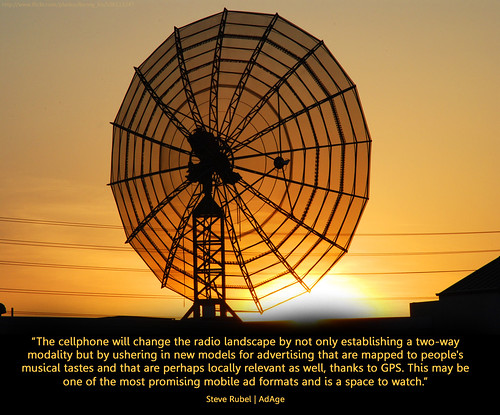
In this interesting AdAge article Steve Rubel talks about how new media do not usually supplant old media, they add to it. That is, with the possible exception of mobile internet and the radio. The radio has a few problems, some summed up in The use of conventional and new music media: implications for future technologies;
"Due to its broadcast nature, the only way to control the mix of music played on the radio is to change stations. Participants came to know what shows would be likely to play music they might like, and not have heard, but found it difficult to fit their time around these programs. Moreover, they might miss or forget the name of the song or band before remembering to buy the music."
That is all magically fixed by 'Cloud Music':
"With a number of websites offering [music] free (chiefly LastFM from my usage but also Songza, BoomShuffle, Imeem, SpiralFrog, Qtrax and Pandora), iTunes may even become redundant and the idea of owning a track may be history. Instead, all your music would be within the LastFM (or equivalent) 'cloud', accessible and streamable on whatever your hardware, whenever you want, as long as you are plugged in."
In February - when I wrote that - there wasn't really a way to do this. Not easily anyway. However, with typical Apple aplomb democracy has been brought to a previously difficult task with the iPhone 3G. As I went on to say,
"I think 'cloud music' spearheaded by LastFM and others amounts to nothing less than a quiet revolution in the way we consume music and lays down a first draft for the future of music."
Sounds a bit grand but I think the shift will be quite grand. Radio might be one of those things that goes, a medium that is replaced by something genuinely better.

Still that leaves the problem of what to listen to; choice can be crippling.

From experience (and research in this paper) it seems most of the new music people get comes their way from a few seriously keen musicologists in their group of friends.

The tyranny of choice places like LastFM offer up may be solved by people like this, as they become curators of the massive databases with constantly morphing playlists, which their friends can tune into. Of course big DJs will still exist - and should move into places like LastFM now and get curating - but the rise of the 'local cloud dj' should happen if 'on-demand' music with 'effectively infinite choice' goes ahead.

As Steve Rubel has said in another article:

<span class=
Aye to that.

Monday, 7 April 2008

Gliding about Earth


I commented on Photosynth - the very cool little app swallowed by Microsoft - a while back. Viewfinder is similar except it tacks on to Google Earth, adding an elegant new dimension.

I think if it takes on the multi-shot nature of Photosynth (as opposed to single shot shown in the vid above), it will be better.

The software clearly has a slew of uses but I think simply being beautiful is one. Software becomes art.

Friday, 4 April 2008

Cocoon

Hanging from a branch is Cocoon, O2's latest phone.

Name

I like it for lots of reasons, one of them is that it's called Cocoon and not the RX400 or something similarly cold. Engineers should be allowed to design things, they should not be allowed to name them.

Like Apple's operating systems, imaginatively named products are better because they slice off the bland and replace it with a useful communication moment.

Writing in the Journal of Consumer Psychology, Miller and Kahn (2005) found, at least in colour labels, more imaginative and unusual names beget more favourable perceptions and rates of purchase than functional ones. See their paper for why they think this happens.

Added to the various cognitive dynamics that bring about this effect, the nature of the label will cause a cognitive Litchenberg figure to branch out activating all sorts of potentially interesting and positive associations. There's something snug about a cocoon, something exciting about what's inside, and, of course, something natural.

Nature crops up again in a nice bit of 'ornimorphism' (attributing bird features to inanimate objects - yes, I made the word up), where the dock is called a nest, which lends it further cutesy charm.

More imaginative naming for bits in technology ecosystems please.

Design

It's clearly white, but the design doesn't end up tripping over itself to imitate Jonathan Ive; it has a sleekness and freshness of its own. I particularly like the LED lights on the outer shell that spell out messages, callers and the time.

Marketing

Anyway, that's the product; the marketing's is also good example of something done well because digital is used for digital, not as some lame TV follow up or place to stick JPEGs of posters.

VCCP discovered the 40 most influential bloggers, gave them a Cocoon and no formal instructions to do anything in particular. I believe similar blogger outreach was done with the Nokia N95.

The result of shirking the need to be perfect has payed off. According to Revolution, "72 per cent of the bloggers who took part said they would not have expected a brand such as O2 to do something like this, while 80 per cent would now recommend Cocoon/O2 to a friend." So impressive were the results on early sales that a TV spot was not commissioned, saving considerable money.

And engaging bloggers means a denser network of links that then exploits the algorithms of the Google ranking system to get higher within it. Such organic seeding obviates the need for specialists to artificially get it ranked higher, again saving money. All in all, good job O2 and VCCP.