This is global air traffic in a 24 hour period as captured by satellite (and they all seem to be going to London.)
Showing posts with label geotility. Show all posts
Showing posts with label geotility. Show all posts
Thursday, 8 January 2009
like glowing ants


Friday, 7 November 2008
getting creepy
 New technologies can look like magic. That's Douglas Adams speaking.
But magic comes in two shades: black and white (which if the last posts are anything to go by seems to be a minor obsession at the moment).
The black stuff indicates some dark intention; the white stuff a benevolent effect.
New tech goes the same way. Phorm looks black. Genius looks white. But, in essence, they both do the same thing: use our data to sell more effectively.
And there's going to be a load more black technologies as the web breaks out and evolves into an Internet of Things.
Throw into the mix that data capture will get a whole lot smarter not only because of new ways of getting it (through GPS, RFID, accelerometers and the like [SPIME devices]) but because our increasing desire for personalisation means absolute transparency (that's Kelly), and you have some really quite creepy tech around the corner.
Stuff that knows about YOU. Where YOU are. What YOU like. Maybe even why YOU like it - and tense changes of all those. It's gonna get freaky.
The challenge is to tweak and present these technologies from having a perceived dark purpose (I don't really think Phorm does) to being understood as benevolent. We need to fuzz them up.
Wednesday, 6 August 2008
crime mashup

"It is simply unacceptable at this point in history that a citizen can use Web services to track the movies he is renting, the weather around his house, and the books he's recently purchased but cannot as easily monitor data regarding the quality of his drinking water, legislation, or regulations that will directly impact his work or personal life, what contracts are currently available to bid on for his state, or what crimes have recently occurred on his street."James Willis, director of eGovernment for the Rhode Island Office, 2005
It is.
Or it was.
Now there's ZubediPI which tells me the West End is a bit dodgy when it comes to theft and violence amongst a whole host of other rather useful stuff.
Or it was.
Now there's ZubediPI which tells me the West End is a bit dodgy when it comes to theft and violence amongst a whole host of other rather useful stuff.
Monday, 7 April 2008
Gliding about Earth
I commented on Photosynth - the very cool little app swallowed by Microsoft - a while back. Viewfinder is similar except it tacks on to Google Earth, adding an elegant new dimension.
I think if it takes on the multi-shot nature of Photosynth (as opposed to single shot shown in the vid above), it will be better.
The software clearly has a slew of uses but I think simply being beautiful is one. Software becomes art.
Sunday, 16 March 2008
Things to see
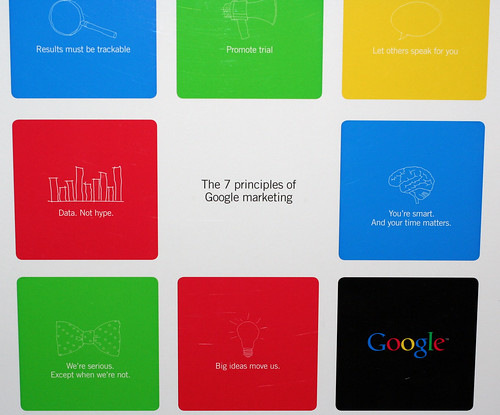
In the "Find businesses" bit on Google maps typing 'things to see' in the 'What' box and a location in the 'Where' box loads up a mix of Google and user-created content of interesting places in the specified location.
It's very useful. It will probably get even more useful when location-aware mobile web is chucked into the mix (see also Socialight and TagMaps).
It's also very Google and, along with other things like 'I'm feeling lucky' button, it is what makes the Google brand special. 'Things to see' adds in something magical and yet so functional.
Google has no brand guidelines (although I did find some principles in the pic above) and no silly, vapid slogan, it just gets on with the job and in places where there is no cost to functionality it is happy to be playful.
It does; it doesn't just say what it does. More of this from other brands please.
Saturday, 1 March 2008
Happy Maps
 In 2006 Adrian White, a social psychologist at the University of Leicester, compiled this, a world happiness map. You can get the full version here. The redder, the happier.
In a similar spirit, this little gem maps out 'feelings' from around the user-generated web and mashes it up with Google Maps:
 It's not particularly powerful at the moment but is nevertheless a really interesting idea. I love the possibility of analysing subjective content over geographical location like this. If time were to be added in as well it would become even more interesting because you could potentially track the emotional wake of a certain news story after it breaks. Nice simple and playful interface too.
Wednesday, 30 January 2008
The Web Breaks Out

As all the tech trend round-ups of 2007 bounce about in articles on and offline generally citing 2007 as the 'Year of the Social Network', I wondered what next year's - or the one in five years' time (can't be precise about these things) - will be extolling.
I'm not a great believer in predicting stuff: there's just too much we can't know and there's randomness, but as a general feel for what might happen here goes.
I think it will be about how the web broke out, starting to slide from behind our screens and swirling deeper into the real world. This is not just mobile Internet. It's better.
The first major sign of this on a large scale is the fantastic Nike+. The Internet is not quite in your shoe but it's getting very close. Cut away the fact that the runner is informed by her iPod about all sorts of useful things (e.g. how fast she is going etc) and that the music it plays enhances the running experience and all the iPod is to the Nike+ system is a delivery boy, running messages between a shoe and the Internet.
With the advent of mobile-network enabled Internet or, even better, blanketed wireless Internet, this delivery boy is no longer needed. The Internet will be manifest in 'physical widgets', that is, real world objects augmented by their connection to the Internet. Something that sort of looks like this is Wattson, a sexy little physical widget that shows your energy consumption based on beamed data from your electricity meter.

This break out means that anything in the real world can be networked in. iPods already have; the iPod Touch is equipped with WiFi, allowing songs to be downloaded in a zone. One such zone is Starbucks, where songs playing in-store can be instantly downloaded as easily as buying a coffee. I have also written the possibility of 'kitchen widgets' here. These are essentially video recipe books that are creative by other users or pros and that could be made to sync with your grocery orders.
Outside of the house, your car will be able to update its hard drives before you set off for work, possibly adding your personalised news bulletins, recently customized iTunes playlists or tweaking the car's systems to be consistent with what it knows the weather will be like on the route you are going to take. In addition to this within-car wizardry, wireless blankets will allow between-car communication, calculating position, speed and host of other variables to possibly warn drivers about impending collisions. This is something being developed here.
Add to the wireless mix one more thing and the game changes again. If your physical widget knows where it is, this opens up a plethora of possibilities. Cars with the collision avoidance system I mentioned a second ago could factor in danger spots to improve saftey. People could create geo-playlists - songs linked to certain locations - and others could then walk in their musical vapour trails.
Similarly, cards in cameras will be dispensed and photos will take residence online as soon as they are snapped. Again, this is starting already. That particular kind of chip may be short-lived because cameras will have in-built wireless transmitters (this already exists in the form of the phone camera, it just hasn't gone vice versa yet).
The positions of photos taken can be recorded as well, allowing you to track back to the precise spot where you took it. Like geo-playlists, geo-slideshows could exist, where photographers could exhibit photos viewable on screens in certain locations (Flickr already have a rudimentary system in place for this, here, as do Google in Picasa Web.)
Perhaps the most exciting application of location aware photos is the possibility that hyperlinks can be built between them, allowing 3D models of the world to be built by millions of users. Microsoft are developing such a system called Photosynth.
Building on this is the very ripe area of geosearch. Here the physical world can be searched. Early versions of this are being actively researched. For example, a version of augmented reality using a mobile phone has been developed by Nokia here. In this GPS and orientation sensors dance together to allow buildings to be recognised via the camera.
The vision in my mind of how this will turn out is holding your camera up to a street and seeing in the overlay directions to your destination or the result of your search highlighted. Something like this:

This sort of thing will inevitably lead to (potentially very useful or spammy) location-sensitive advertising exploding out. Hungry? The sponsored links in the overlay will direct somewhere tasty, maybe even telling you today's specials. Google are understandbly excited about this and reckon that mobile ad revenue will be well over $1bn by 2012 (source: Financial Times).
So this is where I think the biggest trend in technology will be found in 2008 - the Internet unleashed and bursting out of screens. Probably, 2008 will only be the start of all that and much of the stuff I mentioned here will likely come later.
And if you'll let me be fanciful and imagine the logical endpoint of this expansion, I'd say it will be neurally accessible Internet. Where we can call upon the Internet in the same way we call upon a memory and where there is the potential to affect other perceptual systems. Where is the shop again? We could literally see it subtly highlighted in our vision, dispensing with the need for the mobile phones I mentioned earlier. But that's for another blog. Brain-Internet interfaces are a long way off but the Internet moving beyond its confines in the screen is not.
Tuesday, 22 January 2008
Sick cat - some remedies
 I spoke about Jaguar as an unwell brand here and suggested that it needed to lose those Ford, elitist jet-set and old-man associations. I said instead of being the car of the retiring director this should be the intelligent choice for the high-level executive. Here I'll give some ideas about how to achieve this injection of youth and intelligence using non-traditional media.
Internet
The first thing I would do is include the car in the home's wireless network. This would open the doors to a lot of interesting applications. A few might be:
- The Jaguar Playlist. This would include playlists of cutting-edge music and exquisite classical available to the public and Jaguar owners, except the Jag owners would have the playlists available automatically in their cars.
 A Jaguar interior complete with music so good that it might as well be made right there. Click the image to enlarge.

- Add GPS to the mix and it would be possible to create geo-playlists. In a similar manner to Night Driving, where VW (DDB) tried to inject the sheer pleasure back into driving by offering night driving routes, geo-playlists would foster driving pleasure though offering great driving routes with an accompanying soundtrack. Drivers would literally discover new music as they drive
- All sorts of other things that could be 'downloaded' to the car include pre-planned routes you have designed on your computer, entertainment for passengers, the car's improved software (much like Apple do to improve the functioning of the iPods and iPhones), the locations of traffic works, local petrol prices and so on.
- GPS and car data could also be married together to add value to the driving experience by 'uploading' back to the computers in the house. This might allow for a Jaguar driving analysis website where driving stats could be translated into actionable suggestions like how to consume less fuel or improve your driving routes. It could even be start of 'Driving Web 2.0', where Jaguar owners share great driving routes or arrange group activities.
Film
Moving away from music, while BMW have BMW Films and Audi have the Audi Channel it would seem there is gap for a really gripping Internet 'TV' series in a similar multi threaded, cognitively-feisty style to shows like 24, Lost and Prison Break. Although money might seem like an issue here, I really don't think it is. Season 1 of 24 cost $35,000,000, which works out at about $32, 400 per minute ($35m / [24 episodes x 45 mins]). Guinness just spent a rumoured £10,000,000 ($21,000,000) on this, which works out at $14m per minute ($21,000,000/1.5 mins).
Now, there's probably a tiny bit of comparing apples and oranges here because of media budgets and agency fees (not sure if these are included in that figure) but even so I know what I would rather watch. Even a six part Internet TV show loosely based around Jaguar in some way (designs for their next model are stolen they need to recover them?) would be worth it and attract (rather than impose upon) a healthy number of viewers. The shows could be downloaded into the car's system (like the playlists earlier) for stationary periods or for the back seats.
Gaming
I am not entirely sure about the much banded-about claim that the games industry is bigger than the film industry but it is big and it is not just catering to pale teenagers. Instead, it looks like this:

 (Data from ESA)
Put simply, the people who play computer games overlap with the age group I think Jaguar should be aiming for. It would be a great way reach the Jaguar audience, give off a younger feel and invite people into the brand instead of forcing it upon them. The money is feasible as well. Digital Spy reports that the average cost of developing a PS3 game is $15 million. Assuming the game takes a year to develop, even a relatively inexpensive game would only soak up perhaps 10% of the budget (Jaguar's global ad spend in 2004 was $100m according to this.)
I don't even think the game need be completely dedicated to driving. The most popular genres in the industry include strategy, role playing, action and sports games. One idea might be to let players be like ex-special forces agent Frank Martin, the driver-cum-action hero in Transporter. This would combine driving elements from things like Need For Speed with the strategy, action and role playing of Tom Clancy's Splinter Cell Chaos Theory. Essentially, the idea would be to complete some intellectually challenging mission with the Jaguar car as one of your major tools.
The next suggestion is to create link-ups with other 'artfully engineered' fields, like architecture or digital art. Perhaps Jaguar could associate itself with all sorts of things that fuse art and technology. They could have the Jaguar Architecture Awards or put on an exhibition of artists whose work celebrates the interdisciplinary spirit at the Tate Modern (e.g. Theo Jansen, Julius Popp, Alex Bradley and Charles Poulet or Ryoji Ikeda.)
Art and technology
The next suggestion is to create link-ups with other 'artfully engineered' fields, like architecture or digital art. Perhaps Jaguar could associate itself with all sorts of things that fuse art and technology. They could have the Jaguar Architecture Awards or put on an exhibition of artists whose work celebrates the interdisciplinary spirit at the Tate Modern (e.g. Theo Jansen, Julius Popp, Alex Bradley and Charles Poulet or Ryoji Ikeda.)
I'll add more as I think of them but it's things like this that I think Jaguar should be doing. Not things like the "Gorgeous" campaign.
Subscribe to:
Posts (Atom)