Thursday, 15 January 2009
quality adwords
Posted by
Will
at
10:39
2
comments
Labels: communications, digital, internet, media, websites
Thursday, 11 December 2008
what's digital and why you should apply

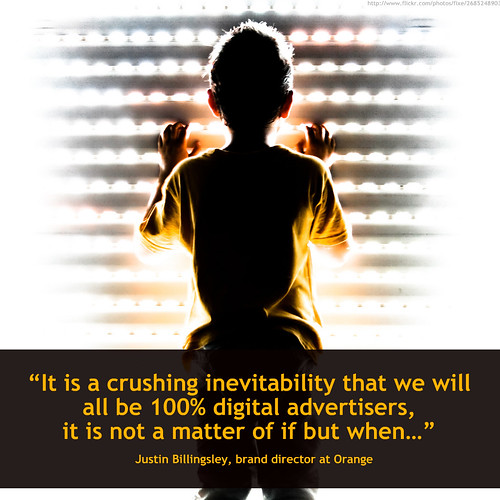
It might be overstated (there’s probably always going to be the “‘bed, bog, bath’ element”) but Mr Billingsley’s comment is almost certainly right: we’re going to be digital advertisers because the world is now digital, and getting more so.
What does all this digital malarkey mean for people looking to get into the communications business and, before we look at that, what does digital mean anyway?
There are two important things there for grads trying to get into the industry. The first is, “whose roof”?
This interactivity let’s you do a lot more than you can at your typical traditional ATL agency. Or to reunite that idea with its owner:
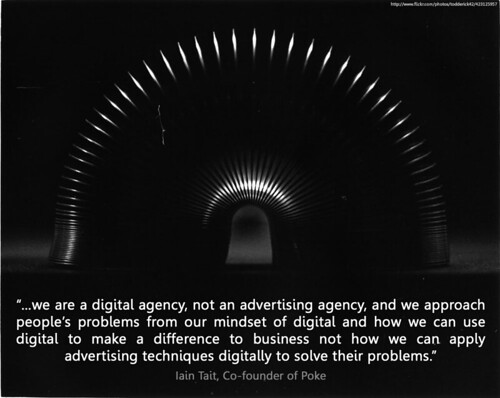
I think that's really exciting (and Mr Tait has 9 more great reasons digital is better for those interested). In digital you’re unshackled from just doing TV, print and radio to all sorts of exciting things like sites, applications, blogs, games, branded content, widgets, podcasts, social things and experimental stuff. And a lot of this (not all) is actually useful to people; it's additive rather than interruptive.
In my experience grads tend to think of digital as something on-the-sidey and techy. Maybe it once was. Now it ain’t. Technology is so ubiquitous, so ‘ready-to-hand’, that it’s becoming invisible and when that happens it gets socially interesting. In other words, technology and culture used to be separate, increasingly they are the same (look what you're doing now.)
It’s a brilliant time to get into an industry that’s only going to grow (even in these tough times) and that’s much more about interesting interactive ideas than it is about tech.
Go on, apply!
Obviously I am biased but this would be a good place to start...
(For those wanting more, I suggest you have a play in here, read this, canoe back up this and maybe watch this. That should be enough to be getting on with.)
Posted by
Will
at
18:06
8
comments
Labels: communications, data, design, digital, internet, media, mobile, websites
Monday, 10 November 2008
a good, good guide
Posted by
Will
at
16:02
0
comments
Labels: data, digital, internet, ordinary, software, technology, websites
Saturday, 8 November 2008
50,000
Posted by
Will
at
00:02
0
comments
Labels: blogs, communications, design, digital, internet, media, mobile, photography, software, websites
Friday, 10 October 2008
believing real
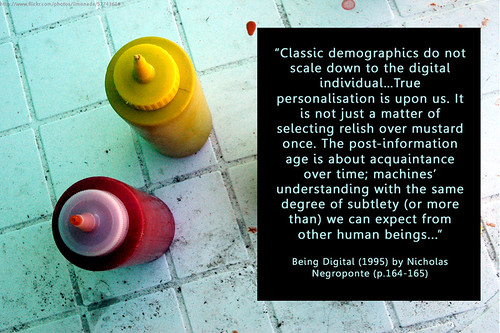
One of the first things I think when I see something online, and one of the first things that gets banded about on comment lists, is whether or not something is genuine, rather than set-up, faked, CGed etc. If it's genuine, interest soars; if not, interest dwindles (usually).With this in mind here's a variation on Kelly's idea:
When content is faked, it becomes emotionally worthless.
When content is faked, stuff which isn't fake becomes scarce and valuable.
When content is faked, you need to show people things which are not faked.
Posted by
Will
at
17:22
0
comments
Labels: communications, design, digital, technology, video, websites
Wednesday, 17 September 2008
buy-product
Selling on social networks can only be a by-product (hence the title 'buy-product'. Geddit? Oh dear, I am sorry) of the activities occurring on those sites, never a primary activity.
The long version is this:
In market economies there are two big problems with information: it's (occasionally)* inadequate and it's superabundant.
Why is information inadequate? Because you only know how good something is after you have bought it, so how do you choose between alternatives?
Why is there too much information? Because everyone wants a slice of the pie making those alternatives and the market gets flooded with products or services and thus information about those. (How do you choose between one-hundred types of olive oil? You don't for the most part. It's crippling. You move on.)
Add in the fact that this competition strips profits to the bone and you have three pretty good reasons for why brands should (and do so successfully) exist: to remove doubt about quality and ease the process of otherwise crippling choice for people who want to buy stuff, and pump scarcity (and thus juicer profits) back into things for people who want to sell stuff.
However, in the spirit of several recent books, solutions to the problem of inadequate and superabundant information can also be solved by [dramatic pause] other people. And more effectively because trust in other individuals is second only to personal experience itself.
Other people can literally 'test' products and services for you before you buy them yourself (by buying them themselves) and help narrow down the choice for you (by having had to narrow down the choice for themselves.)
People have probably been doing this since information in markets got to be doubly-dodgy. Nothing new in the behaviour. It even has a 5-syllable name: recommendation.
However, what might be new is that hitherto implicit recommendation could be made explicit and more useful with a dash of digital. Making stuff explicit seems to me to be the formula of the successful things in recent web (Facebook makes social relationships explicit, blogs records thoughts that would otherwise only exist in conversation or the mind, LastFM records the wake of your audio, StumbleUpon ossifies your digital discoveries etc.)
How would this work? Social networks would allow self-expression at a much finer level of detail allowing libraries of music, films, books, clothes**, etc that people have honed (not harvested automatically, which was the problem with Beacon). (Eventually content could be brought within such networks, so they operates as hubs of digital content.)
This in itself could present recommendations based on content (like iTunes Genuis) but also those made by other people in your group of friends. These recommendations wouldn't really be recommendations but comments/ratings tagged onto things by people. 'This track is awesome' could be really useful from someone who you (or your computer) knows you share taste with.
Picture time:
One of the nice things about such a system is that it's lovely for people, providing stuff they might be interested in. However, there is also an opportunity here for social networks.
Another picture first:
And now I am going to quote myself, which is probably a bit wanky but here we go from a few posts back:
"When people use Google, they're looking for information. When they use Amazon, they're buying (or researching). The ads are working here because people want information, it's welcome if its good enough.The point is that in the social space clumsy selling (ads) is not welcome: the communication gets tarnished by it, so it's ignored and disliked. But, that is not to say that selling as a by-product is out of the question. Links to things - and charging the producers a little for those links - suits everyone.
When they use Facebook (or any other social media) they're expressing, communicating and interacting with others (being social not being cognitive). The same ads aren't working here for the same reason you'd be a bit miffed if someone marched into the pub, dropped a sausage in your pint, yaddered on about how delicious they are and, by the way, how they are half-price at the moment."
* I put 'occasionally' in brackets because as soon as information is partially inadequate it gets perceived at wholly inadequate.
** Self-generated recommendations will probably work for clothes; other-generated recommendations won't work as well. People like their clothes to be different (but not too different) from their peers.
Posted by
Will
at
18:55
3
comments
Labels: digital, internet, media, software, technology, websites
Thursday, 7 August 2008
mixin
One. Vodafone should be doing something like this.
They could have a whole arsenal of apps to turn their positioning - make the most of now - into a something valuable for people and link it up in lovely ways to mobile and social platforms.
Two. It's so helpful when you come across a new site not to have to explain it in your blog but just embed the code for a video they provide, which does the job for you, thank you very much.
Posted by
Will
at
19:01
0
comments
Wednesday, 6 August 2008
crime mashup
"It is simply unacceptable at this point in history that a citizen can use Web services to track the movies he is renting, the weather around his house, and the books he's recently purchased but cannot as easily monitor data regarding the quality of his drinking water, legislation, or regulations that will directly impact his work or personal life, what contracts are currently available to bid on for his state, or what crimes have recently occurred on his street."James Willis, director of eGovernment for the Rhode Island Office, 2005
Or it was.
Now there's ZubediPI which tells me the West End is a bit dodgy when it comes to theft and violence amongst a whole host of other rather useful stuff.
Saturday, 5 April 2008
Pixels and Colour
Having been nowhere before computers, pixels are now everywhere.They rarely get noticed because their sum is greater. Christian Zuzunaga - apart from having a great surname - has created a really strong visual language of lushly coloured pixels across his work.
One example that is doing the digital rounds, after being in Design Week, is the sofa above; I wouldn't want this in my house but I'd love it on my wall (as I pic, I'd add quickly).
His other work is exciting too. You'll find them on his website, which I would also class as a piece of art in itself, although I am a sucker for bright colours on black.
Posted by
Will
at
11:41
0
comments
Thursday, 27 March 2008
Medium-rare ads
Time is irrelevant because shows can be called up on-demand, making the 'old' system of programming look as silly as everyone being served up with the exact same meal in a restaurant. Space - or location - is irrelevant because although TVs are stationary, screens are mobile. Content can be picked up anywhere as long as you have access to the cloud.
Online TV also has the chance to be interactive. People are already using traditional TV and online together to enhance the experience (and here). Online TV will just remove the space between laptop and TV, packing it down into one device.
Because of this inevitability, the move by Hulu to exploit the interactivity of the medium is a good thing.
If online TV is going to be free, it's going to have to be ad supported. It could be charged but when you have free vs paid, free will win out as long as the 'costs of free' aren't too great.
The 'cost of free' being advertising and the 'too great' bit being when the ads subtract significantly from the experience by being intrusive and/or irrelevant.
By adding choice to the ad serving process the costs are lessened because people will feel they have some choice in the matter and - now going beyond what is happening at Hulu - choice might improve relevance, the nirvana of advertising that has allowed Google to make billions.
I've got a few ideas about how more choice can be added into the mix to make people feel more in control and to give them better (more relevant) ads.
The first thing to note is the gulf between products on a show and buying them. The Internet could close this gap to a few centimeters. Take for example House's leather jacket, something that keeps him both "warm and cool" and something that was probably just chosen by the show's wardrobe people rather than any money changing hands for its use.

Yet, there is demand for his jacket; people are asking where to buy one. It would be fairly simple to have an overlay with a tagging system similar to Facebook's (below), except rather than being static, it would be dynamic; hypervideo. The tags would be put in place by the production team or automatically once the technology gets good enough at object recognition.
Everything in a show becomes a clickable object. Links out to products could be collected on a little 'shelf' which you could sift through at the end of the show. The transient nature of things in video becomes irrelevant. Clothes worn, gadgets used, songs played could all be put on the 'shelf' for later inspection and possible purchase. People could chose a specific type of ad (like clothing, gadgets or music) depending on their whim. I would find this much more useful than interupting messages or even a pre-show ad.
For some, this might seem rather unpleasant because of the risk of corrupting artistic output. This is as naïve as the idea of the sentimentalist idea of the noble savage because creativity has always used the oxygen of commerce. John Hegarty, BBH's creative supremo, uses Titian's The Annunciation as an example: "In the bottom right-hand corner you will see a decanter. Why? Well, the Venetians had developed clear glass and they wanted it in there as an advert. So the connection between culture and commerce is hundreds of years old." (source)
Second, I agree with Hegarty's other point that the only problem with such placement is when it is done badly, when it is perpendicular to the story. It reminds me of the deliberately obtuse faux product placement in the Truman Show by Truman's synthetic wife:
In this situation both show and brand come off looking bad. As Hegarty says, "It doesn't satisfy the viewer, so it doesn't work for the advertiser" (also see this paper by Nigel Hollis, Chief Global Analyst at Millward Brown for more on this). Put differently, corrupting artistic output is not in the interests of either the people making the shows or the advertisers.I would much rather have something like this, where I get to chose the ads in a more ecologically valid environment than have my viewing experience lacerated by the tyranny of jingles and over-enthusiastic voice overs. And with the long tail this could be very profitable for shows and films.
Advertising is here to stay. The more useful we can make it the better it will be for all involved. And one way to do this is let people have more choice about the ads they consume.
Posted by
Will
at
12:42
0
comments
Labels: communications, digital, internet, media, software, technology, video, websites
Sunday, 16 March 2008
Things to see
In the "Find businesses" bit on Google maps typing 'things to see' in the 'What' box and a location in the 'Where' box loads up a mix of Google and user-created content of interesting places in the specified location.
It's very useful. It will probably get even more useful when location-aware mobile web is chucked into the mix (see also Socialight and TagMaps).
It's also very Google and, along with other things like 'I'm feeling lucky' button, it is what makes the Google brand special. 'Things to see' adds in something magical and yet so functional.
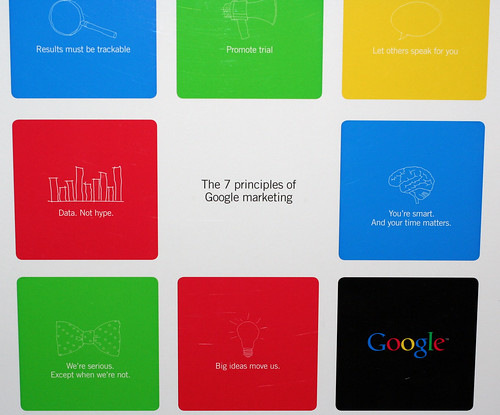
Google has no brand guidelines (although I did find some principles in the pic above) and no silly, vapid slogan, it just gets on with the job and in places where there is no cost to functionality it is happy to be playful.
It does; it doesn't just say what it does. More of this from other brands please.
Posted by
Will
at
23:42
0
comments
Labels: communications, geotility, websites
Friday, 7 March 2008
Music by mood
Burst is interesting. Instead of just taking the genre approach to tagging music, you can browse tag clouds of moods and instruments. Nice clean design too.Viscosity: modern art generator
Posted by
Will
at
13:06
0
comments
Ficlets: narrative quilts
Sony seem to be operating a strategy of 'technology with character' especially with their laptops and MP3 players. This comes through in their digital efforts (by Dare). Things like the Walkman Project and the Malkovich Vaio site scream a more refined appreciation of music and creative approach to computing than your average punter. I suppose directing your efforts at early adopters and people who pride themselves on doing their own thing (people like.no.other you could say) is sensible when you are up against the ubiquity of the iPod because the exclusivity and creative associations of Sony will ensure later trickle down.Anyway, Sony isn't what I wanted to talk about, it's just the premise of the Malkovich site, namely to continue on a script he started, that chimes with this other site I came across called Ficlets. Here, rather like those children's games, you get to continue on someone else's story (or indeed write a prequel to it). Narratives are stitched together by the many. In all likelihood this will create some horrible quilts but power of the Internet means that the occasional gem will appear. Anyway, I like.
Posted by
Will
at
12:35
0
comments
Labels: communications, digital, internet, websites
Saturday, 1 March 2008
Happy Maps
In 2006 Adrian White, a social psychologist at the University of Leicester, compiled this, a world happiness map. You can get the full version here. The redder, the happier.In a similar spirit, this little gem maps out 'feelings' from around the user-generated web and mashes it up with Google Maps:
It's not particularly powerful at the moment but is nevertheless a really interesting idea. I love the possibility of analysing subjective content over geographical location like this. If time were to be added in as well it would become even more interesting because you could potentially track the emotional wake of a certain news story after it breaks. Nice simple and playful interface too.
Posted by
Will
at
11:10
0
comments
Labels: data, geotility, psychology, trends, websites
Saturday, 23 February 2008
Cloud Music
The web's a bit like a vacuum: it is sucking up all sorts of things off desktops, start bars and docks. Outlook and Thunderbird aren't really needed what with Gmail et al.. Microsoft Office is under threat from Google Docs and things like Empressr. Photo software is being supplanted with things like Flauntr, Flickr and Photoshop Express. Skype isn't really required if you use web-based Gmail chat. The list goes on....This is so-called cloud computing, which as Google's head honcho says, "starts with the premise that the data services and architecture should be on servers" and not computer hard drives (source). In other words, all you may need in the future is a browser; everything else will be accessible via the net.
Music is the latest addition to the list. With a number of websites offering it free (chiefly LastFM from my usage but also Songza, BoomShuffle, Imeem, SpiralFrog, Qtrax and Pandora), iTunes may even become redundant and the idea of owning a track may be history. Instead, all your music would be within the LastFM (or equivalent) cloud, accessible and streamable on whatever your hardware, whenever you want, as long as you are plugged in.
Artists receive a share of the advertising revenue for having their tracks played, which as the LastFMers say is "redesigning the music economy".
As it stands LastFM is limited in its features with music streaming. For example, you can only build one playlist. But it will probably start getting as sophisticated as iTunes. At least, I hope it does.
I think 'cloud music' spearheaded by LastFM and others amounts to nothing less than a quiet revolution in the way we consume music and lays down a first draft for the future of music. I just hope it works.
Posted by
Will
at
20:23
0
comments
Labels: digital, internet, music, software, technology, websites
Friday, 22 February 2008
Sputtr
Sputtr is great. Search multiple sites from one page and customise it too.Would be nice if the ugly banner ad weren't there and they put search-relevent text ads (like AdWords) in a box at the top of the ads. I think they would make revenue from this setup. Nevertheless, a super site.
Posted by
Will
at
03:20
0
comments
Labels: websites
Monday, 18 February 2008
VW website
The brilliant new site from VW has a warming simplicity but a ferocious power. Well done Tribal DDB.
Posted by
Will
at
23:15
0
comments
Labels: communications, internet, websites
Monday, 28 January 2008
BBC Beta
The BBC is one of the most visited sites on the net and yet it looks old. Although I do like things to look digitally pretty (and site could do with a face lift), this is more than skin deep: it looks functionally old. I am talking about the HTML, the static design, the annoying Windows Media Player or Real Player videos, the funny little buttons and so on.Anyway, I just headed over to the main BBC page (I normally only use the News page) and to my joy found this, a great-looking new(ish) beta page that launched last month. Clean, simple, personalised, localised and searchable. I hope something similar happens to the BBC News page soon.
Posted by
Will
at
00:41
0
comments
Tuesday, 22 January 2008
Just Doing It on the Internet
In a previous post I wondered what a 'land-based' brand has to do to make the best use of the Internet. Here I talk about the brand I think has done this.
If the image hadn't given you a fat enough clue, it's Nike. Wherever you find Nike in the digital landscape it is using the Internet’s raw power and operating at the sparking edge. Unquestionably the best example of this is Nike+. Here data, community and personalized experience dance together to create an exquisite digital universe for runners.
The ad budget is diverted away from messages that people are likely to want to block out to a useful application that people want to use, which implicitly communicates what the brand stands for anyway and is likely to reach far more people through that potent tool, word-of-mouth, than by traditional means.
Nike+ is not the only feather in Nike’s digital cap. On a smaller scale, for example, Nike Rockstar Workout (cutting-edge dance instruction for women) and Nike ID (database-driven shoe customization) do the same to offer services and content to people.
And these ideas clearly work: Nike has added $6bn to its revenue in the last four years something which its management happily admits is in large part because of how the brand has behaved online.
So, I believe Nike has made the best use of the Internet for actually using the things the web is good at, leading the way in using them to improve marketing and for being the engine for fantastic commercial growth. The Nike brand is not stuck in the drive just looking nice; it is out on the road and leading the way.
(If anyone is wondering what my other choice would be, it's Apple. Along with Nike+ iTunes is probably the best digital 'ad' ever. Why does it meet 'ad' status? It's free. It is continuously updated (thus very slightly aging your old iPod's with its new features). It locks you into Apple. It's a wonderful experience (ever tried using Sony's Sonic Stage? I'd rather try to swallow a Sony MP3 than connect it to SonicStage.) [Oct 2008 addition] And now with Genius it is actually creating sales based on the library's content.)
Posted by
Will
at
21:33
0
comments
Labels: communications, internet, websites