Showing posts with label philosophy. Show all posts

Friday, 10 October 2008

rebel selling

This is a screen grab from LastFM before they ruined their design. Putting that to one side for the moment, the interesting thing about it is that, after 'rock', 'alternative' came in as the second most popular tag. A screen grab from today shows much the same pattern.

[Aside: It's interesting how 'seen live' is a major label too. Like Kevin Kelly has said when stuff gets superabundant it gets cheaper to the point of being free. When this happens things that can't be copied become more valued by both the ordinary people, hence the tag's popularity, and record companies, hence the money in music now being in touring.]


There is more than a strong whiff of irony about one of the most popular tags being 'alternative': 'popular' and 'alternative', at first blush, cannot operate in the same place in a Gaussian distribution.

Now, it could be something particular about LastFMers: they might be alternative sort of folk. There's that. It's part of the reason the 'alternative' tag is so big. But, there's a greater truth too: 'alternative' is the driver of capitalism and culture.

Bakunin, Nietzsche, Sombart and Schumpeter all saw capitalism not for the homogeneity it created but as a fundamentally creative (and thus destructive) system. Capitalism and culture can be stated as the effort to escape sameness.

But you get information problems here. There are too many alternatives. Just like brands are there to help solve this problem, so certain things become pin-ups for 'alternative' to avoid the crippling effects of having too many alternative things. These things are then popular for being alternative.
Here, then, 'alternative' and 'popular' can operate the same place on a Gaussian distribution: everyone is trying not to be mainstream.

(Another irony here: counterculturalists believe they are rebelling against 'the system' when they are most probably contributing towards it, because rebellion is in the very spirit of capitalism. This could be problematic: "
Not only does it distract energy and effort from the sort of initiatives that lead to concrete improvements in people's lives, but it encourages wholesale contempt for such incremental changes [The Rebel Sell])

Tuesday, 7 October 2008

why psychology is so important

The mind has evolved to solve certain problems that kept cropping up in evolutionary history. Part of that is a general intelligence to work stuff out (be flexible) that history hasn't prepared it for. However, there are lots of other things that are more specific and muddy general intelligence.

When I say psychology is not the same as philosophy now but vital to it, what I mean is that without an understanding of the mind, we cannot get a good understanding of reality. We have to know the mud to remove it.

All knowledge gathering without an awareness of the mind's natural biases is the straight line in the diagram below. Knowing how the mind works allows you to travel along the bendy line, circumventing the mud, and obtaining unfettered knowledge. Close eyes, deep hum....

Sunday, 27 July 2008

gardens and the human condition

uiruriamu/flickr

Insomnia and the BBC World Service coupled up to draw my attention to this beguiling, offbeat little essay, Gardens: An Essay on the Human Condition.

It's not a book about gardens; it's a book about humans through the lens of gardens.

One of its most interesting ideas is the paradox that while we consider gardens cocoons of respite they are, of necessity, also places of care, places where "longing for repose is pitted against a deep restlessness".

It is, in horribly bland modern terms, an idea about work/life balance. The metaphorical garden must be a place where neither continuous labour nor wanton abandon can exist but instead a rich combination of the two.

Friday, 21 March 2008

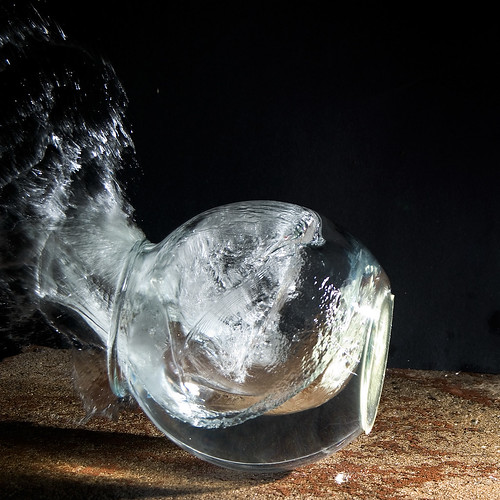
Choice and the Fishbowl

(from turbojoe)

My sister, an artist, has become enamoured with the new Whole Foods Store in Kensington High Street. Not as a place to buy food though. Rather it's a food gallery to her, a place for loving shots of shiny aubergines, forests of broccoli and piles of proud lemons. I was told I had to see it. So I did.

It's beautiful; the newest museum to open in the area. Everything is plentiful. There are more than one hundred types of olive oil. Too much olive oil really. Too much to take in. As the Guardian commented there is a "tyranny of choice". This is something that I am experiencing beyond olive oil.

Choice is a very modern problem born out of a perceived modern benefit, namely that it affords personal freedom. On a personal level, I find it has a very demotivating effect. A few choices are good. My willingness to engage with those choices is healthy at this small number. Beyond that I get more and more despairing, dizzying almost, until my attention packs its bags and moves on to something else.

As usual with things like this I wanted to see what was out there in the psychological literature (this is a hangover from my experimental psychology degree and generally uncontrollable curiosity). Sure enough, the decision malaise afforded by over-choice has been empirically documented. The best place to read about it would be in this book, The Paradox of Choice: Why More Is Less, or in this fun talk by the author, Barry Schwartz, at TED.

One example in the book is particularly striking. It comes from a paper in the Journal of Personality and Social Psychology in 2000 and involved jam. Either lots of it (24 types) or a few jars (6 types) on a two tables, to be precise. Despite the 24 jams having more of a magpie effect (Ooh, look at all that jam...) it was debilitating to the decision making process (Ahh! There's too much. I can get jam some other time) selling a tenth less than the smaller collection.

Russell Brand, in his own sexually honest way, is in touch with that too: in one of his shows on TV, I remember him bemoaning how the combination of the truly vast quantities of pornography available on the Internet and tabbed browsing literally crippled his ability to 'finish', restraining because the next girl might 'just be a little better'.

One can imagine how if this sort of logic is applied to less solitary sexual pursuits, people can put off securing a partner because the choice is too large and the thought that a better one could come along is too alive in people's minds. The result is probably a growing single population. Information from the Office for National Statistics might support this: marriages are at a 110 year low (although there could just be less explicit acknowledgement of relationships).

In more commercial areas, I think that, apart from wonderful design and effortless functionality, there is significant benefit to Apple's slim number of choices both between and within products. Steve Jobs claims that Apple has less than 30 major products (and amazing this produces a $30 billion company). More specifically, for the iPod, the choice is between Shuffle, Nano, Classic and Touch and then there is usually only a binary choice when it comes to size (80Gb or 160Gb for the Classic at the time of writing this). You're not even going to break a cognitive sweat there.

In another example altogether, I have noticed how top restaurants have small menus; lesser places have tomes indexing all manner of available foods. Gordon Ramsay in his rescue-an-ailing-restaurant TV show normally always suggests trimming the menu down. Now, it's very possible that both in the Apple and menu cases, fewer options means more focus for the people behind the scenes on the creative output; nevertheless, I still think that a small choice is actually wonderfully inviting for consumers because it is so delightfully easy.

Indeed, the empirical work uncovers another great insight. After having chosen from a small number of options you are happier with your choice than had you chosen from a bigger pool. This is because of what you might call post-decision anxiety, the worry that the choice you have made is correct given all the other options available.

Schwartz explains: with so many choices it is "easy to imagine up a choice that would have been better" thus inducing regret for the choice made, which has the ultimate effect of subtracting from the satisfaction in the decision, even when the decision is a good one. This is compounded by having more factors with more choice to compare your particular decision to and more chance of being dissatisfied with that decision, so called opportunity costs.

Schwartz introduces a really lovely metaphor as way of ossifying all this: the fishbowl. The walls of the bowl are the boundaries of choice. It's not good if they are too small; there is no freedom. However, if they are too big it's, in Schwartz New York patter, "a recipe for misery and...disaster".