Just discovered this beautiful little baby created by flight404 and midwifed by the Radiohead/Aniboom video competition. Everywhere I look Radiohead is innovating, which includes getting other people to be innovative for you. Check out the high res version here.
Showing posts with label music. Show all posts
Showing posts with label music. Show all posts
Saturday, 26 July 2008


Thursday, 24 July 2008
local cloud dj
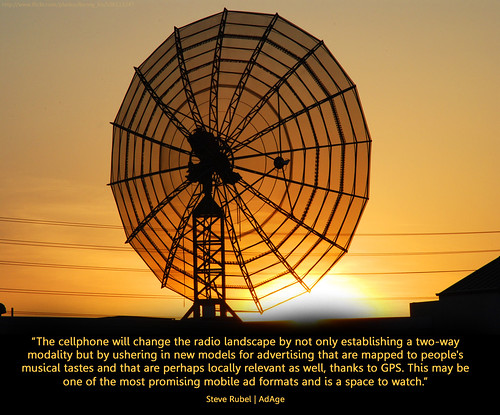
In this interesting AdAge article Steve Rubel talks about how new media do not usually supplant old media, they add to it. That is, with the possible exception of mobile internet and the radio. The radio has a few problems, some summed up in The use of conventional and new music media: implications for future technologies;
"Due to its broadcast nature, the only way to control the mix of music played on the radio is to change stations. Participants came to know what shows would be likely to play music they might like, and not have heard, but found it difficult to fit their time around these programs. Moreover, they might miss or forget the name of the song or band before remembering to buy the music."That is all magically fixed by 'Cloud Music':
"With a number of websites offering [music] free (chiefly LastFM from my usage but also Songza, BoomShuffle, Imeem, SpiralFrog, Qtrax and Pandora), iTunes may even become redundant and the idea of owning a track may be history. Instead, all your music would be within the LastFM (or equivalent) 'cloud', accessible and streamable on whatever your hardware, whenever you want, as long as you are plugged in."In February - when I wrote that - there wasn't really a way to do this. Not easily anyway. However, with typical Apple aplomb democracy has been brought to a previously difficult task with the iPhone 3G. As I went on to say,
"I think 'cloud music' spearheaded by LastFM and others amounts to nothing less than a quiet revolution in the way we consume music and lays down a first draft for the future of music."
Sounds a bit grand but I think the shift will be quite grand. Radio might be one of those things that goes, a medium that is replaced by something genuinely better.
Still that leaves the problem of what to listen to; choice can be crippling.
From experience (and research in this paper) it seems most of the new music people get comes their way from a few seriously keen musicologists in their group of friends.
The tyranny of choice places like LastFM offer up may be solved by people like this, as they become curators of the massive databases with constantly morphing playlists, which their friends can tune into. Of course big DJs will still exist - and should move into places like LastFM now and get curating - but the rise of the 'local cloud dj' should happen if 'on-demand' music with 'effectively infinite choice' goes ahead.
As Steve Rubel has said in another article:
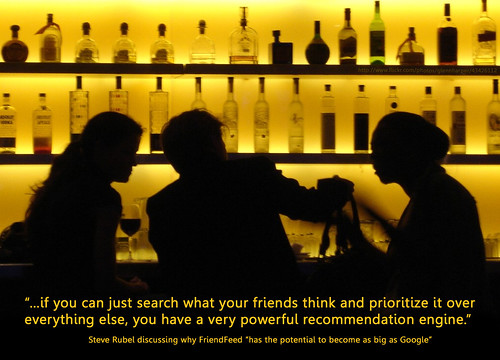
Aye to that.
Still that leaves the problem of what to listen to; choice can be crippling.
From experience (and research in this paper) it seems most of the new music people get comes their way from a few seriously keen musicologists in their group of friends.
The tyranny of choice places like LastFM offer up may be solved by people like this, as they become curators of the massive databases with constantly morphing playlists, which their friends can tune into. Of course big DJs will still exist - and should move into places like LastFM now and get curating - but the rise of the 'local cloud dj' should happen if 'on-demand' music with 'effectively infinite choice' goes ahead.
As Steve Rubel has said in another article:
Aye to that.
Monday, 14 July 2008
radioheadness
Radiohead seems bigger than the sum of its parts. I happen to think their music is fantastic but I have just got this niggle that their music alone shouldn't be so big. Isn't it too drony for most people?
With The Tipping Point still kicking about in my mind from a recent re-read I can't help but feel some of their success can be attributed to their seriously innovative activity away from their instruments, like the video above where instead of capturing light bouncing off them (like a camera does) they have captured something else bouncing off and played around with the data. Then there's the web-only free album and all the remixing possibilities they create, like the video above, which comes with Google Code to make your own visualisations. This remix property is something Kevin Kelly predicted:
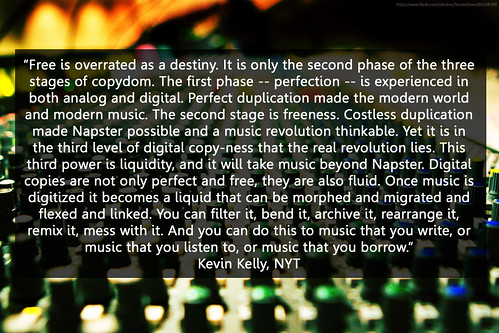
"Once music is digitized it becomes a liquid that can be morphed and migrated and flexed and linked. You can filter it, bend it, archive it, rearrange it, remix it, mess with it." Radiohead seem to be pushing people into this stage; other bands are still coming to grips with stage two, freeness.
Perennially operating on the edge lends a serious ding to the band's cachet. For one, it acts to get the attention of early adopters. It also may create a 'Coke effect'. In blind taste tests most people rate Pepsi as tasting better. When they see the labels Coke is preferred. Brand associations literally change taste perception. Radiohead's associations might literally change music perception or force people to give it 'more of a try' because cool early adopters, people who are serious about music, are serious about Radiohead.
Or maybe the slightly drony alienated sound is just what people like.
(Thanks very much to Faris who mentioned this post on his blog)
Wednesday, 23 April 2008
Binaural beats

When two sounds with two different frequencies are played in stereo (i.e. to each ear), binaural beats are heard. These aren't real but equal to the difference between the stereo frequencies. You can listen to one here (headphones needed, toggle between each ear to see the effect vanish).
There are several companies that claim such binaural beats improve mental functioning and memory by reverse engineering brain frequencies via the audio. Naturally, the combined simplicity and complexity of this idea caught certain people's imagination, to the point that a musician-physicist mate of mine wondered it there was anything to it last year during exams.
There isn't. In this recent study binaural beats had zero effect on brain frequencies and, what is more, participants in the experimental group were more forgetful and more depressed than controls.
Cognitive neuroscience, one. New Age monkeys, nil.
(If you want to see more on music and mind, see this post.)
Monday, 31 March 2008
Blowtorch

How do you produce quality in new media and all the participation it offers without suffering the rubbish that is most user-generated content. One answer might be Blowtorch. It's co-create with high standards exclusively for 18-24 year olds. That is, audiences get a say in the creative output - the soundtrack, the editing, the cinematography etc. I can see this sort of thing being eminently attractive to certain people.
Set up by a satisfying mix of entertainment, technology and advertising pros, this gets me excited because it's progressive. Unlike the rest of Hollywood whose nerves about damaging their precious DVD sales have meant congealment, Blowtorch's new rules of participation and using all the different media pipes to engage is new and needed.
Friday, 7 March 2008
Music by mood
 Burst is interesting. Instead of just taking the genre approach to tagging music, you can browse tag clouds of moods and instruments. Nice clean design too.
Saturday, 23 February 2008
Cloud Music
 The web's a bit like a vacuum: it is sucking up all sorts of things off desktops, start bars and docks. Outlook and Thunderbird aren't really needed what with Gmail et al.. Microsoft Office is under threat from Google Docs and things like Empressr. Photo software is being supplanted with things like Flauntr, Flickr and Photoshop Express. Skype isn't really required if you use web-based Gmail chat. The list goes on....
This is so-called cloud computing, which as Google's head honcho says, "starts with the premise that the data services and architecture should be on servers" and not computer hard drives (source). In other words, all you may need in the future is a browser; everything else will be accessible via the net.
Music is the latest addition to the list. With a number of websites offering it free (chiefly LastFM from my usage but also Songza, BoomShuffle, Imeem, SpiralFrog, Qtrax and Pandora), iTunes may even become redundant and the idea of owning a track may be history. Instead, all your music would be within the LastFM (or equivalent) cloud, accessible and streamable on whatever your hardware, whenever you want, as long as you are plugged in.
Artists receive a share of the advertising revenue for having their tracks played, which as the LastFMers say is "redesigning the music economy".
As it stands LastFM is limited in its features with music streaming. For example, you can only build one playlist. But it will probably start getting as sophisticated as iTunes. At least, I hope it does.
I think 'cloud music' spearheaded by LastFM and others amounts to nothing less than a quiet revolution in the way we consume music and lays down a first draft for the future of music. I just hope it works.
Friday, 22 February 2008
Great opening credits
Often the opening credits get forgotten, what with the focus on the show's content. Yet the best have a way of immediately transporting you into the show's world. Here are a few of my favourites, in no particular order...
House
Beautiful mix of Da Vinci-style medical drawings, flyovers and human body CG set against Massive Attack's brilliant Teardrop.
Dexter
The morning routine suffused with graphic and chilling homicide allusions.
Weeds
Suburban conformity set against Malvina Reynold's Little Boxes (after Season One each new episode uses a different cover).
Six Feet Under
I have no idea what the proper name for that first musical 'strike' is, but it alone can take me into the world of one of the best shows in history. This opening sequence is just beautiful.
Darkplace
Few people have heard of Darkplace. Even fewer get it. But this opening sequence is the paragon of parody and a great snapshot of the deluded, troubled genius that is Garth Marenghi.
Carnivale
The sweeping and unusual epic that should never have been axed.
The Office (UK)
Grey Slough.
Scrubs
Just like the show and its characters this sequence is eminently likeable and upbeat.
Nip/Tuck
Plastic and sterile visuals coupled with The Engine Room's icy A Perfect Lie.
24
So this isn't the full sequence but the frazzled visuals and screechy, electronic sound are great.
House
Beautiful mix of Da Vinci-style medical drawings, flyovers and human body CG set against Massive Attack's brilliant Teardrop.
Dexter
The morning routine suffused with graphic and chilling homicide allusions.
Weeds
Suburban conformity set against Malvina Reynold's Little Boxes (after Season One each new episode uses a different cover).
Six Feet Under
I have no idea what the proper name for that first musical 'strike' is, but it alone can take me into the world of one of the best shows in history. This opening sequence is just beautiful.
Darkplace
Few people have heard of Darkplace. Even fewer get it. But this opening sequence is the paragon of parody and a great snapshot of the deluded, troubled genius that is Garth Marenghi.
Carnivale
The sweeping and unusual epic that should never have been axed.
The Office (UK)
Grey Slough.
Scrubs
Just like the show and its characters this sequence is eminently likeable and upbeat.
Nip/Tuck
Plastic and sterile visuals coupled with The Engine Room's icy A Perfect Lie.
24
So this isn't the full sequence but the frazzled visuals and screechy, electronic sound are great.
Wednesday, 13 February 2008
Light played by key
 Scan of a the front cover, digitally unmodified
Was digging around in a box today and came across this little book of postcards purchased at the New York's Museum of Modern Art in 1963 when it was running Thomas Wilfred's Lumia Suite, Op.168. First, I love the idea of a little book of postcards. I have only ever seen postcards sold separately.
Secondly, the work is exciting and fantastic. Wilfred was a pioneer in 'art from light' - Lumia. To do this he used a machine that he called the Clavilux, which translates as 'light played by key'. His music would literally take shape in light form. He first showed off these 'light sculptures' (see my other blog for something similar) in 1922 in New York. After this he gave performances all over the world.
This, off the back of the book of postcards, explains Lumia Suite, Op. 158 in some more detail:
 I have scanned in a few stills below, tried to remove the dust and scratches digitally and restored a bit of the colour vibrancy lost in the scan.


There is a little bit more of his work here. I think he would have liked the current light exhibition in London at the moment, Switched On London. Also, I think he would have liked BMW's 'See How it Feels' ad. (Or rather the creatives over at WCRS liked his work!). Here it is with UNKLE's sensational remix of Beethoven's 9th Symphony:
Secondly, the work is exciting and fantastic. Wilfred was a pioneer in 'art from light' - Lumia. To do this he used a machine that he called the Clavilux, which translates as 'light played by key'. His music would literally take shape in light form. He first showed off these 'light sculptures' (see my other blog for something similar) in 1922 in New York. After this he gave performances all over the world.
This, off the back of the book of postcards, explains Lumia Suite, Op. 158 in some more detail:
 I have scanned in a few stills below, tried to remove the dust and scratches digitally and restored a bit of the colour vibrancy lost in the scan.


There is a little bit more of his work here. I think he would have liked the current light exhibition in London at the moment, Switched On London. Also, I think he would have liked BMW's 'See How it Feels' ad. (Or rather the creatives over at WCRS liked his work!). Here it is with UNKLE's sensational remix of Beethoven's 9th Symphony:
Friday, 8 February 2008
Alternative is mainstream
 Just noticed on LastFM how 'alternative' is ironically one of the most popular tags, at least for LastFM users.
Tuesday, 29 January 2008
Crash
The film Crash may be rather pessimistic and over-wrought at times. It may also have rather too many ribbons of serendipitous connectedness running through it, tying everything and everyone neatly together. It looked like one of those hyperlink TV shows (like Lost, 24, Prison Break etc) squashed into a film. But I loved it.
Here is a scene, which I love for packing a weighty dramatic punch. Thandie Newton and Matt Dillon's acting in both the earlier encounter (which sets up the tension for this scene) and this scene is brilliant. This is combined with Mark Isham's emollient score (the piece here is called 'Flames') and Paul Haggis' direction to create this mini-masterpiece:
Wonderfully, it's expanding out into the TV series it looked liked it had been squashed into. Leaving off from where the film finished it will go beyond the film's focus on ethnic relations and promises to reprise the original cast.
Here is a scene, which I love for packing a weighty dramatic punch. Thandie Newton and Matt Dillon's acting in both the earlier encounter (which sets up the tension for this scene) and this scene is brilliant. This is combined with Mark Isham's emollient score (the piece here is called 'Flames') and Paul Haggis' direction to create this mini-masterpiece:
Subscribe to:
Posts (Atom)