Sunday, 1 March 2009


Thursday, 15 January 2009

Thursday, 8 January 2009
like glowing ants
This is global air traffic in a 24 hour period as captured by satellite (and they all seem to be going to London.)
Wednesday, 7 January 2009
google new year

The genius of Google’s advertising is that it doesn’t look like advertising while probably doing a better job than most advertising. It’s so functional, so straight-up. It doesn’t even feel like false altruism where you know that your wallet will have to appear at some point. It’s just lovely, simple and it perpetuates the use of Google.
Thursday, 11 December 2008
what's digital and why you should apply
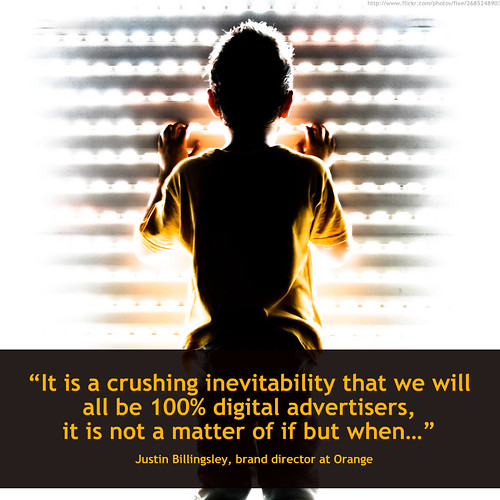
It might be overstated (there’s probably always going to be the “‘bed, bog, bath’ element”) but Mr Billingsley’s comment is almost certainly right: we’re going to be digital advertisers because the world is now digital, and getting more so.
What does all this digital malarkey mean for people looking to get into the communications business and, before we look at that, what does digital mean anyway?

There are two important things there for grads trying to get into the industry. The first is, “whose roof”?
This interactivity let’s you do a lot more than you can at your typical traditional ATL agency. Or to reunite that idea with its owner:
I think that's really exciting (and Mr Tait has 9 more great reasons digital is better for those interested). In digital you’re unshackled from just doing TV, print and radio to all sorts of exciting things like sites, applications, blogs, games, branded content, widgets, podcasts, social things and experimental stuff. And a lot of this (not all) is actually useful to people; it's additive rather than interruptive.
In my experience grads tend to think of digital as something on-the-sidey and techy. Maybe it once was. Now it ain’t. Technology is so ubiquitous, so ‘ready-to-hand’, that it’s becoming invisible and when that happens it gets socially interesting. In other words, technology and culture used to be separate, increasingly they are the same (look what you're doing now.)
It’s a brilliant time to get into an industry that’s only going to grow (even in these tough times) and that’s much more about interesting interactive ideas than it is about tech.
Go on, apply!
Obviously I am biased but this would be a good place to start...
(For those wanting more, I suggest you have a play in here, read this, canoe back up this and maybe watch this. That should be enough to be getting on with.)
Monday, 10 November 2008
a good, good guide

Saturday, 8 November 2008
50,000

Friday, 7 November 2008
getting creepy
 New technologies can look like magic. That's Douglas Adams speaking.


Thursday, 30 October 2008
Friday, 17 October 2008
clients paying agencies to advertise agencies

turn left where the telephone box used to be

- A man asks for directions to a shop in a small town. The postman tells hims to go up the road and turn left where the telephone box used to be.
Why has the postman failed in his communication? Because he makes the assumption that the listener knows what he knows. Or rather, he fails to appreciate the listener's knowledge is not the same as his. This lacks a word in English but it's something like empathy. Psychologists, however, do have a term for this faculty, theory of mind. Using clever methods - like the Sally/Anne task - it is possible to see this mental trick coming online around the age of four in developmentally typical children. Autistics never master this. The point: communicators need a theory of mind - or the ability to see events through the eyes of those they are communicating to - in order to be successful. - Passive audiences were never passive. Audiences have always actively understood communications, it's just that before digital they never had a way to express it; digital makes stuff that has always happened explicit.
- There are no such things as messages. There are stimuli and responses.
- The best creativity elicits the best contribution from the receiver (the artist rules his subjects by turning them into accomplices)
- There is no dichotomy between creativity and effectiveness in communications. Effectiveness is the end; creativity is the means.
- Advertising creativity makes client's money go further. Anything outside of that definition is not creativity.
- Brand body language is what people read. When the body language doesn't match the communication, there's a problem.
- Good brands make you feel safe, they release you from anxiety (mostly likely because of problems with information in market economies)
digital britian
"Our ambition is to see Digital Britain as the leading major economy for innovation, investment and quality in the digital and communications industries. We will seek to bring forward a unified framework to help maximise the UK's competitive advantage and the benefits to society."
clarity crunch
"My favorite time to manage is during a bust. It brings more clarity about what your customers need and what your priorities should be."
Thursday, 16 October 2008
Friday, 10 October 2008
believing real
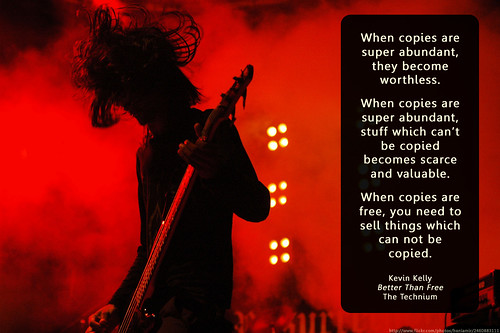 One of the first things I think when I see something online, and one of the first things that gets banded about on comment lists, is whether or not something is genuine, rather than set-up, faked, CGed etc. If it's genuine, interest soars; if not, interest dwindles (usually).
With this in mind here's a variation on Kelly's idea:
When content is faked, it becomes emotionally worthless.
When content is faked, stuff which isn't fake becomes scarce and valuable.
When content is faked, you need to show people things which are not faked.
rebel selling
 This is a screen grab from LastFM before they ruined their design. Putting that to one side for the moment, the interesting thing about it is that, after 'rock', 'alternative' came in as the second most popular tag. A screen grab from today shows much the same pattern.
[Aside: It's interesting how 'seen live' is a major label too. Like Kevin Kelly has said when stuff gets superabundant it gets cheaper to the point of being free. When this happens things that can't be copied become more valued by both the ordinary people, hence the tag's popularity, and record companies, hence the money in music now being in touring.]

Bakunin, Nietzsche, Sombart and Schumpeter all saw capitalism not for the homogeneity it created but as a fundamentally creative (and thus destructive) system. Capitalism and culture can be stated as the effort to escape sameness.
But you get information problems here. There are too many alternatives. Just like brands are there to help solve this problem, so certain things become pin-ups for 'alternative' to avoid the crippling effects of having too many alternative things. These things are then popular for being alternative. Here, then, 'alternative' and 'popular' can operate the same place on a Gaussian distribution: everyone is trying not to be mainstream.
(Another irony here: counterculturalists believe they are rebelling against 'the system' when they are most probably contributing towards it, because rebellion is in the very spirit of capitalism. This could be problematic: "Not only does it distract energy and effort from the sort of initiatives that lead to concrete improvements in people's lives, but it encourages wholesale contempt for such incremental changes [The Rebel Sell])
Tuesday, 7 October 2008
why psychology is so important
When I say psychology is not the same as philosophy now but vital to it, what I mean is that without an understanding of the mind, we cannot get a good understanding of reality. We have to know the mud to remove it.
All knowledge gathering without an awareness of the mind's natural biases is the straight line in the diagram below. Knowing how the mind works allows you to travel along the bendy line, circumventing the mud, and obtaining unfettered knowledge. Close eyes, deep hum....

Wednesday, 17 September 2008
buy-product


Selling on social networks can only be a by-product (hence the title 'buy-product'. Geddit? Oh dear, I am sorry) of the activities occurring on those sites, never a primary activity.
The long version is this:
In market economies there are two big problems with information: it's (occasionally)* inadequate and it's superabundant.
Why is information inadequate? Because you only know how good something is after you have bought it, so how do you choose between alternatives?
Why is there too much information? Because everyone wants a slice of the pie making those alternatives and the market gets flooded with products or services and thus information about those. (How do you choose between one-hundred types of olive oil? You don't for the most part. It's crippling. You move on.)
Add in the fact that this competition strips profits to the bone and you have three pretty good reasons for why brands should (and do so successfully) exist: to remove doubt about quality and ease the process of otherwise crippling choice for people who want to buy stuff, and pump scarcity (and thus juicer profits) back into things for people who want to sell stuff.
However, in the spirit of several recent books, solutions to the problem of inadequate and superabundant information can also be solved by [dramatic pause] other people. And more effectively because trust in other individuals is second only to personal experience itself.
Other people can literally 'test' products and services for you before you buy them yourself (by buying them themselves) and help narrow down the choice for you (by having had to narrow down the choice for themselves.)
People have probably been doing this since information in markets got to be doubly-dodgy. Nothing new in the behaviour. It even has a 5-syllable name: recommendation.
However, what might be new is that hitherto implicit recommendation could be made explicit and more useful with a dash of digital. Making stuff explicit seems to me to be the formula of the successful things in recent web (Facebook makes social relationships explicit, blogs records thoughts that would otherwise only exist in conversation or the mind, LastFM records the wake of your audio, StumbleUpon ossifies your digital discoveries etc.)
How would this work? Social networks would allow self-expression at a much finer level of detail allowing libraries of music, films, books, clothes**, etc that people have honed (not harvested automatically, which was the problem with Beacon). (Eventually content could be brought within such networks, so they operates as hubs of digital content.)
This in itself could present recommendations based on content (like iTunes Genuis) but also those made by other people in your group of friends. These recommendations wouldn't really be recommendations but comments/ratings tagged onto things by people. 'This track is awesome' could be really useful from someone who you (or your computer) knows you share taste with.
Picture time:
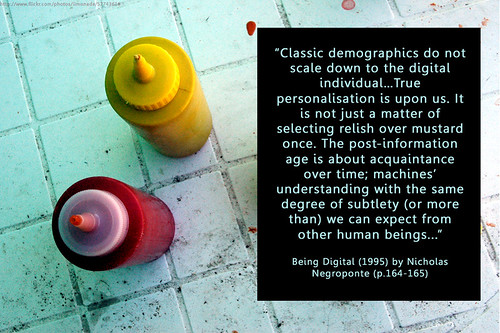
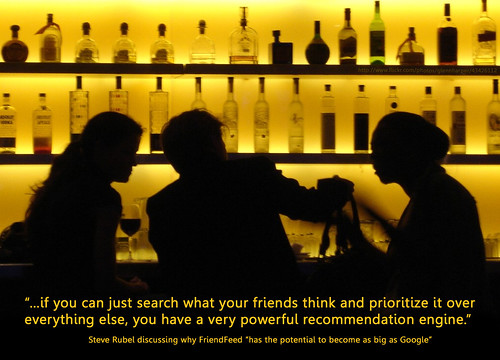
One of the nice things about such a system is that it's lovely for people, providing stuff they might be interested in. However, there is also an opportunity here for social networks.
Another picture first:
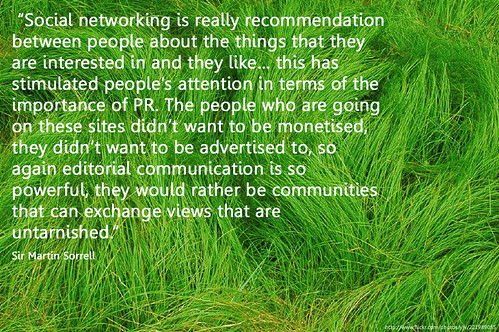
And now I am going to quote myself, which is probably a bit wanky but here we go from a few posts back:
"When people use Google, they're looking for information. When they use Amazon, they're buying (or researching). The ads are working here because people want information, it's welcome if its good enough.The point is that in the social space clumsy selling (ads) is not welcome: the communication gets tarnished by it, so it's ignored and disliked. But, that is not to say that selling as a by-product is out of the question. Links to things - and charging the producers a little for those links - suits everyone.
When they use Facebook (or any other social media) they're expressing, communicating and interacting with others (being social not being cognitive). The same ads aren't working here for the same reason you'd be a bit miffed if someone marched into the pub, dropped a sausage in your pint, yaddered on about how delicious they are and, by the way, how they are half-price at the moment."
* I put 'occasionally' in brackets because as soon as information is partially inadequate it gets perceived at wholly inadequate.
** Self-generated recommendations will probably work for clothes; other-generated recommendations won't work as well. People like their clothes to be different (but not too different) from their peers.
Thursday, 11 September 2008
negroponte's predictions
Here's a smattering of things I liked, with the occasional few words after each from the perspective of now.
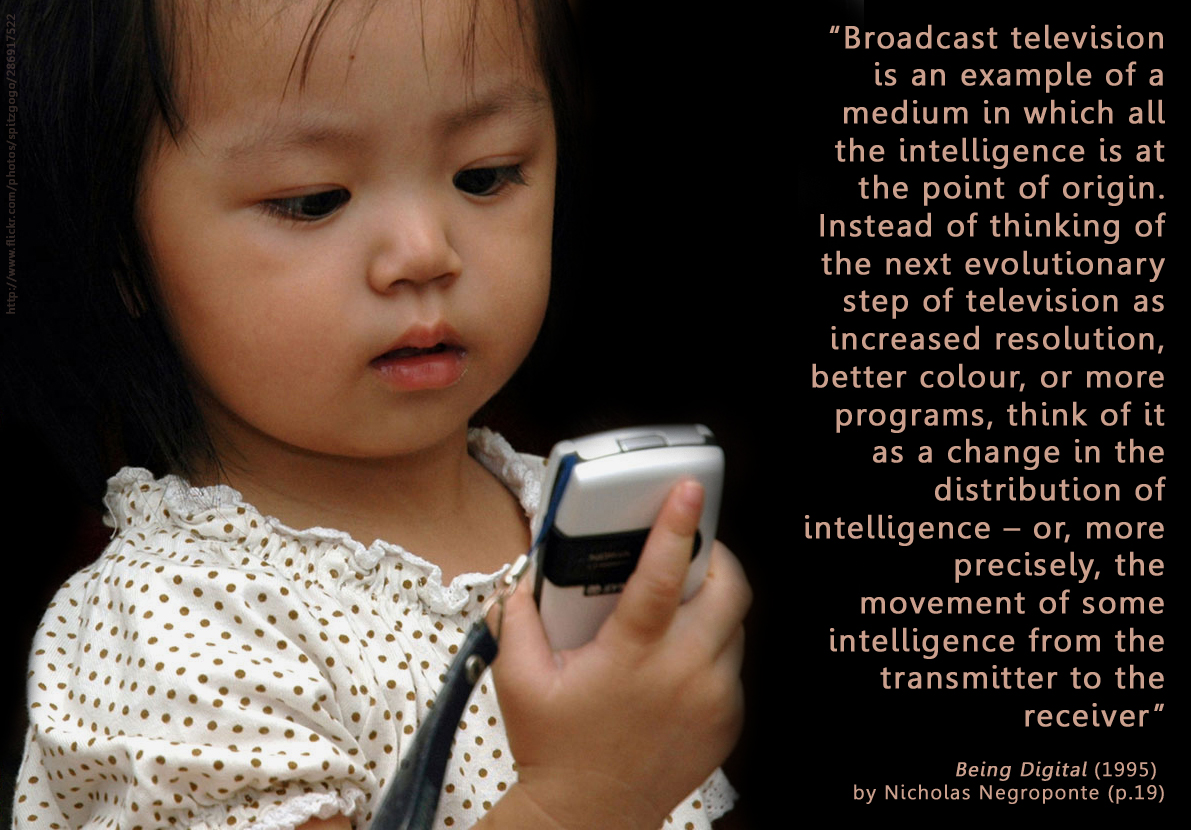
The tidiest way I have seen the 'receive -> interact' paradigm change articulated.
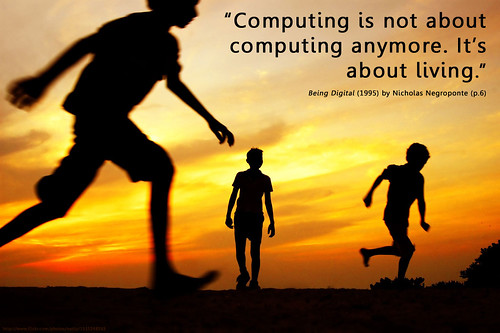
Basically, Apple's strategy and success.
RSS, Google Reader...
Creeping in more and more. He also talked about "the tiny hole or two in plastic or metal, through which your voices access a small microphone" (p.159). This is still proving difficult.
Things like Google Reader's Top Recommendations, Amazon's recommend emails and iTunes' Genius represent this one quite nicely. Although still some way to go here.
Hulu, BBC iPlayer and all the underground antecedents to these.
This idea - communication as well as information - is rephrased a lot by pundits. What's impressive about this is that it saw the value of social online before it was made explicit with, sorry, nasty phrase coming up, Web 2.0.
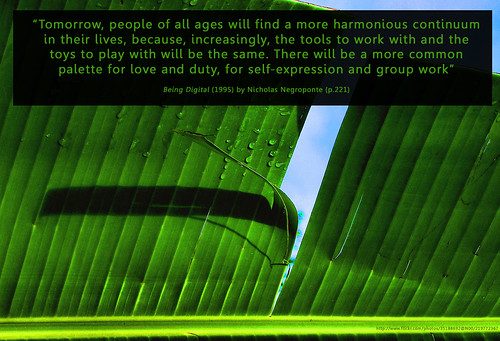
Blogging seems the best example.
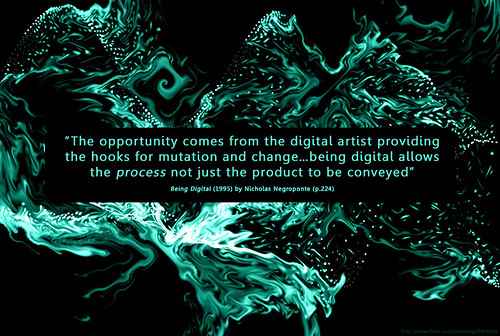
Radiohead is my favorite example of this at the mo. (Also see here for what bitcasting - another of Negroponte's babies - is all about and how Radiohead's House of Cards 'video' is likely to have been the first example of this).
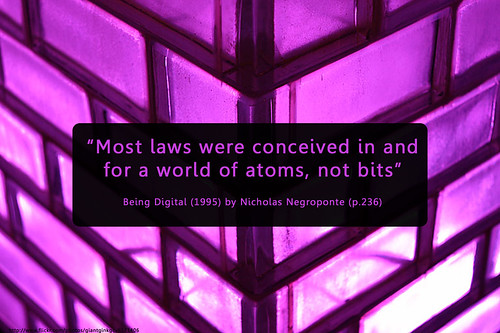
Very broadly gets to the nub of all the legal issues bouncing around online.
And a few others that didn't make it into digital bites:
"Clipping bits is very different from clipping atoms" p.59
"On the net each person can be an unlicensed TV station" (p.176)One word. YouTube
"...bits that describe other bits...will proliferate in digital broadcasting. These will be added by humans aided by machines, at the time of release...or later (by viewers and commentators). The result will be a stream with so much header information that your computer really can help you deal with the massive amount of content" (p.179)tags, labels etc
"automobiles will enjoy another very particular benefit of being digital: they will know where they are" (p.216)SatNav.
"The important point is to recognise that the future of digital devices can include some very different shapes and sizes from those that might naturally leap to mind from our current frames (sic) of reference. Computer retailing of equipment and supplies may not be limited to Radio Shack and Staples, but include the likes of Saks and stores that sell products from Nike, Levis and Banana Republic."Basically, the web breaking out from behind screens, which I have thought about here. Nike+ is the golden example of this right now. A continuation of this idea:
"When this happens in a tiny format, all "things" can be digitally active. For example, every teacup, article of clothing, and (yes) book in your house can say where it is. In the future, the concept of being lost will be as unlikely as being "out of print"I like the nod to long tail stuff at the end there with "as unlikely as being out of print"
(Skepticism: the book, being widely read, could have prompted people to work on the things Negroponte predicted ('invented'), giving the impression that the book is farsighted when it may have been prescriptive to future-makers)