 I like Gartner's Hype Cycle. It's meant to describe the adoption of technology on a wide level. I can almost feel it happening on a personal level with new products and services. Also thought that it has relevance beyond technology: it can be quite easily appropriated for anything new that is marketed, like politicians.
Tuesday, 18 March 2008
The Technology Rollercoaster
I like Gartner's Hype Cycle. It's meant to describe the adoption of technology on a wide level. I can almost feel it happening on a personal level with new products and services. Also thought that it has relevance beyond technology: it can be quite easily appropriated for anything new that is marketed, like politicians.


Contravesy, truth and experts
Had another thought about experts and the media.
In the last post, Rethinking Expertise (here), I said the "media forged and perpetuated a scientific controversy [about MMR and autism] where none existed".
Sadly, this is good business. It is in the interests of commercial news outlets to perpetuate (and even serve up) illusory controversy.
Fox, ever reliable for being unreliable, admit to this. Although they may be operating ideologically as well here, Murdoch says there are business reasons for his network's radical stance on climate change.
In the last post, Rethinking Expertise (here), I said the "media forged and perpetuated a scientific controversy [about MMR and autism] where none existed".
Sadly, this is good business. It is in the interests of commercial news outlets to perpetuate (and even serve up) illusory controversy.
Fox, ever reliable for being unreliable, admit to this. Although they may be operating ideologically as well here, Murdoch says there are business reasons for his network's radical stance on climate change.
Another reason why experts must be allowed to shout louder than ordinary people.
Monday, 17 March 2008
Rethinking Expertise
 Who's better? An expert or many ordinary people?
 As scientists observe the universe and its contents other academics observe the scientists. Prof. Harry Collins is one of these scientific voyeurs who peers through the crack in the ceiling of knowledge-building and records how it is done. My girlfriend and I went to a little talk of his in the Exeter quays last week.
Having spent a long time with gravitational-wave physicists he has given man-birth to Gravity's Shadow (2004), the sort of book you could knock an ox out with, running to some 870 pages. During his experience with these experts he started thinking about the nature of expertise. This is the subject of his (and Robert Evans') most recent (pithier) offering, Rethinking Expertise (2007).
His talk was a summary of one of the book's points. In his forthright, laddish way he sketched a quick and basic history of the philosophy and sociology of science. Without technical labels, which I add back in here, he covered falsification (Popper, 1959, esp. pg. 27–48) and the problems with it (Kuhn, 1977; Lakatos, 1970, 1974; Maxwell, 1972; Meehl, 1978, 1990; Putnam, 1974) including the problem of facts (who is to know if it is the fact or the method to get to that fact that is wrong?). With this breakdown in philosophical robustness so trust in experts dwindled.
In a nod to Feyeraband’s (1975) Dadaistic 'anything goes' idea, the suggestion was that all trust was lost. In a Feyerabandian world science is no different to other things like Jade Goody's opinions or reading the future by dropping fruit on the floor and examining the patterns. Peer-reviewed science has no great difference in terms of methodological soundness to that of personal experience in this scenario. I strongly agree with Collins that a society like this is "not one you would like to live in"; hell is Feyeraband's world.
His concern is that despite the intellectual repugnance of this scenario, it is gaining some currency under the idea that "ordinary people are wiser than experts in some technical areas". For an example he cited the case of MMR and autism where a dodgy paper (Wakefield et al, 1998) and the media forged and perpetuated a scientific controversy where none existed. In his words, the link between these two on the available evidence is "zero" (he is right). To this one woman in the audience shouted "That's not true"; she knew someone whose child had both MMR vaccine and autism.
The whole force of Collins' point was evident in this little bit of heckling. It is stunningly simple (as basic as common-sense gets some might think), but no less important for that: All else being equal we should listen to "those who know what they are talking about". In this case, the evidence said there was no link, the co-occurrence of the MMR vaccine and autism in this child she knew was irrelevant. If she had retorted, "What, it is just coincidence that the child has autism and had the vaccine?", the answer can only be "Yes, precisely that: a coincidence."
I was reminded of an episode of House where House lambasts a junior for choosing the a treatment option on personal factors despite the fact it saved the patient's life. This is because statistically more people would be killed using that particular treatment over time than the evidence-based option.
Had the junior doctor used the evidence-based (correct) option the patient would have died. Nevertheless, it would have been the right option. Experts must be allowed to be experts, even if they are wrong occasionally because the cost of having no experts is far too great. In the case of MMR, lives are at risk.
Collins and Evans call expertise "the pressing intellectual problem of the age". It's certainly a biggie. And as the number of opinions on technical issues froth up with more user-generated content online I think their point, although simple, is very important. No one is cleverer than everyone. But that does not mean everyone is cleverer than experts.
9,581,206 abortions
 The World Clock. Real-time data (well, statistically predicted data) on all sorts of things, abortions, marriages, divorces, oil pumped, bikes produced and so on. Also check out The Food Clock - that's a lot of chickens.
Stealing a gorilla
Ad agency WCRS didn't worry about ripping off Simons and Chabris (1999) (paper available here and original video here) when they made this:
After a bit of Internet detective work, it turns out the authors never gave permission (I found out from this great little blog where plagiarists are named and shamed, youthoughtwewouldntnotice.com).
Ok, it's for public safety and its making a point for a good cause, but apart from the obvious plagiarism, which is bad enough for a supposedly 'creative' agency, this smacks more of stupidity by failing to appreciate that the Internet is the world's most sophisticated plagiarism program. And their Gorilla suit wasn't as good. Tut.
(if the link goes down here is the campaign website)
After a bit of Internet detective work, it turns out the authors never gave permission (I found out from this great little blog where plagiarists are named and shamed, youthoughtwewouldntnotice.com).
Ok, it's for public safety and its making a point for a good cause, but apart from the obvious plagiarism, which is bad enough for a supposedly 'creative' agency, this smacks more of stupidity by failing to appreciate that the Internet is the world's most sophisticated plagiarism program. And their Gorilla suit wasn't as good. Tut.
Sunday, 16 March 2008
Things to see
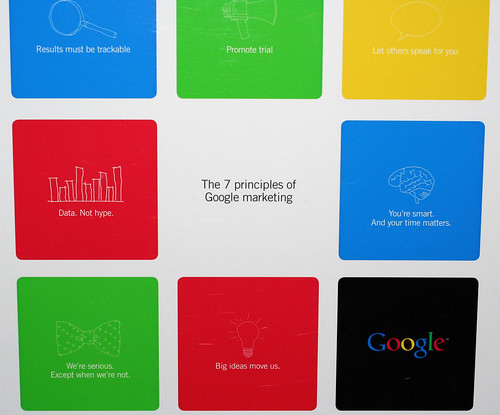
In the "Find businesses" bit on Google maps typing 'things to see' in the 'What' box and a location in the 'Where' box loads up a mix of Google and user-created content of interesting places in the specified location.
It's very useful. It will probably get even more useful when location-aware mobile web is chucked into the mix (see also Socialight and TagMaps).
It's also very Google and, along with other things like 'I'm feeling lucky' button, it is what makes the Google brand special. 'Things to see' adds in something magical and yet so functional.
Google has no brand guidelines (although I did find some principles in the pic above) and no silly, vapid slogan, it just gets on with the job and in places where there is no cost to functionality it is happy to be playful.
It does; it doesn't just say what it does. More of this from other brands please.
Friday, 7 March 2008
spEak You're bRanes
 Dodginess abounds in Web 2.0. I have posted about it here and here. One of the worst locations for this on the BBC's Have Your Say page which is a playground for the permanently outraged and confused.
Someone has catalogued all this on spEak You're bRanes (a nod to Iannucci-Morris satire gem, The Day Today). They have even organised it into categories, like Armchair Generals, Curtain Twitchers, Unfocused Rage, Permanently Bewildered and Werthers Original Imperialists to name a few. Makes for great reading.
Music by mood
 Burst is interesting. Instead of just taking the genre approach to tagging music, you can browse tag clouds of moods and instruments. Nice clean design too.


Viscosity: modern art generator
 Click to enlarge
Ficlets: narrative quilts
 Sony seem to be operating a strategy of 'technology with character' especially with their laptops and MP3 players. This comes through in their digital efforts (by Dare). Things like the Walkman Project and the Malkovich Vaio site scream a more refined appreciation of music and creative approach to computing than your average punter. I suppose directing your efforts at early adopters and people who pride themselves on doing their own thing (people like.no.other you could say) is sensible when you are up against the ubiquity of the iPod because the exclusivity and creative associations of Sony will ensure later trickle down.
Anyway, Sony isn't what I wanted to talk about, it's just the premise of the Malkovich site, namely to continue on a script he started, that chimes with this other site I came across called Ficlets. Here, rather like those children's games, you get to continue on someone else's story (or indeed write a prequel to it). Narratives are stitched together by the many. In all likelihood this will create some horrible quilts but power of the Internet means that the occasional gem will appear. Anyway, I like.
Who had my milk?!
 Passive Aggressive Notes is one of my favorite niche blogs. Self-described as the home for "painfully polite and hilariously hostile writings from shared spaces the world over", it provides a gleeful repository of thinly veiled threats, deftly controlled anger and cranky politesse. (See also the ranting and raving on the Best of Craig's List)
Saturday, 1 March 2008
Happy Maps
 In 2006 Adrian White, a social psychologist at the University of Leicester, compiled this, a world happiness map. You can get the full version here. The redder, the happier.
In a similar spirit, this little gem maps out 'feelings' from around the user-generated web and mashes it up with Google Maps:
 It's not particularly powerful at the moment but is nevertheless a really interesting idea. I love the possibility of analysing subjective content over geographical location like this. If time were to be added in as well it would become even more interesting because you could potentially track the emotional wake of a certain news story after it breaks. Nice simple and playful interface too.
Statistics and Art
Intricate, massive, overwhelming and visually obsessed with quantity, Chris Jordan's work portrays "contemporary American culture through the austere lens of statistics" in pursuit of a "different effect than the raw numbers alone" (source). Squeezing down Jordan's work to fit here will doubtlessly remove some of its impressiveness but there are successive zooms (clicking on the last one in a series will reveal actual size). Shoot over to Jordan's site to see more but here are a few choice bits from Running the Numbers.
Nearly half a million mobiles phones - the number retired in the US every day


1.14 million paper bags - the amount used in one hour in the US


11,000 jet trails - the number of commercial flights every 8 hours in the US


Subscribe to:
Posts (Atom)