
GoodGuide is great. It helps you find healthy, safe and green products. And - most importantly - it's now available on the iPhone. The fact that it's on the iPhone isn't the important bit. It's that it can be used at the point of purchase, which I'd imagine impinges much more on buying decisions than the memory of the site from home or work.
Showing posts with label ordinary. Show all posts
Showing posts with label ordinary. Show all posts
Monday, 10 November 2008


Sunday, 27 July 2008
gardens and the human condition

Insomnia and the BBC World Service coupled up to draw my attention to this beguiling, offbeat little essay, Gardens: An Essay on the Human Condition.
It's not a book about gardens; it's a book about humans through the lens of gardens.
One of its most interesting ideas is the paradox that while we consider gardens cocoons of respite they are, of necessity, also places of care, places where "longing for repose is pitted against a deep restlessness".
It is, in horribly bland modern terms, an idea about work/life balance. The metaphorical garden must be a place where neither continuous labour nor wanton abandon can exist but instead a rich combination of the two.
Saturday, 26 July 2008

Friday, 18 July 2008

Saturday, 5 April 2008
Tube paranoia

I'm a little bit fascinated by The Underground. The visual language always gives me satisfaction. Then there is the strangeness to being underneath everything. I love this ad for making explicit what I always imagine (in slightly less pristine visuals) is going on above my head on the tube.
Most of all, the tube is intriguing because of the people on it. There's all the covert reading over shoulders, the seat politics, proximity negotiations, the conspicuously empty seats around a nutter and the wilful avoidance of making eye contact to the point where the mundane transmutes into the sublime.
In one of the most massively artificial places humans are forced to congregate, everyone wants their own cocoon; even Tony Blair was ignored on the tube. The only thing that punctures everyone's individual seals is a collective comedy or tragedy, like when someone's shopping or afro is pinched in the door. The valence of the emotion depending on which side of the doors the person is when this happens.
Simmel said in The Metropolis and Mental Life that "[t]he deepest problems of modern life derive from the claim of the individual to preserve autonomy and individuality of his existence in the face of overwhelming social forces...." One result of this struggle is the urban blasé, an indifference to much of the stimuli of the city.
This deadening of the senses though may not be entirely accurate. A nifty virtual reality experiment published in the British Journal of Psychiatry this month has shown a large proportion of tube travellers felt paranoia - a sharpening of the senses - where eye contact is misconstrued for something more malignant.
Transparente. Agency: Contrapunto Madrid
Most of all, the tube is intriguing because of the people on it. There's all the covert reading over shoulders, the seat politics, proximity negotiations, the conspicuously empty seats around a nutter and the wilful avoidance of making eye contact to the point where the mundane transmutes into the sublime.
In one of the most massively artificial places humans are forced to congregate, everyone wants their own cocoon; even Tony Blair was ignored on the tube. The only thing that punctures everyone's individual seals is a collective comedy or tragedy, like when someone's shopping or afro is pinched in the door. The valence of the emotion depending on which side of the doors the person is when this happens.
Simmel said in The Metropolis and Mental Life that "[t]he deepest problems of modern life derive from the claim of the individual to preserve autonomy and individuality of his existence in the face of overwhelming social forces...." One result of this struggle is the urban blasé, an indifference to much of the stimuli of the city.
This deadening of the senses though may not be entirely accurate. A nifty virtual reality experiment published in the British Journal of Psychiatry this month has shown a large proportion of tube travellers felt paranoia - a sharpening of the senses - where eye contact is misconstrued for something more malignant.
Friday, 21 March 2008
Choice and the Fishbowl

My sister, an artist, has become enamoured with the new Whole Foods Store in Kensington High Street. Not as a place to buy food though. Rather it's a food gallery to her, a place for loving shots of shiny aubergines, forests of broccoli and piles of proud lemons. I was told I had to see it. So I did.
It's beautiful; the newest museum to open in the area. Everything is plentiful. There are more than one hundred types of olive oil. Too much olive oil really. Too much to take in. As the Guardian commented there is a "tyranny of choice". This is something that I am experiencing beyond olive oil.
Choice is a very modern problem born out of a perceived modern benefit, namely that it affords personal freedom. On a personal level, I find it has a very demotivating effect. A few choices are good. My willingness to engage with those choices is healthy at this small number. Beyond that I get more and more despairing, dizzying almost, until my attention packs its bags and moves on to something else.
As usual with things like this I wanted to see what was out there in the psychological literature (this is a hangover from my experimental psychology degree and generally uncontrollable curiosity). Sure enough, the decision malaise afforded by over-choice has been empirically documented. The best place to read about it would be in this book, The Paradox of Choice: Why More Is Less, or in this fun talk by the author, Barry Schwartz, at TED.
One example in the book is particularly striking. It comes from a paper in the Journal of Personality and Social Psychology in 2000 and involved jam. Either lots of it (24 types) or a few jars (6 types) on a two tables, to be precise. Despite the 24 jams having more of a magpie effect (Ooh, look at all that jam...) it was debilitating to the decision making process (Ahh! There's too much. I can get jam some other time) selling a tenth less than the smaller collection.
Russell Brand, in his own sexually honest way, is in touch with that too: in one of his shows on TV, I remember him bemoaning how the combination of the truly vast quantities of pornography available on the Internet and tabbed browsing literally crippled his ability to 'finish', restraining because the next girl might 'just be a little better'.
One can imagine how if this sort of logic is applied to less solitary sexual pursuits, people can put off securing a partner because the choice is too large and the thought that a better one could come along is too alive in people's minds. The result is probably a growing single population. Information from the Office for National Statistics might support this: marriages are at a 110 year low (although there could just be less explicit acknowledgement of relationships).
In more commercial areas, I think that, apart from wonderful design and effortless functionality, there is significant benefit to Apple's slim number of choices both between and within products. Steve Jobs claims that Apple has less than 30 major products (and amazing this produces a $30 billion company). More specifically, for the iPod, the choice is between Shuffle, Nano, Classic and Touch and then there is usually only a binary choice when it comes to size (80Gb or 160Gb for the Classic at the time of writing this). You're not even going to break a cognitive sweat there.
In another example altogether, I have noticed how top restaurants have small menus; lesser places have tomes indexing all manner of available foods. Gordon Ramsay in his rescue-an-ailing-restaurant TV show normally always suggests trimming the menu down. Now, it's very possible that both in the Apple and menu cases, fewer options means more focus for the people behind the scenes on the creative output; nevertheless, I still think that a small choice is actually wonderfully inviting for consumers because it is so delightfully easy.
Indeed, the empirical work uncovers another great insight. After having chosen from a small number of options you are happier with your choice than had you chosen from a bigger pool. This is because of what you might call post-decision anxiety, the worry that the choice you have made is correct given all the other options available.
Schwartz explains: with so many choices it is "easy to imagine up a choice that would have been better" thus inducing regret for the choice made, which has the ultimate effect of subtracting from the satisfaction in the decision, even when the decision is a good one. This is compounded by having more factors with more choice to compare your particular decision to and more chance of being dissatisfied with that decision, so called opportunity costs.
Schwartz introduces a really lovely metaphor as way of ossifying all this: the fishbowl. The walls of the bowl are the boundaries of choice. It's not good if they are too small; there is no freedom. However, if they are too big it's, in Schwartz New York patter, "a recipe for misery and...disaster".
It's beautiful; the newest museum to open in the area. Everything is plentiful. There are more than one hundred types of olive oil. Too much olive oil really. Too much to take in. As the Guardian commented there is a "tyranny of choice". This is something that I am experiencing beyond olive oil.
Choice is a very modern problem born out of a perceived modern benefit, namely that it affords personal freedom. On a personal level, I find it has a very demotivating effect. A few choices are good. My willingness to engage with those choices is healthy at this small number. Beyond that I get more and more despairing, dizzying almost, until my attention packs its bags and moves on to something else.
As usual with things like this I wanted to see what was out there in the psychological literature (this is a hangover from my experimental psychology degree and generally uncontrollable curiosity). Sure enough, the decision malaise afforded by over-choice has been empirically documented. The best place to read about it would be in this book, The Paradox of Choice: Why More Is Less, or in this fun talk by the author, Barry Schwartz, at TED.
One example in the book is particularly striking. It comes from a paper in the Journal of Personality and Social Psychology in 2000 and involved jam. Either lots of it (24 types) or a few jars (6 types) on a two tables, to be precise. Despite the 24 jams having more of a magpie effect (Ooh, look at all that jam...) it was debilitating to the decision making process (Ahh! There's too much. I can get jam some other time) selling a tenth less than the smaller collection.
Russell Brand, in his own sexually honest way, is in touch with that too: in one of his shows on TV, I remember him bemoaning how the combination of the truly vast quantities of pornography available on the Internet and tabbed browsing literally crippled his ability to 'finish', restraining because the next girl might 'just be a little better'.
One can imagine how if this sort of logic is applied to less solitary sexual pursuits, people can put off securing a partner because the choice is too large and the thought that a better one could come along is too alive in people's minds. The result is probably a growing single population. Information from the Office for National Statistics might support this: marriages are at a 110 year low (although there could just be less explicit acknowledgement of relationships).
In more commercial areas, I think that, apart from wonderful design and effortless functionality, there is significant benefit to Apple's slim number of choices both between and within products. Steve Jobs claims that Apple has less than 30 major products (and amazing this produces a $30 billion company). More specifically, for the iPod, the choice is between Shuffle, Nano, Classic and Touch and then there is usually only a binary choice when it comes to size (80Gb or 160Gb for the Classic at the time of writing this). You're not even going to break a cognitive sweat there.
In another example altogether, I have noticed how top restaurants have small menus; lesser places have tomes indexing all manner of available foods. Gordon Ramsay in his rescue-an-ailing-restaurant TV show normally always suggests trimming the menu down. Now, it's very possible that both in the Apple and menu cases, fewer options means more focus for the people behind the scenes on the creative output; nevertheless, I still think that a small choice is actually wonderfully inviting for consumers because it is so delightfully easy.
Indeed, the empirical work uncovers another great insight. After having chosen from a small number of options you are happier with your choice than had you chosen from a bigger pool. This is because of what you might call post-decision anxiety, the worry that the choice you have made is correct given all the other options available.
Schwartz explains: with so many choices it is "easy to imagine up a choice that would have been better" thus inducing regret for the choice made, which has the ultimate effect of subtracting from the satisfaction in the decision, even when the decision is a good one. This is compounded by having more factors with more choice to compare your particular decision to and more chance of being dissatisfied with that decision, so called opportunity costs.
Schwartz introduces a really lovely metaphor as way of ossifying all this: the fishbowl. The walls of the bowl are the boundaries of choice. It's not good if they are too small; there is no freedom. However, if they are too big it's, in Schwartz New York patter, "a recipe for misery and...disaster".
Friday, 7 March 2008
spEak You're bRanes
 Dodginess abounds in Web 2.0. I have posted about it here and here. One of the worst locations for this on the BBC's Have Your Say page which is a playground for the permanently outraged and confused.
Someone has catalogued all this on spEak You're bRanes (a nod to Iannucci-Morris satire gem, The Day Today). They have even organised it into categories, like Armchair Generals, Curtain Twitchers, Unfocused Rage, Permanently Bewildered and Werthers Original Imperialists to name a few. Makes for great reading.


Who had my milk?!
 Passive Aggressive Notes is one of my favorite niche blogs. Self-described as the home for "painfully polite and hilariously hostile writings from shared spaces the world over", it provides a gleeful repository of thinly veiled threats, deftly controlled anger and cranky politesse. (See also the ranting and raving on the Best of Craig's List)
Saturday, 1 March 2008
Statistics and Art
Intricate, massive, overwhelming and visually obsessed with quantity, Chris Jordan's work portrays "contemporary American culture through the austere lens of statistics" in pursuit of a "different effect than the raw numbers alone" (source). Squeezing down Jordan's work to fit here will doubtlessly remove some of its impressiveness but there are successive zooms (clicking on the last one in a series will reveal actual size). Shoot over to Jordan's site to see more but here are a few choice bits from Running the Numbers.
Nearly half a million mobiles phones - the number retired in the US every day


1.14 million paper bags - the amount used in one hour in the US


11,000 jet trails - the number of commercial flights every 8 hours in the US


Thursday, 7 February 2008
When do people use sunbeds?
 I love Google Trends for things like this graph, where the numbers carve out a picture of people's otherwise unknown behaviour, like hitting the sunbeds in the first few months of the year. This makes perfect sense but would have otherwise remained a secret had I not decided, on a whim, to search for "tanning bed" (not that I was looking for one or anything, even though now would be the time to search for one!)
I suppose this sort of information could be factored into AdSense to make things more seasonally relevant.
Sunday, 27 January 2008
Witty Distortionist

 Modern conceptual artists usually annoy me for dressing up their own mediocre talent with a thick layer of impentrable nonsense.
 Sebastian Errazuriz, however, is neither mediocre nor content to smother his work in babble. Instead, his work is that great leveller - fun. I think it buzzes with a charming wit and a simplicity. The slightly creepy duck-light and the lego man helmet are just two examples. His website has more (but appears to be under development at the moment)
He doesnt just disort the ordinary and everyday though. In 2005, he created an illuminated crane-cum-nightlight to scare-off demons in Santiago. The year after he planted a magnolia tree smack-bang in the middle of of the same city's National Stadium, in the same place that Pinochet tortured his political foes three decades ago.

A football match was even played around it!

Thursday, 24 January 2008
In bad catalogues
 Specifically for chilly days (when you have forgotten your coat, jumper, bra and judgement) this will replace the shape of nipples with the much more normal shape of medium-sized soap.
Saturday, 19 January 2008
Ordinary Night London
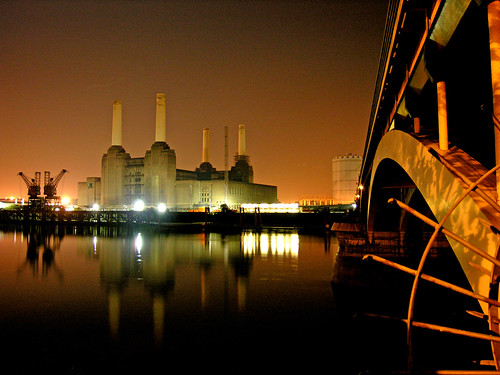

Just came across this on Flickr and thought it was great. Made all the more so because there is a nice story behind it. One of those ones that makes a little incision into the ordinary, lets you take a peek in and closes up when you're done. I love little things like that, events that don't change anything but are nonetheless thoroughly interesting.
 I read a book like that last month, which starts with a crisp London nightscape. A neurosurgeon, unable to sleep, peers out into the night to see a plane with an engine on fire gliding across the cool night's sky, with the BT tower in the foreground. The book is Saturday by Ian McEwan.
The plotlessness of it - whilst being the primary cause of dislike among many Amazon reviewers - was the gateway to an exquisite celebration of the ordinary, which manages to capture something about what it is like to live in London right now.
 I recommend this book with caution because people are clearly split between viewing this as boring, smug drivel and a work of majestic literary observation. In a geekier moment, I noticed this is supported by the soft u-shaped function that has emerged from the review graph on Amazon.
If you love the rich details of ordinary life then this is unmissable; if not, it's not.
 I read a book like that last month, which starts with a crisp London nightscape. A neurosurgeon, unable to sleep, peers out into the night to see a plane with an engine on fire gliding across the cool night's sky, with the BT tower in the foreground. The book is Saturday by Ian McEwan.
 I recommend this book with caution because people are clearly split between viewing this as boring, smug drivel and a work of majestic literary observation. In a geekier moment, I noticed this is supported by the soft u-shaped function that has emerged from the review graph on Amazon.
If you love the rich details of ordinary life then this is unmissable; if not, it's not.
Subscribe to:
Posts (Atom)