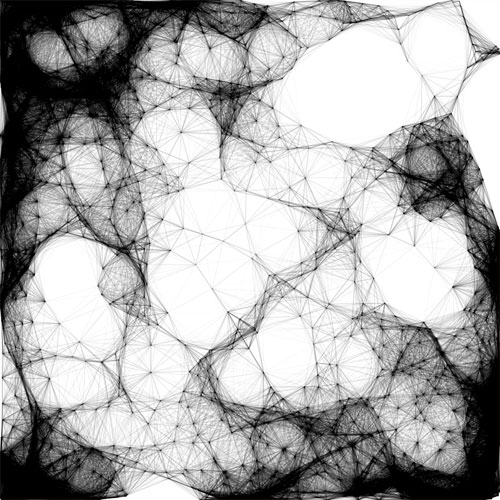
This is global air traffic in a 24 hour period as captured by satellite (and they all seem to be going to London.)
Showing posts with label data. Show all posts
Showing posts with label data. Show all posts
Thursday, 8 January 2009
like glowing ants


Thursday, 11 December 2008
what's digital and why you should apply
Something I did for the folks over at AdGrads.

It might be overstated (there’s probably always going to be the “‘bed, bog, bath’ element”) but Mr Billingsley’s comment is almost certainly right: we’re going to be digital advertisers because the world is now digital, and getting more so.
What does all this digital malarkey mean for people looking to get into the communications business and, before we look at that, what does digital mean anyway?

There are two important things there for grads trying to get into the industry. The first is, “whose roof”?
This interactivity let’s you do a lot more than you can at your typical traditional ATL agency. Or to reunite that idea with its owner:

I think that's really exciting (and Mr Tait has 9 more great reasons digital is better for those interested). In digital you’re unshackled from just doing TV, print and radio to all sorts of exciting things like sites, applications, blogs, games, branded content, widgets, podcasts, social things and experimental stuff. And a lot of this (not all) is actually useful to people; it's additive rather than interruptive.
In my experience grads tend to think of digital as something on-the-sidey and techy. Maybe it once was. Now it ain’t. Technology is so ubiquitous, so ‘ready-to-hand’, that it’s becoming invisible and when that happens it gets socially interesting. In other words, technology and culture used to be separate, increasingly they are the same (look what you're doing now.)
It’s a brilliant time to get into an industry that’s only going to grow (even in these tough times) and that’s much more about interesting interactive ideas than it is about tech.
Go on, apply!
Obviously I am biased but this would be a good place to start...
(For those wanting more, I suggest you have a play in here, read this, canoe back up this and maybe watch this. That should be enough to be getting on with.)
Monday, 10 November 2008
a good, good guide

GoodGuide is great. It helps you find healthy, safe and green products. And - most importantly - it's now available on the iPhone. The fact that it's on the iPhone isn't the important bit. It's that it can be used at the point of purchase, which I'd imagine impinges much more on buying decisions than the memory of the site from home or work.
Friday, 7 November 2008
getting creepy
 New technologies can look like magic. That's Douglas Adams speaking.
But magic comes in two shades: black and white (which if the last posts are anything to go by seems to be a minor obsession at the moment).
The black stuff indicates some dark intention; the white stuff a benevolent effect.
New tech goes the same way. Phorm looks black. Genius looks white. But, in essence, they both do the same thing: use our data to sell more effectively.
And there's going to be a load more black technologies as the web breaks out and evolves into an Internet of Things.
Throw into the mix that data capture will get a whole lot smarter not only because of new ways of getting it (through GPS, RFID, accelerometers and the like [SPIME devices]) but because our increasing desire for personalisation means absolute transparency (that's Kelly), and you have some really quite creepy tech around the corner.
Stuff that knows about YOU. Where YOU are. What YOU like. Maybe even why YOU like it - and tense changes of all those. It's gonna get freaky.
The challenge is to tweak and present these technologies from having a perceived dark purpose (I don't really think Phorm does) to being understood as benevolent. We need to fuzz them up.



Thursday, 16 October 2008
Wednesday, 20 August 2008
smarter reviews
Once mobile internet gets properly off the ground, lots of shopping in the real world will change. It will change because prices and reviews - things normally all the way back at home - will suddenly be at your fingertips in stores. The buying decision is going to get another brain contributing.
But reviews have their problems.
Say I am swotting up on a new book I have heard is rather tasty or investigating a new camera so I don't have to mashup (read, lazily appropriate) others' photos on Flickr. I read a load of book reviews on various sites. For the camera, I come up against some sites wanting my money for their opinions, others with more reviews than I can possibly read and perhaps a couple of blog posts from some real keenos.

Here's my beef with all of this.
 'Old' media stuff is dense and long but trustworthy and rich. It's also one person's view normally.
Customer reviews are helpful because they are likely to tell it like it is; they have no reason not to. Except some people can't tell it like it is even if they want to, making a chunk of customer reviews unhelpful by being unreadable, like this beauty from the BBC's gleefully entertaining Have Your Say (distilled here).


And even when people can get their thoughts in order, how do you know that what they like you are going to like? So you look at quite a few of these, try to average across opinion. That's a bit time-consuming. One quick way to do this is to look at things like the 5 stars on Amazon.


This is beautifully quick but often rather unhelpful: it doesn't tell you all that much. Added to that, fans swarm in and leave in their slaver pages of universally positive reviews. In its most extreme form this sort of review takes binary form.: thumbs up or down, cool or not, rotten or fresh. Essentially, the problem with taking lots of data and reducing them, is that it can only provide a dirty average.

Basically, the problems of reviews are that we have work hard to find them, when we do there is too much information overall and there is a poor summary of it. We need something that combines the best bits. Basically, something that is quick but rich:
So all the power of collaboration is used. All the time spent reading and cogitating is stripped away. The in-depth, expert stuff is there if you want it. And, most importantly, the reviews become a whole lot more powerful by taking into account who has left them.
This has probably been thought up somewhere before. All the same, I don't see this kind of thing anywhere. And it is the perfect sort of review system for mobile: lightweight, powerful, visual, personalised and genuinely useful.
Wednesday, 6 August 2008
crime mashup

"It is simply unacceptable at this point in history that a citizen can use Web services to track the movies he is renting, the weather around his house, and the books he's recently purchased but cannot as easily monitor data regarding the quality of his drinking water, legislation, or regulations that will directly impact his work or personal life, what contracts are currently available to bid on for his state, or what crimes have recently occurred on his street."James Willis, director of eGovernment for the Rhode Island Office, 2005
It is.
Or it was.
Now there's ZubediPI which tells me the West End is a bit dodgy when it comes to theft and violence amongst a whole host of other rather useful stuff.
Or it was.
Now there's ZubediPI which tells me the West End is a bit dodgy when it comes to theft and violence amongst a whole host of other rather useful stuff.
Monday, 7 April 2008
Gliding about Earth
I commented on Photosynth - the very cool little app swallowed by Microsoft - a while back. Viewfinder is similar except it tacks on to Google Earth, adding an elegant new dimension.
I think if it takes on the multi-shot nature of Photosynth (as opposed to single shot shown in the vid above), it will be better.
The software clearly has a slew of uses but I think simply being beautiful is one. Software becomes art.
Monday, 17 March 2008
Rethinking Expertise
 Who's better? An expert or many ordinary people?
 As scientists observe the universe and its contents other academics observe the scientists. Prof. Harry Collins is one of these scientific voyeurs who peers through the crack in the ceiling of knowledge-building and records how it is done. My girlfriend and I went to a little talk of his in the Exeter quays last week.
Having spent a long time with gravitational-wave physicists he has given man-birth to Gravity's Shadow (2004), the sort of book you could knock an ox out with, running to some 870 pages. During his experience with these experts he started thinking about the nature of expertise. This is the subject of his (and Robert Evans') most recent (pithier) offering, Rethinking Expertise (2007).
His talk was a summary of one of the book's points. In his forthright, laddish way he sketched a quick and basic history of the philosophy and sociology of science. Without technical labels, which I add back in here, he covered falsification (Popper, 1959, esp. pg. 27–48) and the problems with it (Kuhn, 1977; Lakatos, 1970, 1974; Maxwell, 1972; Meehl, 1978, 1990; Putnam, 1974) including the problem of facts (who is to know if it is the fact or the method to get to that fact that is wrong?). With this breakdown in philosophical robustness so trust in experts dwindled.
In a nod to Feyeraband’s (1975) Dadaistic 'anything goes' idea, the suggestion was that all trust was lost. In a Feyerabandian world science is no different to other things like Jade Goody's opinions or reading the future by dropping fruit on the floor and examining the patterns. Peer-reviewed science has no great difference in terms of methodological soundness to that of personal experience in this scenario. I strongly agree with Collins that a society like this is "not one you would like to live in"; hell is Feyeraband's world.
His concern is that despite the intellectual repugnance of this scenario, it is gaining some currency under the idea that "ordinary people are wiser than experts in some technical areas". For an example he cited the case of MMR and autism where a dodgy paper (Wakefield et al, 1998) and the media forged and perpetuated a scientific controversy where none existed. In his words, the link between these two on the available evidence is "zero" (he is right). To this one woman in the audience shouted "That's not true"; she knew someone whose child had both MMR vaccine and autism.
The whole force of Collins' point was evident in this little bit of heckling. It is stunningly simple (as basic as common-sense gets some might think), but no less important for that: All else being equal we should listen to "those who know what they are talking about". In this case, the evidence said there was no link, the co-occurrence of the MMR vaccine and autism in this child she knew was irrelevant. If she had retorted, "What, it is just coincidence that the child has autism and had the vaccine?", the answer can only be "Yes, precisely that: a coincidence."
I was reminded of an episode of House where House lambasts a junior for choosing the a treatment option on personal factors despite the fact it saved the patient's life. This is because statistically more people would be killed using that particular treatment over time than the evidence-based option.
Had the junior doctor used the evidence-based (correct) option the patient would have died. Nevertheless, it would have been the right option. Experts must be allowed to be experts, even if they are wrong occasionally because the cost of having no experts is far too great. In the case of MMR, lives are at risk.
Collins and Evans call expertise "the pressing intellectual problem of the age". It's certainly a biggie. And as the number of opinions on technical issues froth up with more user-generated content online I think their point, although simple, is very important. No one is cleverer than everyone. But that does not mean everyone is cleverer than experts.
9,581,206 abortions
 The World Clock. Real-time data (well, statistically predicted data) on all sorts of things, abortions, marriages, divorces, oil pumped, bikes produced and so on. Also check out The Food Clock - that's a lot of chickens.
Saturday, 1 March 2008
Happy Maps
 In 2006 Adrian White, a social psychologist at the University of Leicester, compiled this, a world happiness map. You can get the full version here. The redder, the happier.
In a similar spirit, this little gem maps out 'feelings' from around the user-generated web and mashes it up with Google Maps:
 It's not particularly powerful at the moment but is nevertheless a really interesting idea. I love the possibility of analysing subjective content over geographical location like this. If time were to be added in as well it would become even more interesting because you could potentially track the emotional wake of a certain news story after it breaks. Nice simple and playful interface too.
Statistics and Art
Intricate, massive, overwhelming and visually obsessed with quantity, Chris Jordan's work portrays "contemporary American culture through the austere lens of statistics" in pursuit of a "different effect than the raw numbers alone" (source). Squeezing down Jordan's work to fit here will doubtlessly remove some of its impressiveness but there are successive zooms (clicking on the last one in a series will reveal actual size). Shoot over to Jordan's site to see more but here are a few choice bits from Running the Numbers.
Nearly half a million mobiles phones - the number retired in the US every day


1.14 million paper bags - the amount used in one hour in the US


11,000 jet trails - the number of commercial flights every 8 hours in the US


Wednesday, 20 February 2008
Data made lovely
 Tables, charts, numbers and all that prompt me to embark on completely unrelated journeys of imagination into other more interesting things. Data is boring. However, the Trendalyzer - a vast pot of data - is not. It is magnificent.
Set up by the Gapminder Foundation and acquired by Google last year (there was something Google-like about the simplicity, look and spirit of the software even before they got involved), this software “unveils the beauty of statistics by converting boring numbers into enjoyable interactive animations” (source).
I love it for its central idea (pooling lots of data and making it beautiful) and the execution (a simple, powerful and playful interface).
Thursday, 7 February 2008
When do people use sunbeds?
 I love Google Trends for things like this graph, where the numbers carve out a picture of people's otherwise unknown behaviour, like hitting the sunbeds in the first few months of the year. This makes perfect sense but would have otherwise remained a secret had I not decided, on a whim, to search for "tanning bed" (not that I was looking for one or anything, even though now would be the time to search for one!)
I suppose this sort of information could be factored into AdSense to make things more seasonally relevant.
Subscribe to:
Posts (Atom)