This is global air traffic in a 24 hour period as captured by satellite (and they all seem to be going to London.)
Showing posts with label design. Show all posts
Showing posts with label design. Show all posts
Thursday, 8 January 2009
like glowing ants


Thursday, 11 December 2008
what's digital and why you should apply
Something I did for the folks over at AdGrads.

It might be overstated (there’s probably always going to be the “‘bed, bog, bath’ element”) but Mr Billingsley’s comment is almost certainly right: we’re going to be digital advertisers because the world is now digital, and getting more so.
What does all this digital malarkey mean for people looking to get into the communications business and, before we look at that, what does digital mean anyway?

There are two important things there for grads trying to get into the industry. The first is, “whose roof”?
This interactivity let’s you do a lot more than you can at your typical traditional ATL agency. Or to reunite that idea with its owner:

I think that's really exciting (and Mr Tait has 9 more great reasons digital is better for those interested). In digital you’re unshackled from just doing TV, print and radio to all sorts of exciting things like sites, applications, blogs, games, branded content, widgets, podcasts, social things and experimental stuff. And a lot of this (not all) is actually useful to people; it's additive rather than interruptive.
In my experience grads tend to think of digital as something on-the-sidey and techy. Maybe it once was. Now it ain’t. Technology is so ubiquitous, so ‘ready-to-hand’, that it’s becoming invisible and when that happens it gets socially interesting. In other words, technology and culture used to be separate, increasingly they are the same (look what you're doing now.)
It’s a brilliant time to get into an industry that’s only going to grow (even in these tough times) and that’s much more about interesting interactive ideas than it is about tech.
Go on, apply!
Obviously I am biased but this would be a good place to start...
(For those wanting more, I suggest you have a play in here, read this, canoe back up this and maybe watch this. That should be enough to be getting on with.)
Saturday, 8 November 2008
50,000

Hit 50,000 hits today on Flickr for digitalbites and not much else happened so I thought it was worth a post. Good times.
Thursday, 16 October 2008
Friday, 10 October 2008
believing real
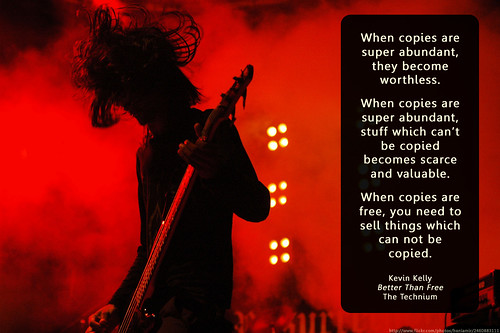 One of the first things I think when I see something online, and one of the first things that gets banded about on comment lists, is whether or not something is genuine, rather than set-up, faked, CGed etc. If it's genuine, interest soars; if not, interest dwindles (usually).
With this in mind here's a variation on Kelly's idea:
When content is faked, it becomes emotionally worthless.
When content is faked, stuff which isn't fake becomes scarce and valuable.
When content is faked, you need to show people things which are not faked.
I'd add on that some stuff that's great is faked (e.g. Cadbury's Gorilla; clearly that's not a real ape drumming away). It's when stuff is faked and needn't have been (or could have been done for real) that the emotional bottom drops out.
Saturday, 5 April 2008
Being human and the future
 Visions of the future of technology are always desperately void of any human element. That's one reason why I like Diesel's knowing 2007 winter ads: they admit that humans are at the centre of all this technology.
This isn't a new idea. People building things got interested in the users at the centre of their systems mostly to safeguard against that human propensity to mess up. For this they needed people who understood or could find out how humans tick: psychologists.
Although there is a history of psychologists and engineers occasionally getting into bed with each other before WW2, the relationship became serious after its start because as early computer scientist Grace Hopper said, "after that, we had systems". The systems they were dealing with were primarily airplanes and the ecosystem that went with that (e.g. radar monitoring). User-centred design became a necessity: lives were at stake.
Since then the relationship between psychologists and engineers has properly ossified. The marriage is called Human Factors (HF), although Ergonomics, Cognitive Engineering and Human Computer Interaction are other terms banded about.
No longer is it about simply making complex systems more tolerant of that human habit of making mistakes. Instead, it aims to create the best fit between the human mind and all the things it has built. More than ever, this is vital as technology becomes ubiquitous.
This includes things like
This last bit, about "subjective, affective" stuff is getting more and more important. In fact, in a big sit down last month of clever people in this area, the question was asked "what will Human-Computer Interaction (HCI) be like in the year 2020?"
As I said at the outset, visions of the future of technology are always desperately void of any human element. Not in the answer to HCI2020: Being Human: Human-Computer Interaction in the Year 2020 reduces the answers down into a digestible form (in widescreen, which joyously fills my 22 inches of screen real estate) where the central focus is on "the embodiment of human values at the heart of computing."
Here is a summary:
Part 1 - timeline of major changes over last 20 years and beyond in computing, living and society
Changing Computers
1960s - Mainframe: one machine, many users
1980s - Personal computer: one computer, one user
2000s - Mobility era: many computers, one user
2020s - Ubiquity era: thousands of computers, one user
(I think this may have missed out the possibility of returning full circle, to a mainframe which supports many users. The mainframe or cloud will be the Internet.)
Interfaces
Replacing WIMP with more natural gesture, pen, multi-touch, speech, eye and mind control
Displays
All materials could be digitised as screens become flexible and part of the fabric of life (e.g. Animated textiles)
Hybrid digital-biological displays
Mobile
A very large part of all computing will be in the palm of our hands
Act as extension to our hands, shifting from communication devices to interaction devices (e.g. Apple's plans for the iPhone)
Robotics
Robots become semantic learners and can make inferences about the world (e.g. attractiveness or if now is a good time to be interrupted)
Life caching
When space is no longer an issue more and more of life can be recorded (e.g. MyLifeBits and see this Sci.Am. article)
More home brews
Just as content is no longer created centrally, application creation is decentralised so amateurs can freely mash-up more relevant and personalised applications (e.g. Feel Map or BabyNameMap)
Always on
Simply, that communication channels will be permanently open, everywhere and all the time.
Changing Lives
Learning differently
Learning, using and testing of material will change as new technologies are deployed in the classroom (e.g. podcasts, digital classrooms, Ubi-Learning etc). Home, school and play will be blurred.
Living differently in the family
More digital connections between family. This is not just communication, but also sharing of media and even events (e.g. grandma being 'at' the party whilst being 100 miles away). One issue may be surveillance by parents over children using technology developed for peace of mind.
New ways of growing older
Medical sensors are decentralised to allow better monitoring of health. 'Silver' social networks will be useful in health respects as well as assuaging social isolation. Increases in the amount of games for older populations.
Changing Societies
Computing and government get closer
Government will change the way they work because of computers; public will change the way government operates because of computers.
Part 2 - transformation of interaction
Human Values in the Face of Change
The changes in Part 1 are summarised:
- The end of interface stability - they'll be everywhere and in everything
- The growth of techno-dependency - we wont be able to cope without it
- The growth of hyper-connectivity - being connected to family, friends and society
- The end of the ephemeral - desire to be digital magpies, collecting as much as we can
- The growth of creative engagement - "the proliferation and appropriation of new kinds of digital tools by people from all walks of life
The end of interface stability
- the issues raised by "the shifting boundary between computers and humans", like personal space, defining features of an individual if technology is part of us,
-the issues raised by "the shifting boundary between computers and the everyday world", like opting in and out of invisible interaction
- the issues raised by "living in a computational ecosystem", like the emergent effects of multiple systems working together, trusting them and problems of accountability.
The growth of techno-dependency
- what happens when systems fail and when there is a digital outage (e.g. YouTube in February)?
- what kind of basic skills will atrophy (c.f. calculator and mental arithmetic)
The growth of hyper-connectivity
- with everyone connected to everyone there are issues of etiquette. "For example, students feel it is perfectly acceptable to email their professors with excuses for late assignments using informal text slang. Professors, however, may feel differently."
- The need for independence and quiet reflection amid the constantly 'on' state.
- Work and home blurring, and the effect this has on life.
- The difference between digital crowd and mob, and whether the former reflects opinion accurately or just extreme and offensive views
The end of the ephemeral
- How digital footprints and privacy work
- Authentication, security and personal identification to protect the digital footprint
- Human memory is selective and constructive, digital memory is stable; how do these play out? Should we be able to delete digital memories (like completely removing a Facebook account, which is notoriously difficult)
- How will identity be shaped if such (unwanted) digital memories persist?
- People's awareness of when data are collected about them
- The possibility of geo-aware systems being used for surveillance by friends, family, society or state
The growth of creative engagement
- Is more automation a good thing?
- "How can the interaction and design of new computational tools be structured so they do not impede creative engagement?"
- "What new toolkits can be developed to enable scientists, and others to create tools for themselves to solve their own problems and explore new avenues?"
- How will new tools affect expertise?
Part 2, 3 & 4 - a desirable HCI agenda
I wont go into this in detail. See the paper for more.
Lots to be thinking about.
Pixels and Colour
 Having been nowhere before computers, pixels are now everywhere.
They rarely get noticed because their sum is greater. Christian Zuzunaga - apart from having a great surname - has created a really strong visual language of lushly coloured pixels across his work.
One example that is doing the digital rounds, after being in Design Week, is the sofa above; I wouldn't want this in my house but I'd love it on my wall (as I pic, I'd add quickly).
His other work is exciting too. You'll find them on his website, which I would also class as a piece of art in itself, although I am a sucker for bright colours on black.
Saturday, 22 March 2008
London Transport Aesthetic
 Transport for London gave me one of these the other day. Inside was a bike light. It has no batteries but in Trevor Baylis style is wind-up. I think it was part of a campaign of caring for cyclists, because I also read they were giving out Fresnel lenses, which let truckers see cyclists more easily and there has been quite a bit of TV advertising, including a moonwalking gorilla.
Anyway, I like the box. Although on this occasion it's minimalism is probably borne out of frugality, it made me wonder about the the whole aesthetic of Transport for London, something I have long loved.
The original red, white and blue roundel and font (Johnston Sans) by Edward Johnston has remained largely unchanged since he designed it in 1918. It's arguably the logo most synonymous with London (in fact most of the main images of London are to do with the transport system: the street names, the taxi, the buses...) and has spawned all sorts of lovely sister logos as the network expanded:

(from Wikipedia)
Then there's the electrical circuit style map designed by Harry Beck in 1933 (inspired by George Dow). This is a masterful piece of work which despite jettisoning geographical truth (probably as a result) enables the most effortless understanding of its contents.
The design coherence of the London transport system was directed under the keen and meticulous eye of Frank Pick. He is rumoured to have travelled the entire network, often at night, to ensure high standards (reminds me of another design fanatic, Steve Jobs, who is reputed to have had fine Italian marble for a New York first Apple store to be sent to California first so he could check the veining).
Pick visited Europe and returned under the influence of "European modernism" which prompted the installation of then achingly modern architecture, including "sweeping curves with geometric detailing, exposed brickwork and concrete" (Design Museum). Even in new designs this exposed, progressive spirit is still part of the visual language, like the recent and industrially beautiful Westminster Tube Station.

Friday, 21 March 2008
Photoslop
 Either the model met with a nasty accident or someone forgot to digitally reattach her index finger
 Warping tiles - she's been Liquified. Her little line of gab about confidence takes on an errie meaning after the glitch too.
 The freaky severed hand
Friday, 7 March 2008
Viscosity: modern art generator
 Click to enlarge
Saturday, 1 March 2008
Statistics and Art
Intricate, massive, overwhelming and visually obsessed with quantity, Chris Jordan's work portrays "contemporary American culture through the austere lens of statistics" in pursuit of a "different effect than the raw numbers alone" (source). Squeezing down Jordan's work to fit here will doubtlessly remove some of its impressiveness but there are successive zooms (clicking on the last one in a series will reveal actual size). Shoot over to Jordan's site to see more but here are a few choice bits from Running the Numbers.
Nearly half a million mobiles phones - the number retired in the US every day


1.14 million paper bags - the amount used in one hour in the US


11,000 jet trails - the number of commercial flights every 8 hours in the US


Monday, 18 February 2008
Capturing Lightning
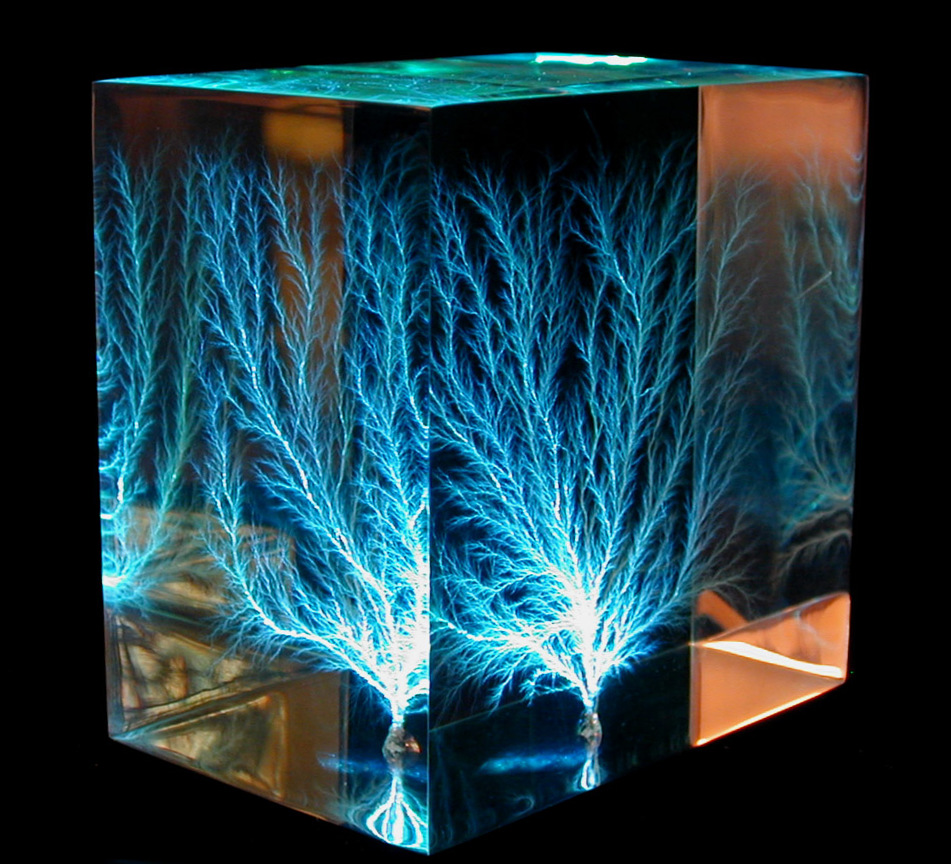
These beautiful dendritic patterns are made by injecting a piece of insulating material with a high speed beam of electrons. The fractals are thought to extend right down to the molecular level. Here's a vid of a Litchenberg figure being created and the subsequent light fizz:
Thursday, 7 February 2008
Obama Style
 Obama's web background image
Was just flitting about the US Presidential candidates' websites and noticed that a lot of effort has gone into Obama's site. Much more than Clinton's or McCain's. Gives a nice flavour for where the different candidates are focussing their energies. Obama's with its clean design, open spaces, lens flare and misty ocean spray effect speaks to a more design-savvy younger type. The others are just busier and clunkier, like an e-commerce site from a few years back. In fact, just found the New York Times have gone so/too far as to voice this difference with that increasingly popular personality assay, your computer orientation. Obama as Mac, Hillary as PC.
Magnetic Curtains
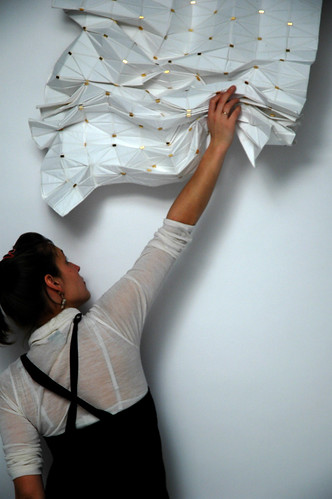
What a great idea. Lots of little magnets allow you to manipulate the curtain. More here.
Monday, 28 January 2008
BBC Beta
 The BBC is one of the most visited sites on the net and yet it looks old. Although I do like things to look digitally pretty (and site could do with a face lift), this is more than skin deep: it looks functionally old. I am talking about the HTML, the static design, the annoying Windows Media Player or Real Player videos, the funny little buttons and so on.
Anyway, I just headed over to the main BBC page (I normally only use the News page) and to my joy found this, a great-looking new(ish) beta page that launched last month. Clean, simple, personalised, localised and searchable. I hope something similar happens to the BBC News page soon.

Sunday, 27 January 2008
Witty Distortionist

 Modern conceptual artists usually annoy me for dressing up their own mediocre talent with a thick layer of impentrable nonsense.
 Sebastian Errazuriz, however, is neither mediocre nor content to smother his work in babble. Instead, his work is that great leveller - fun. I think it buzzes with a charming wit and a simplicity. The slightly creepy duck-light and the lego man helmet are just two examples. His website has more (but appears to be under development at the moment)
He doesnt just disort the ordinary and everyday though. In 2005, he created an illuminated crane-cum-nightlight to scare-off demons in Santiago. The year after he planted a magnolia tree smack-bang in the middle of of the same city's National Stadium, in the same place that Pinochet tortured his political foes three decades ago.

A football match was even played around it!

Thursday, 24 January 2008


Tuesday, 15 January 2008
Nice desk
 Jonathan Ive is probably the most influential designer in consumer eletronics, defining the aesthetic which everyone else in technology imitates. Now it's extending to furniture with the Milk Desk, a beautifully minimalistic design with a fantastic website to go with. All products should have website that let you explore the item like this.
Subscribe to:
Posts (Atom)