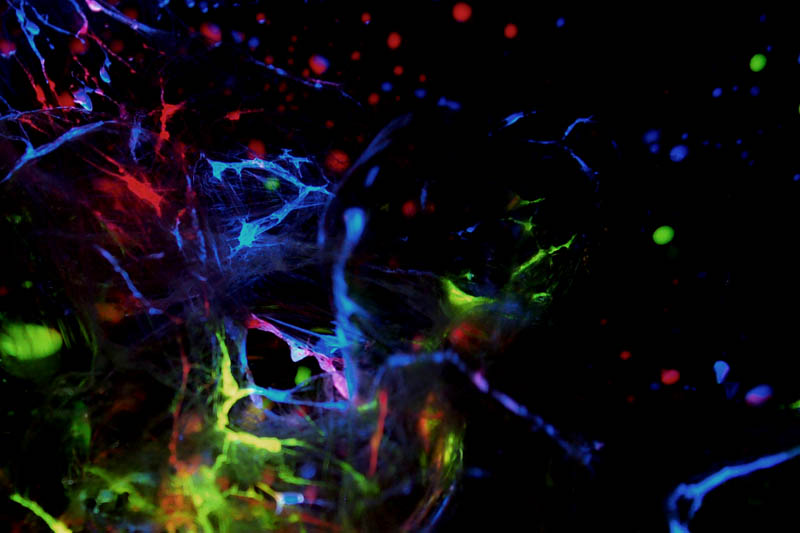
This stunning image comes from the inside of a transgenic mouse's head (hippocampus I think). Each neuron is expressed as a different colour. More here.Sunday, 27 July 2008
brainbow
This stunning image comes from the inside of a transgenic mouse's head (hippocampus I think). Each neuron is expressed as a different colour. More here.
Posted by
Will
at
23:16
1 comments
Labels: art, neuroscience
loving novelty, craving depth
“I feel that much of my life is ebbing away in the tide of minute-by-minute distraction . . . I’m not certain what the effect on the world will be. But psychologists do say that intense close engagement with things does provide the most human satisfaction.” The psychologists are right. McKibben describes himself as “loving novelty” and yet “craving depth”, the contemporary predicament in a nutshell.
What a great way of nailing down that very modern way of operating, 'loving novelty' but 'craving depth'.
(Or in T.S. Eliot's better words the new arrives “Filled with fancies and empty of meaning / Tumid apathy with no concentration”.)
This is almost certainly due to the dopaminergic system in the brain. Newness and the promise of reward fire up areas of the brain rich in dopamine (Knutson, Westdorp, Kaiser, & Hommer, 2000).
When expected reward fails to arrive dopamine levels plunge - and the pleasure drains away - but the brain wants its hit so carries on seeking. It carries on trying to find the new. (Read Panksepp's great book on this sort of thing for more)
Digital experiences are very much like this. Newness. Excitement. Reality. Disappointment. Seeking newness again. 30 minutes on YouTube should be enough to elicit this gamut of emotions in anyone with an intact dopaminergic system. And it leaves you feeling grubby.
We can't help but be magpies to novelty. It is hardwired. We can, however, try to build digital experiences that supply real depth that don't feel like cheap distractions.
This is one reason why I think gaming should be bigger in advertising. And others do too.
More depth please.
Posted by
Will
at
16:19
0
comments
Labels: internet, neuroscience, psychology
Wednesday, 23 April 2008
Binaural beats
There are several companies that claim such binaural beats improve mental functioning and memory by reverse engineering brain frequencies via the audio. Naturally, the combined simplicity and complexity of this idea caught certain people's imagination, to the point that a musician-physicist mate of mine wondered it there was anything to it last year during exams.
There isn't. In this recent study binaural beats had zero effect on brain frequencies and, what is more, participants in the experimental group were more forgetful and more depressed than controls.
Cognitive neuroscience, one. New Age monkeys, nil.
(If you want to see more on music and mind, see this post.)
Posted by
Will
at
12:23
1 comments
Labels: music, neuroscience, psychology
Saturday, 29 March 2008
Litchenberg, Memory & Brands
The electrons are the start of a thought. This can be engendered by by external factors, like sound and light bouncing off things and hitting our receiving dishes (retinas or eardrums) or by internal factors.
Next a branch of activity spreads out rapidly. Neurons get excited and excite their connected neighbours. A pattern is made. And the pattern is memory.
Heraclitus wasn't talking about the brain when he said 'the cosmos speaks in patterns' but his epigram is apt for the way in which it works (this is von Oech's more accessible translation; for those who care, the literal translation, according to Robinson is 'all things happen according to the logos').
Such patterns of activation build up from repeated activation. As the father of this idea, Hebb, put it, "any two cells or systems of cells that are repeatedly active at the same time will tend to become 'associated', so that activity in one facilitates activity in the other." (Hebb, 1949, p.70). Or in other words, neurons that fire together, wire together.
That makes the prediction that if you activate a certain thought, access to a related thought will be zippier because it's already partly activated.
And this is true. Flash up the word 'bird' and 'robin' will be recognised more quickly than an unrelated word (e.g. 'arm', see Neely, 1977 for more. Plus if you care how the 'recognised more quickly' bit is measured have a look at what a lexical decision task is.)
This extends to thoughts about groups of people, also known as stereotypes (e.g. Germans, bankers, the elderly). Information about groups is built up over time (probably in the neocortical system [McCelland et al, 1995] and deployed to lubricate the whole process of person perception.
Where it gets really interesting is how these activated information bundles affect the rest of what the brain is up to. That is, how perception affects action. Lovely examples abound; here are six:
- People primed with politeness stereotypes are less likely to interrupt an ongoing conversation.
- The African American stereotype makes people more aggressive in response to slight provocation.
- The elderly stereotypes makes people walk more slowly and more forgetful.
- The professor and football hooligan stereotypes once activated affect the marks people get on general knowledge tests.
- The neuropsychological patient stereotype makes people score poorly on an executive function test.
- Primed with religious stereotypes people behave more pro-socially
Paul Feldwick has said “A brand is simply a collection of perceptions in the mind of the consumer.” John Grant has even more pithily dubbed a brand the "sum of the ideas associated with it".
The ideas associated with a brand are built up over time by interaction with it and messages about it; firing together and wiring together the brand and it's associated ideas.
The logo of a brand, as its paragon symbol, should therefore act as a Litchenberg electron beam, causing an immediate pattern of activation to spread, bringing alive the ideas and concepts most closely associated with the brand.
Added to that, if the link between perception and action in stereotyping is anything to go on, presentation of the logo should affect behaviour in measurable ways.
It does. According to this great paper, published in next month's Journal of Consumer Research. After being presented with either the Apple logo or IBM logo (so fast as to be below conscious awareness), people behaved in ways consistent with the brand's associated ideas.
People who has seen the Apple logo were more creative than those exposed to the IBM one, as measured in a task thinking up different uses of a brick and as determined by independent judges.This makes the Apple slogan self-fulfilling: 'Think different' really does make you think different.
Posted by
Will
at
01:05
0
comments
Labels: communications, neuroscience, psychology
Friday, 21 March 2008
Cognocomputer Science
I have a dream for the Web [in which computers] become capable of analyzing all the data on the Web – the content, links, and transactions between people and computers. A ‘Semantic Web’, which should make this possible, has yet to emerge, but when it does, the day-to-day mechanisms of trade, bureaucracy and our daily lives will be handled by machines talking to machines. The ‘intelligent agents’ people have touted for ages will finally materialize.
I think these two juggernauts will collide soon because if Tim Berners-Lee's vision of Semantic Web (or Web 3.0 as some dub it) is to come true the next generation of computer scientists are going to need to be trained in cognitive (neuro)science as well.
This is because if the Internet is to assuage the pressure on, and extend the power of, our mental faculties by replacing, and enhancing, their functions, it makes sense that the functions be known.
And right now the best people to ask about how the brain and mind operates are the cognitive neuroscientists. They have their computer already built and are trying to work out how it operates. Computer scientists, the architects of the future Internet, are trying to build something that does something like the mind. They should talk to each other more.
More than this though it will pay to be expert in both. The mind will give insights to better computer systems as it is backwards engineered. Cognocomputer scientists will be needed in a Semantic Web future.
Posted by
Will
at
13:39
0
comments
Labels: digital, internet, neuroscience, psychology
Wednesday, 19 March 2008
Speak without speaking
Technology has been developed to turn nerve signals on their way to the vocal cords into computer-generated voice. Impressive.
Posted by
Will
at
20:19
0
comments
Labels: neuroscience, psychology, technology
Wednesday, 20 February 2008
Work alone
This paper shows that it may be best to work with others out of sight, at least for manual jobs. This is because you involuntarily model other people's behaviour (probably something to do with mirror neurons) and this affects your own performance negatively. The study is concerned with manual tasks so it would be interesting to see what happens at a higher cognitive level.
Posted by
Will
at
23:34
0
comments
Labels: neuroscience, psychology
Wednesday, 13 February 2008
3D from 2D
The clever people at Stanford are developing a way of getting 3D out of 2D. This is interesting in its own right but also because it is precisely the same job that the visual system performs on the retinal image.The Stanford team seem to have come up with something much better than any other algorithm out there. I wonder whether similar algorithms are deployed in our visual system?
You can upload your own image and have their software work its extra-dimension-adding magic.
Posted by
Will
at
22:20
0
comments
Labels: neuroscience, psychology
Sunday, 6 January 2008
Digital minds
1. Interaction means stronger memories
e.g. LG - Life's Good when... - people completed the sentence and made YouTube videos from that
e.g. Orange Paper Film Festival
e.g. Levi's Mobile Audio Mixer (MAX)
2. Social capital
e.g. Nike+
e.g. Nikon and Flickr
e.g. Times Health Club
3. Virtual living
e.g. Lynx/Axe - Improve your Game or Get in There
e.g. Nike+ podcasts
I'll update this as I have more thoughts but there are three reasons why digital is the best.
Posted by
Will
at
22:56
0
comments
Labels: digital, neuroscience, psychology