This is global air traffic in a 24 hour period as captured by satellite (and they all seem to be going to London.)
Showing posts with label technology. Show all posts
Showing posts with label technology. Show all posts
Thursday, 8 January 2009
like glowing ants


Monday, 10 November 2008
a good, good guide

GoodGuide is great. It helps you find healthy, safe and green products. And - most importantly - it's now available on the iPhone. The fact that it's on the iPhone isn't the important bit. It's that it can be used at the point of purchase, which I'd imagine impinges much more on buying decisions than the memory of the site from home or work.
Friday, 7 November 2008
getting creepy
 New technologies can look like magic. That's Douglas Adams speaking.
But magic comes in two shades: black and white (which if the last posts are anything to go by seems to be a minor obsession at the moment).
The black stuff indicates some dark intention; the white stuff a benevolent effect.
New tech goes the same way. Phorm looks black. Genius looks white. But, in essence, they both do the same thing: use our data to sell more effectively.
And there's going to be a load more black technologies as the web breaks out and evolves into an Internet of Things.
Throw into the mix that data capture will get a whole lot smarter not only because of new ways of getting it (through GPS, RFID, accelerometers and the like [SPIME devices]) but because our increasing desire for personalisation means absolute transparency (that's Kelly), and you have some really quite creepy tech around the corner.
Stuff that knows about YOU. Where YOU are. What YOU like. Maybe even why YOU like it - and tense changes of all those. It's gonna get freaky.
The challenge is to tweak and present these technologies from having a perceived dark purpose (I don't really think Phorm does) to being understood as benevolent. We need to fuzz them up.
Friday, 10 October 2008
believing real
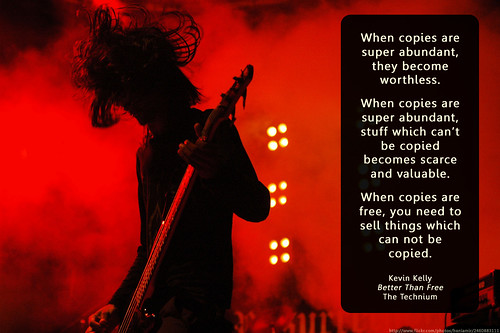 One of the first things I think when I see something online, and one of the first things that gets banded about on comment lists, is whether or not something is genuine, rather than set-up, faked, CGed etc. If it's genuine, interest soars; if not, interest dwindles (usually).
With this in mind here's a variation on Kelly's idea:
When content is faked, it becomes emotionally worthless.
When content is faked, stuff which isn't fake becomes scarce and valuable.
When content is faked, you need to show people things which are not faked.
I'd add on that some stuff that's great is faked (e.g. Cadbury's Gorilla; clearly that's not a real ape drumming away). It's when stuff is faked and needn't have been (or could have been done for real) that the emotional bottom drops out.
Wednesday, 17 September 2008
buy-product

The short version of this post is:
Selling on social networks can only be a by-product (hence the title 'buy-product'. Geddit? Oh dear, I am sorry) of the activities occurring on those sites, never a primary activity.
The long version is this:
In market economies there are two big problems with information: it's (occasionally)* inadequate and it's superabundant.
Why is information inadequate? Because you only know how good something is after you have bought it, so how do you choose between alternatives?
Why is there too much information? Because everyone wants a slice of the pie making those alternatives and the market gets flooded with products or services and thus information about those. (How do you choose between one-hundred types of olive oil? You don't for the most part. It's crippling. You move on.)
Add in the fact that this competition strips profits to the bone and you have three pretty good reasons for why brands should (and do so successfully) exist: to remove doubt about quality and ease the process of otherwise crippling choice for people who want to buy stuff, and pump scarcity (and thus juicer profits) back into things for people who want to sell stuff.
However, in the spirit of several recent books, solutions to the problem of inadequate and superabundant information can also be solved by [dramatic pause] other people. And more effectively because trust in other individuals is second only to personal experience itself.
Other people can literally 'test' products and services for you before you buy them yourself (by buying them themselves) and help narrow down the choice for you (by having had to narrow down the choice for themselves.)
People have probably been doing this since information in markets got to be doubly-dodgy. Nothing new in the behaviour. It even has a 5-syllable name: recommendation.
However, what might be new is that hitherto implicit recommendation could be made explicit and more useful with a dash of digital. Making stuff explicit seems to me to be the formula of the successful things in recent web (Facebook makes social relationships explicit, blogs records thoughts that would otherwise only exist in conversation or the mind, LastFM records the wake of your audio, StumbleUpon ossifies your digital discoveries etc.)
How would this work? Social networks would allow self-expression at a much finer level of detail allowing libraries of music, films, books, clothes**, etc that people have honed (not harvested automatically, which was the problem with Beacon). (Eventually content could be brought within such networks, so they operates as hubs of digital content.)
This in itself could present recommendations based on content (like iTunes Genuis) but also those made by other people in your group of friends. These recommendations wouldn't really be recommendations but comments/ratings tagged onto things by people. 'This track is awesome' could be really useful from someone who you (or your computer) knows you share taste with.
Picture time:


One of the nice things about such a system is that it's lovely for people, providing stuff they might be interested in. However, there is also an opportunity here for social networks.
Another picture first:

And now I am going to quote myself, which is probably a bit wanky but here we go from a few posts back:
* I put 'occasionally' in brackets because as soon as information is partially inadequate it gets perceived at wholly inadequate.
** Self-generated recommendations will probably work for clothes; other-generated recommendations won't work as well. People like their clothes to be different (but not too different) from their peers.
Selling on social networks can only be a by-product (hence the title 'buy-product'. Geddit? Oh dear, I am sorry) of the activities occurring on those sites, never a primary activity.
The long version is this:
In market economies there are two big problems with information: it's (occasionally)* inadequate and it's superabundant.
Why is information inadequate? Because you only know how good something is after you have bought it, so how do you choose between alternatives?
Why is there too much information? Because everyone wants a slice of the pie making those alternatives and the market gets flooded with products or services and thus information about those. (How do you choose between one-hundred types of olive oil? You don't for the most part. It's crippling. You move on.)
Add in the fact that this competition strips profits to the bone and you have three pretty good reasons for why brands should (and do so successfully) exist: to remove doubt about quality and ease the process of otherwise crippling choice for people who want to buy stuff, and pump scarcity (and thus juicer profits) back into things for people who want to sell stuff.
However, in the spirit of several recent books, solutions to the problem of inadequate and superabundant information can also be solved by [dramatic pause] other people. And more effectively because trust in other individuals is second only to personal experience itself.
Other people can literally 'test' products and services for you before you buy them yourself (by buying them themselves) and help narrow down the choice for you (by having had to narrow down the choice for themselves.)
People have probably been doing this since information in markets got to be doubly-dodgy. Nothing new in the behaviour. It even has a 5-syllable name: recommendation.
However, what might be new is that hitherto implicit recommendation could be made explicit and more useful with a dash of digital. Making stuff explicit seems to me to be the formula of the successful things in recent web (Facebook makes social relationships explicit, blogs records thoughts that would otherwise only exist in conversation or the mind, LastFM records the wake of your audio, StumbleUpon ossifies your digital discoveries etc.)
How would this work? Social networks would allow self-expression at a much finer level of detail allowing libraries of music, films, books, clothes**, etc that people have honed (not harvested automatically, which was the problem with Beacon). (Eventually content could be brought within such networks, so they operates as hubs of digital content.)
This in itself could present recommendations based on content (like iTunes Genuis) but also those made by other people in your group of friends. These recommendations wouldn't really be recommendations but comments/ratings tagged onto things by people. 'This track is awesome' could be really useful from someone who you (or your computer) knows you share taste with.
Picture time:
One of the nice things about such a system is that it's lovely for people, providing stuff they might be interested in. However, there is also an opportunity here for social networks.
Another picture first:
And now I am going to quote myself, which is probably a bit wanky but here we go from a few posts back:
"When people use Google, they're looking for information. When they use Amazon, they're buying (or researching). The ads are working here because people want information, it's welcome if its good enough.The point is that in the social space clumsy selling (ads) is not welcome: the communication gets tarnished by it, so it's ignored and disliked. But, that is not to say that selling as a by-product is out of the question. Links to things - and charging the producers a little for those links - suits everyone.
When they use Facebook (or any other social media) they're expressing, communicating and interacting with others (being social not being cognitive). The same ads aren't working here for the same reason you'd be a bit miffed if someone marched into the pub, dropped a sausage in your pint, yaddered on about how delicious they are and, by the way, how they are half-price at the moment."
* I put 'occasionally' in brackets because as soon as information is partially inadequate it gets perceived at wholly inadequate.
** Self-generated recommendations will probably work for clothes; other-generated recommendations won't work as well. People like their clothes to be different (but not too different) from their peers.
Thursday, 11 September 2008
negroponte's predictions
Prediction is usually a dubious business: things are way too uncertain and we just don't know what we're going to know in the future ('unknown unknowns' in NNT's terms). That's why Being Digital by Nicholas Negroponte, which came out in 1995, is all the more freakish in its prescience.
Here's a smattering of things I liked, with the occasional few words after each from the perspective of now.

The tidiest way I have seen the 'receive -> interact' paradigm change articulated.

Basically, Apple's strategy and success.

RSS, Google Reader...

Creeping in more and more. He also talked about "the tiny hole or two in plastic or metal, through which your voices access a small microphone" (p.159). This is still proving difficult.
Things like Google Reader's Top Recommendations, Amazon's recommend emails and iTunes' Genius represent this one quite nicely. Although still some way to go here.

Hulu, BBC iPlayer and all the underground antecedents to these.

This idea - communication as well as information - is rephrased a lot by pundits. What's impressive about this is that it saw the value of social online before it was made explicit with, sorry, nasty phrase coming up, Web 2.0.

Blogging seems the best example.

Radiohead is my favorite example of this at the mo. (Also see here for what bitcasting - another of Negroponte's babies - is all about and how Radiohead's House of Cards 'video' is likely to have been the first example of this).

Very broadly gets to the nub of all the legal issues bouncing around online.
And a few others that didn't make it into digital bites:
(Skepticism: the book, being widely read, could have prompted people to work on the things Negroponte predicted ('invented'), giving the impression that the book is farsighted when it may have been prescriptive to future-makers)
Here's a smattering of things I liked, with the occasional few words after each from the perspective of now.
The tidiest way I have seen the 'receive -> interact' paradigm change articulated.
Basically, Apple's strategy and success.
RSS, Google Reader...
Creeping in more and more. He also talked about "the tiny hole or two in plastic or metal, through which your voices access a small microphone" (p.159). This is still proving difficult.
Things like Google Reader's Top Recommendations, Amazon's recommend emails and iTunes' Genius represent this one quite nicely. Although still some way to go here.
Hulu, BBC iPlayer and all the underground antecedents to these.
This idea - communication as well as information - is rephrased a lot by pundits. What's impressive about this is that it saw the value of social online before it was made explicit with, sorry, nasty phrase coming up, Web 2.0.
Blogging seems the best example.
Radiohead is my favorite example of this at the mo. (Also see here for what bitcasting - another of Negroponte's babies - is all about and how Radiohead's House of Cards 'video' is likely to have been the first example of this).
Very broadly gets to the nub of all the legal issues bouncing around online.
And a few others that didn't make it into digital bites:
"Clipping bits is very different from clipping atoms" p.59
"On the net each person can be an unlicensed TV station" (p.176)One word. YouTube
"...bits that describe other bits...will proliferate in digital broadcasting. These will be added by humans aided by machines, at the time of release...or later (by viewers and commentators). The result will be a stream with so much header information that your computer really can help you deal with the massive amount of content" (p.179)tags, labels etc
"automobiles will enjoy another very particular benefit of being digital: they will know where they are" (p.216)SatNav.
"The important point is to recognise that the future of digital devices can include some very different shapes and sizes from those that might naturally leap to mind from our current frames (sic) of reference. Computer retailing of equipment and supplies may not be limited to Radio Shack and Staples, but include the likes of Saks and stores that sell products from Nike, Levis and Banana Republic."Basically, the web breaking out from behind screens, which I have thought about here. Nike+ is the golden example of this right now. A continuation of this idea:
"When this happens in a tiny format, all "things" can be digitally active. For example, every teacup, article of clothing, and (yes) book in your house can say where it is. In the future, the concept of being lost will be as unlikely as being "out of print"I like the nod to long tail stuff at the end there with "as unlikely as being out of print"
(Skepticism: the book, being widely read, could have prompted people to work on the things Negroponte predicted ('invented'), giving the impression that the book is farsighted when it may have been prescriptive to future-makers)
Wednesday, 20 August 2008
smarter reviews
Once mobile internet gets properly off the ground, lots of shopping in the real world will change. It will change because prices and reviews - things normally all the way back at home - will suddenly be at your fingertips in stores. The buying decision is going to get another brain contributing.
But reviews have their problems.
Say I am swotting up on a new book I have heard is rather tasty or investigating a new camera so I don't have to mashup (read, lazily appropriate) others' photos on Flickr. I read a load of book reviews on various sites. For the camera, I come up against some sites wanting my money for their opinions, others with more reviews than I can possibly read and perhaps a couple of blog posts from some real keenos.

Here's my beef with all of this.
 'Old' media stuff is dense and long but trustworthy and rich. It's also one person's view normally.
Customer reviews are helpful because they are likely to tell it like it is; they have no reason not to. Except some people can't tell it like it is even if they want to, making a chunk of customer reviews unhelpful by being unreadable, like this beauty from the BBC's gleefully entertaining Have Your Say (distilled here).


And even when people can get their thoughts in order, how do you know that what they like you are going to like? So you look at quite a few of these, try to average across opinion. That's a bit time-consuming. One quick way to do this is to look at things like the 5 stars on Amazon.


This is beautifully quick but often rather unhelpful: it doesn't tell you all that much. Added to that, fans swarm in and leave in their slaver pages of universally positive reviews. In its most extreme form this sort of review takes binary form.: thumbs up or down, cool or not, rotten or fresh. Essentially, the problem with taking lots of data and reducing them, is that it can only provide a dirty average.

Basically, the problems of reviews are that we have work hard to find them, when we do there is too much information overall and there is a poor summary of it. We need something that combines the best bits. Basically, something that is quick but rich:
So all the power of collaboration is used. All the time spent reading and cogitating is stripped away. The in-depth, expert stuff is there if you want it. And, most importantly, the reviews become a whole lot more powerful by taking into account who has left them.
This has probably been thought up somewhere before. All the same, I don't see this kind of thing anywhere. And it is the perfect sort of review system for mobile: lightweight, powerful, visual, personalised and genuinely useful.
Thursday, 24 July 2008
the future is streaming, not downloading

The news that major ISPs in the UK have agreed to smack the wrists of hardcore file-sharers is, ultimately, not really news.
This is because film, tv and music - the most popular shared content - is increasingly available in streamable form obviating the need to download at all. It's all going to be in the cloud.
The likes of LastFM and Pandora could take care of the music. iPlayer is already taking care of the BBC's output phenomenally well. Other places like TV Shack, Videostic and, legally, Hulu, are providing the rest.
It does tickle me a bit that just as the industry catches up, the ways in which we can consume music has moved on. Instead of owning content - and all the problems that brings if you have acquired it illegally - you just own links to that content and get served with ads or pay a small subscription fee for it.
This shouldn't be a new problem for the entertainment industry, it's a better solution.
Friday, 18 April 2008
How to sell evolution
Darwin probably had the best idea any one has ever had. His main theory is so elegant, explaining so much with so little. (His other theory, sexual selection, is also pretty hot stuff.)
I'm not getting into the evolution/creationist debate because a debate needs two sides, and, in purely scientific terms, this 'debate' doesn't have that.
Worryingly, despite the vast importance of this account of life there is a staggering level of ignorance about it.
In my experience with children, teenagers, undergrads and adults:
- some know nothing about it;
- some hold a Lamarckian view (the idea that acquired characteristics can be passed on);
- some have a really weird version where frequency of use begets a trait (my favorite example is that smokers' children will be born with their index and middle finger as one uber-finger with a hole in it for the cigarette);
- lots think in terms of the Great Chain of Being, where there is a linear progression from things like amoeba up to us, stopping off at monkeys along the way. This idea is probably given legs because of Rudy Zallinger's much parodied "The March of Progress" in paleoanthropologist F. Clark Howell's book, Early Man.

This is wrong because, as Pinker says, "evolution did not make a ladder; it made a bush" [p. 343]. That is, we did not evolve from chimpanzees: chimpanzees and humans both evolved from a common ancestor.

One thing that might be really, really useful is computational modelling of evolution (like Paegel, B.M. & Joyce, G.F. (2008). Darwinian evolution on a chip. PLoS Biol.) This brings natural selection to life, in a way that when made a wee bit simpler should wipe away all the misconception in a lovely interactive, tamagotchi-like way.
Evolution - and all complex scientific ideas - should be sold in the digital space. It's where children can interact with, test and better understand such ideas. Given a choice between a dull classroom lecture by a teacher, who will likely be worse than the top teachers used to develop a videogame, and such a videogame, the choice is obvious.
Monday, 7 April 2008
Gliding about Earth
I commented on Photosynth - the very cool little app swallowed by Microsoft - a while back. Viewfinder is similar except it tacks on to Google Earth, adding an elegant new dimension.
I think if it takes on the multi-shot nature of Photosynth (as opposed to single shot shown in the vid above), it will be better.
The software clearly has a slew of uses but I think simply being beautiful is one. Software becomes art.
Saturday, 5 April 2008
Being human and the future
 Visions of the future of technology are always desperately void of any human element. That's one reason why I like Diesel's knowing 2007 winter ads: they admit that humans are at the centre of all this technology.
This isn't a new idea. People building things got interested in the users at the centre of their systems mostly to safeguard against that human propensity to mess up. For this they needed people who understood or could find out how humans tick: psychologists.
Although there is a history of psychologists and engineers occasionally getting into bed with each other before WW2, the relationship became serious after its start because as early computer scientist Grace Hopper said, "after that, we had systems". The systems they were dealing with were primarily airplanes and the ecosystem that went with that (e.g. radar monitoring). User-centred design became a necessity: lives were at stake.
Since then the relationship between psychologists and engineers has properly ossified. The marriage is called Human Factors (HF), although Ergonomics, Cognitive Engineering and Human Computer Interaction are other terms banded about.
No longer is it about simply making complex systems more tolerant of that human habit of making mistakes. Instead, it aims to create the best fit between the human mind and all the things it has built. More than ever, this is vital as technology becomes ubiquitous.
This includes things like
This last bit, about "subjective, affective" stuff is getting more and more important. In fact, in a big sit down last month of clever people in this area, the question was asked "what will Human-Computer Interaction (HCI) be like in the year 2020?"
As I said at the outset, visions of the future of technology are always desperately void of any human element. Not in the answer to HCI2020: Being Human: Human-Computer Interaction in the Year 2020 reduces the answers down into a digestible form (in widescreen, which joyously fills my 22 inches of screen real estate) where the central focus is on "the embodiment of human values at the heart of computing."
Here is a summary:
Part 1 - timeline of major changes over last 20 years and beyond in computing, living and society
Changing Computers
1960s - Mainframe: one machine, many users
1980s - Personal computer: one computer, one user
2000s - Mobility era: many computers, one user
2020s - Ubiquity era: thousands of computers, one user
(I think this may have missed out the possibility of returning full circle, to a mainframe which supports many users. The mainframe or cloud will be the Internet.)
Interfaces
Replacing WIMP with more natural gesture, pen, multi-touch, speech, eye and mind control
Displays
All materials could be digitised as screens become flexible and part of the fabric of life (e.g. Animated textiles)
Hybrid digital-biological displays
Mobile
A very large part of all computing will be in the palm of our hands
Act as extension to our hands, shifting from communication devices to interaction devices (e.g. Apple's plans for the iPhone)
Robotics
Robots become semantic learners and can make inferences about the world (e.g. attractiveness or if now is a good time to be interrupted)
Life caching
When space is no longer an issue more and more of life can be recorded (e.g. MyLifeBits and see this Sci.Am. article)
More home brews
Just as content is no longer created centrally, application creation is decentralised so amateurs can freely mash-up more relevant and personalised applications (e.g. Feel Map or BabyNameMap)
Always on
Simply, that communication channels will be permanently open, everywhere and all the time.
Changing Lives
Learning differently
Learning, using and testing of material will change as new technologies are deployed in the classroom (e.g. podcasts, digital classrooms, Ubi-Learning etc). Home, school and play will be blurred.
Living differently in the family
More digital connections between family. This is not just communication, but also sharing of media and even events (e.g. grandma being 'at' the party whilst being 100 miles away). One issue may be surveillance by parents over children using technology developed for peace of mind.
New ways of growing older
Medical sensors are decentralised to allow better monitoring of health. 'Silver' social networks will be useful in health respects as well as assuaging social isolation. Increases in the amount of games for older populations.
Changing Societies
Computing and government get closer
Government will change the way they work because of computers; public will change the way government operates because of computers.
Part 2 - transformation of interaction
Human Values in the Face of Change
The changes in Part 1 are summarised:
- The end of interface stability - they'll be everywhere and in everything
- The growth of techno-dependency - we wont be able to cope without it
- The growth of hyper-connectivity - being connected to family, friends and society
- The end of the ephemeral - desire to be digital magpies, collecting as much as we can
- The growth of creative engagement - "the proliferation and appropriation of new kinds of digital tools by people from all walks of life
The end of interface stability
- the issues raised by "the shifting boundary between computers and humans", like personal space, defining features of an individual if technology is part of us,
-the issues raised by "the shifting boundary between computers and the everyday world", like opting in and out of invisible interaction
- the issues raised by "living in a computational ecosystem", like the emergent effects of multiple systems working together, trusting them and problems of accountability.
The growth of techno-dependency
- what happens when systems fail and when there is a digital outage (e.g. YouTube in February)?
- what kind of basic skills will atrophy (c.f. calculator and mental arithmetic)
The growth of hyper-connectivity
- with everyone connected to everyone there are issues of etiquette. "For example, students feel it is perfectly acceptable to email their professors with excuses for late assignments using informal text slang. Professors, however, may feel differently."
- The need for independence and quiet reflection amid the constantly 'on' state.
- Work and home blurring, and the effect this has on life.
- The difference between digital crowd and mob, and whether the former reflects opinion accurately or just extreme and offensive views
The end of the ephemeral
- How digital footprints and privacy work
- Authentication, security and personal identification to protect the digital footprint
- Human memory is selective and constructive, digital memory is stable; how do these play out? Should we be able to delete digital memories (like completely removing a Facebook account, which is notoriously difficult)
- How will identity be shaped if such (unwanted) digital memories persist?
- People's awareness of when data are collected about them
- The possibility of geo-aware systems being used for surveillance by friends, family, society or state
The growth of creative engagement
- Is more automation a good thing?
- "How can the interaction and design of new computational tools be structured so they do not impede creative engagement?"
- "What new toolkits can be developed to enable scientists, and others to create tools for themselves to solve their own problems and explore new avenues?"
- How will new tools affect expertise?
Part 2, 3 & 4 - a desirable HCI agenda
I wont go into this in detail. See the paper for more.
Lots to be thinking about.
Friday, 4 April 2008
Cocoon
 Hanging from a branch is Cocoon, O2's latest phone.
Name
I like it for lots of reasons, one of them is that it's called Cocoon and not the RX400 or something similarly cold. Engineers should be allowed to design things, they should not be allowed to name them.
Like Apple's operating systems, imaginatively named products are better because they slice off the bland and replace it with a useful communication moment.
Writing in the Journal of Consumer Psychology, Miller and Kahn (2005) found, at least in colour labels, more imaginative and unusual names beget more favourable perceptions and rates of purchase than functional ones. See their paper for why they think this happens.
Added to the various cognitive dynamics that bring about this effect, the nature of the label will cause a cognitive Litchenberg figure to branch out activating all sorts of potentially interesting and positive associations. There's something snug about a cocoon, something exciting about what's inside, and, of course, something natural.
Nature crops up again in a nice bit of 'ornimorphism' (attributing bird features to inanimate objects - yes, I made the word up), where the dock is called a nest, which lends it further cutesy charm.
More imaginative naming for bits in technology ecosystems please.
Design
It's clearly white, but the design doesn't end up tripping over itself to imitate Jonathan Ive; it has a sleekness and freshness of its own. I particularly like the LED lights on the outer shell that spell out messages, callers and the time.
Marketing
Anyway, that's the product; the marketing's is also good example of something done well because digital is used for digital, not as some lame TV follow up or place to stick JPEGs of posters.
VCCP discovered the 40 most influential bloggers, gave them a Cocoon and no formal instructions to do anything in particular. I believe similar blogger outreach was done with the Nokia N95.
The result of shirking the need to be perfect has payed off. According to Revolution, "72 per cent of the bloggers who took part said they would not have expected a brand such as O2 to do something like this, while 80 per cent would now recommend Cocoon/O2 to a friend." So impressive were the results on early sales that a TV spot was not commissioned, saving considerable money.
And engaging bloggers means a denser network of links that then exploits the algorithms of the Google ranking system to get higher within it. Such organic seeding obviates the need for specialists to artificially get it ranked higher, again saving money. All in all, good job O2 and VCCP.
Thursday, 27 March 2008
Medium-rare ads

Media companies or algorithms decide how we get our ads served up. Hulu, one of the most promising legit video-on-demand sites, is giving its users more of a say in how they get their ads.

Its inevitable that all TV viewing will be done online in the future because the choice is better (although something will need to be done about choice paralysis) and time and space are no longer constraining factors.
Time is irrelevant because shows can be called up on-demand, making the 'old' system of programming look as silly as everyone being served up with the exact same meal in a restaurant. Space - or location - is irrelevant because although TVs are stationary, screens are mobile. Content can be picked up anywhere as long as you have access to the cloud.
Online TV also has the chance to be interactive. People are already using traditional TV and online together to enhance the experience (and here). Online TV will just remove the space between laptop and TV, packing it down into one device.
Because of this inevitability, the move by Hulu to exploit the interactivity of the medium is a good thing.
If online TV is going to be free, it's going to have to be ad supported. It could be charged but when you have free vs paid, free will win out as long as the 'costs of free' aren't too great.
The 'cost of free' being advertising and the 'too great' bit being when the ads subtract significantly from the experience by being intrusive and/or irrelevant.
By adding choice to the ad serving process the costs are lessened because people will feel they have some choice in the matter and - now going beyond what is happening at Hulu - choice might improve relevance, the nirvana of advertising that has allowed Google to make billions.
I've got a few ideas about how more choice can be added into the mix to make people feel more in control and to give them better (more relevant) ads.
The first thing to note is the gulf between products on a show and buying them. The Internet could close this gap to a few centimeters. Take for example House's leather jacket, something that keeps him both "warm and cool" and something that was probably just chosen by the show's wardrobe people rather than any money changing hands for its use.

Yet, there is demand for his jacket; people are asking where to buy one. It would be fairly simple to have an overlay with a tagging system similar to Facebook's (below), except rather than being static, it would be dynamic; hypervideo. The tags would be put in place by the production team or automatically once the technology gets good enough at object recognition.
 The lovely Kate, tagged on Facebook
Everything in a show becomes a clickable object. Links out to products could be collected on a little 'shelf' which you could sift through at the end of the show. The transient nature of things in video becomes irrelevant. Clothes worn, gadgets used, songs played could all be put on the 'shelf' for later inspection and possible purchase. People could chose a specific type of ad (like clothing, gadgets or music) depending on their whim. I would find this much more useful than interupting messages or even a pre-show ad.
For some, this might seem rather unpleasant because of the risk of corrupting artistic output. This is as naïve as the idea of the sentimentalist idea of the noble savage because creativity has always used the oxygen of commerce. John Hegarty, BBH's creative supremo, uses Titian's The Annunciation as an example: "In the bottom right-hand corner you will see a decanter. Why? Well, the Venetians had developed clear glass and they wanted it in there as an advert. So the connection between culture and commerce is hundreds of years old." (source)
 Titian's The Annunciation (click to enlarge)
Second, I agree with Hegarty's other point that the only problem with such placement is when it is done badly, when it is perpendicular to the story. It reminds me of the deliberately obtuse faux product placement in the Truman Show by Truman's synthetic wife:
 In this situation both show and brand come off looking bad. As Hegarty says, "It doesn't satisfy the viewer, so it doesn't work for the advertiser" (also see this paper by Nigel Hollis, Chief Global Analyst at Millward Brown for more on this). Put differently, corrupting artistic output is not in the interests of either the people making the shows or the advertisers.
I would much rather have something like this, where I get to chose the ads in a more ecologically valid environment than have my viewing experience lacerated by the tyranny of jingles and over-enthusiastic voice overs. And with the long tail this could be very profitable for shows and films.
Advertising is here to stay. The more useful we can make it the better it will be for all involved. And one way to do this is let people have more choice about the ads they consume.
Time is irrelevant because shows can be called up on-demand, making the 'old' system of programming look as silly as everyone being served up with the exact same meal in a restaurant. Space - or location - is irrelevant because although TVs are stationary, screens are mobile. Content can be picked up anywhere as long as you have access to the cloud.
Online TV also has the chance to be interactive. People are already using traditional TV and online together to enhance the experience (and here). Online TV will just remove the space between laptop and TV, packing it down into one device.
Because of this inevitability, the move by Hulu to exploit the interactivity of the medium is a good thing.
If online TV is going to be free, it's going to have to be ad supported. It could be charged but when you have free vs paid, free will win out as long as the 'costs of free' aren't too great.
The 'cost of free' being advertising and the 'too great' bit being when the ads subtract significantly from the experience by being intrusive and/or irrelevant.
By adding choice to the ad serving process the costs are lessened because people will feel they have some choice in the matter and - now going beyond what is happening at Hulu - choice might improve relevance, the nirvana of advertising that has allowed Google to make billions.
I've got a few ideas about how more choice can be added into the mix to make people feel more in control and to give them better (more relevant) ads.
The first thing to note is the gulf between products on a show and buying them. The Internet could close this gap to a few centimeters. Take for example House's leather jacket, something that keeps him both "warm and cool" and something that was probably just chosen by the show's wardrobe people rather than any money changing hands for its use.

Yet, there is demand for his jacket; people are asking where to buy one. It would be fairly simple to have an overlay with a tagging system similar to Facebook's (below), except rather than being static, it would be dynamic; hypervideo. The tags would be put in place by the production team or automatically once the technology gets good enough at object recognition.
 The lovely Kate, tagged on Facebook
Everything in a show becomes a clickable object. Links out to products could be collected on a little 'shelf' which you could sift through at the end of the show. The transient nature of things in video becomes irrelevant. Clothes worn, gadgets used, songs played could all be put on the 'shelf' for later inspection and possible purchase. People could chose a specific type of ad (like clothing, gadgets or music) depending on their whim. I would find this much more useful than interupting messages or even a pre-show ad.
For some, this might seem rather unpleasant because of the risk of corrupting artistic output. This is as naïve as the idea of the sentimentalist idea of the noble savage because creativity has always used the oxygen of commerce. John Hegarty, BBH's creative supremo, uses Titian's The Annunciation as an example: "In the bottom right-hand corner you will see a decanter. Why? Well, the Venetians had developed clear glass and they wanted it in there as an advert. So the connection between culture and commerce is hundreds of years old." (source)
 Titian's The Annunciation (click to enlarge)
Second, I agree with Hegarty's other point that the only problem with such placement is when it is done badly, when it is perpendicular to the story. It reminds me of the deliberately obtuse faux product placement in the Truman Show by Truman's synthetic wife:
 In this situation both show and brand come off looking bad. As Hegarty says, "It doesn't satisfy the viewer, so it doesn't work for the advertiser" (also see this paper by Nigel Hollis, Chief Global Analyst at Millward Brown for more on this). Put differently, corrupting artistic output is not in the interests of either the people making the shows or the advertisers.
I would much rather have something like this, where I get to chose the ads in a more ecologically valid environment than have my viewing experience lacerated by the tyranny of jingles and over-enthusiastic voice overs. And with the long tail this could be very profitable for shows and films.
Advertising is here to stay. The more useful we can make it the better it will be for all involved. And one way to do this is let people have more choice about the ads they consume.
Wednesday, 19 March 2008
Speak without speaking
 Technology has been developed to turn nerve signals on their way to the vocal cords into computer-generated voice. Impressive.
Techno-ideology
What drives the adoption or avoidance of consumer technology? Based on consumer interviews, Robert Kozinets, writing in the Journal of Consumer Research, has suggested four major ideologies.
- Techtopian Ideology - technology = social progress
- Work Machine Ideology - technology = economic progress through greater efficiency
- Green Luddite - technology = a destructive force to the 'authentic'
- Techspressive Ideology - technology = a source of pleasure, fun, and style.
Crystal Ball 2.0
 Martin Wolf Wagner Photography
Advertising Age asked 150 power bloggers about what to expect from digital advertising in 2008. Some of my favorites:
1. Branded content - more services, less messages (Tom Martin & Joe Pulizzi)
2. Local search - digital microbiology not digital astronomy. (Andy Wibbels)
3. Simple mobile apps - splitting the bill, pre-ordering coffee, knowing that song on a TV program (Marie Lena Tupot)
4. Sociosemantics - culture into data into culture (e.g. LastFM music recommendations) (Jay Moonah)
5. SEO - cheap and powerful. Getting search right is gonna be important (Joost de Valk & Martin Calle)
6. Online TV - Real-time video ad-matching + droves of people flocking to digital TV rooms (Paul Cheney)
7. Social media - Facebook (Mike Volpe)
I would add:
8. Location-aware stuff
9. Games
10. Behavioural targeting (for an interesting take on this see Mindset Media, who have developed a personality periodic table)

Tuesday, 18 March 2008
The Technology Rollercoaster
 I like Gartner's Hype Cycle. It's meant to describe the adoption of technology on a wide level. I can almost feel it happening on a personal level with new products and services. Also thought that it has relevance beyond technology: it can be quite easily appropriated for anything new that is marketed, like politicians.
Monday, 17 March 2008
Rethinking Expertise
 Who's better? An expert or many ordinary people?
 As scientists observe the universe and its contents other academics observe the scientists. Prof. Harry Collins is one of these scientific voyeurs who peers through the crack in the ceiling of knowledge-building and records how it is done. My girlfriend and I went to a little talk of his in the Exeter quays last week.
Having spent a long time with gravitational-wave physicists he has given man-birth to Gravity's Shadow (2004), the sort of book you could knock an ox out with, running to some 870 pages. During his experience with these experts he started thinking about the nature of expertise. This is the subject of his (and Robert Evans') most recent (pithier) offering, Rethinking Expertise (2007).
His talk was a summary of one of the book's points. In his forthright, laddish way he sketched a quick and basic history of the philosophy and sociology of science. Without technical labels, which I add back in here, he covered falsification (Popper, 1959, esp. pg. 27–48) and the problems with it (Kuhn, 1977; Lakatos, 1970, 1974; Maxwell, 1972; Meehl, 1978, 1990; Putnam, 1974) including the problem of facts (who is to know if it is the fact or the method to get to that fact that is wrong?). With this breakdown in philosophical robustness so trust in experts dwindled.
In a nod to Feyeraband’s (1975) Dadaistic 'anything goes' idea, the suggestion was that all trust was lost. In a Feyerabandian world science is no different to other things like Jade Goody's opinions or reading the future by dropping fruit on the floor and examining the patterns. Peer-reviewed science has no great difference in terms of methodological soundness to that of personal experience in this scenario. I strongly agree with Collins that a society like this is "not one you would like to live in"; hell is Feyeraband's world.
His concern is that despite the intellectual repugnance of this scenario, it is gaining some currency under the idea that "ordinary people are wiser than experts in some technical areas". For an example he cited the case of MMR and autism where a dodgy paper (Wakefield et al, 1998) and the media forged and perpetuated a scientific controversy where none existed. In his words, the link between these two on the available evidence is "zero" (he is right). To this one woman in the audience shouted "That's not true"; she knew someone whose child had both MMR vaccine and autism.
The whole force of Collins' point was evident in this little bit of heckling. It is stunningly simple (as basic as common-sense gets some might think), but no less important for that: All else being equal we should listen to "those who know what they are talking about". In this case, the evidence said there was no link, the co-occurrence of the MMR vaccine and autism in this child she knew was irrelevant. If she had retorted, "What, it is just coincidence that the child has autism and had the vaccine?", the answer can only be "Yes, precisely that: a coincidence."
I was reminded of an episode of House where House lambasts a junior for choosing the a treatment option on personal factors despite the fact it saved the patient's life. This is because statistically more people would be killed using that particular treatment over time than the evidence-based option.
Had the junior doctor used the evidence-based (correct) option the patient would have died. Nevertheless, it would have been the right option. Experts must be allowed to be experts, even if they are wrong occasionally because the cost of having no experts is far too great. In the case of MMR, lives are at risk.
Collins and Evans call expertise "the pressing intellectual problem of the age". It's certainly a biggie. And as the number of opinions on technical issues froth up with more user-generated content online I think their point, although simple, is very important. No one is cleverer than everyone. But that does not mean everyone is cleverer than experts.
Saturday, 23 February 2008
Cloud Music
 The web's a bit like a vacuum: it is sucking up all sorts of things off desktops, start bars and docks. Outlook and Thunderbird aren't really needed what with Gmail et al.. Microsoft Office is under threat from Google Docs and things like Empressr. Photo software is being supplanted with things like Flauntr, Flickr and Photoshop Express. Skype isn't really required if you use web-based Gmail chat. The list goes on....
This is so-called cloud computing, which as Google's head honcho says, "starts with the premise that the data services and architecture should be on servers" and not computer hard drives (source). In other words, all you may need in the future is a browser; everything else will be accessible via the net.
Music is the latest addition to the list. With a number of websites offering it free (chiefly LastFM from my usage but also Songza, BoomShuffle, Imeem, SpiralFrog, Qtrax and Pandora), iTunes may even become redundant and the idea of owning a track may be history. Instead, all your music would be within the LastFM (or equivalent) cloud, accessible and streamable on whatever your hardware, whenever you want, as long as you are plugged in.
Artists receive a share of the advertising revenue for having their tracks played, which as the LastFMers say is "redesigning the music economy".
As it stands LastFM is limited in its features with music streaming. For example, you can only build one playlist. But it will probably start getting as sophisticated as iTunes. At least, I hope it does.
I think 'cloud music' spearheaded by LastFM and others amounts to nothing less than a quiet revolution in the way we consume music and lays down a first draft for the future of music. I just hope it works.
Friday, 22 February 2008
Design and the Elastic Mind
Wish I could get to this exhibition in the MoMA which looks fascinating. There's about 3000km of water stopping me though. When will museums have online exhibitions?
Subscribe to:
Posts (Atom)