Thursday, 15 January 2009
quality adwords
Posted by
Will
at
10:39
2
comments
Labels: communications, digital, internet, media, websites
Wednesday, 7 January 2009
google new year
The genius of Google’s advertising is that it doesn’t look like advertising while probably doing a better job than most advertising. It’s so functional, so straight-up. It doesn’t even feel like false altruism where you know that your wallet will have to appear at some point. It’s just lovely, simple and it perpetuates the use of Google.
Posted by
Will
at
13:28
0
comments
Labels: communications, digital, internet, media
Thursday, 11 December 2008
what's digital and why you should apply
It might be overstated (there’s probably always going to be the “‘bed, bog, bath’ element”) but Mr Billingsley’s comment is almost certainly right: we’re going to be digital advertisers because the world is now digital, and getting more so.
What does all this digital malarkey mean for people looking to get into the communications business and, before we look at that, what does digital mean anyway?
There are two important things there for grads trying to get into the industry. The first is, “whose roof”?
This interactivity let’s you do a lot more than you can at your typical traditional ATL agency. Or to reunite that idea with its owner:
I think that's really exciting (and Mr Tait has 9 more great reasons digital is better for those interested). In digital you’re unshackled from just doing TV, print and radio to all sorts of exciting things like sites, applications, blogs, games, branded content, widgets, podcasts, social things and experimental stuff. And a lot of this (not all) is actually useful to people; it's additive rather than interruptive.
In my experience grads tend to think of digital as something on-the-sidey and techy. Maybe it once was. Now it ain’t. Technology is so ubiquitous, so ‘ready-to-hand’, that it’s becoming invisible and when that happens it gets socially interesting. In other words, technology and culture used to be separate, increasingly they are the same (look what you're doing now.)
It’s a brilliant time to get into an industry that’s only going to grow (even in these tough times) and that’s much more about interesting interactive ideas than it is about tech.
Go on, apply!
Obviously I am biased but this would be a good place to start...
(For those wanting more, I suggest you have a play in here, read this, canoe back up this and maybe watch this. That should be enough to be getting on with.)
Posted by
Will
at
18:06
8
comments
Labels: communications, data, design, digital, internet, media, mobile, websites
Saturday, 8 November 2008
50,000
Posted by
Will
at
00:02
0
comments
Labels: blogs, communications, design, digital, internet, media, mobile, photography, software, websites
Friday, 17 October 2008
clients paying agencies to advertise agencies
Posted by
Will
at
22:43
0
comments
Labels: communications
turn left where the telephone box used to be
- A man asks for directions to a shop in a small town. The postman tells hims to go up the road and turn left where the telephone box used to be.
Why has the postman failed in his communication? Because he makes the assumption that the listener knows what he knows. Or rather, he fails to appreciate the listener's knowledge is not the same as his. This lacks a word in English but it's something like empathy. Psychologists, however, do have a term for this faculty, theory of mind. Using clever methods - like the Sally/Anne task - it is possible to see this mental trick coming online around the age of four in developmentally typical children. Autistics never master this. The point: communicators need a theory of mind - or the ability to see events through the eyes of those they are communicating to - in order to be successful. - Passive audiences were never passive. Audiences have always actively understood communications, it's just that before digital they never had a way to express it; digital makes stuff that has always happened explicit.
- There are no such things as messages. There are stimuli and responses.
- The best creativity elicits the best contribution from the receiver (the artist rules his subjects by turning them into accomplices)
- There is no dichotomy between creativity and effectiveness in communications. Effectiveness is the end; creativity is the means.
- Advertising creativity makes client's money go further. Anything outside of that definition is not creativity.
- Brand body language is what people read. When the body language doesn't match the communication, there's a problem.
- Good brands make you feel safe, they release you from anxiety (mostly likely because of problems with information in market economies)
Posted by
Will
at
15:20
0
comments
Labels: communications, digital, media
Friday, 10 October 2008
believing real
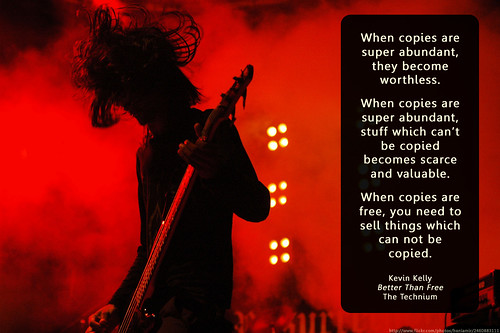
With this in mind here's a variation on Kelly's idea:
When content is faked, it becomes emotionally worthless.
When content is faked, stuff which isn't fake becomes scarce and valuable.
When content is faked, you need to show people things which are not faked.
Posted by
Will
at
17:22
0
comments
Labels: communications, design, digital, technology, video, websites
rebel selling
This is a screen grab from LastFM before they ruined their design. Putting that to one side for the moment, the interesting thing about it is that, after 'rock', 'alternative' came in as the second most popular tag. A screen grab from today shows much the same pattern.[Aside: It's interesting how 'seen live' is a major label too. Like Kevin Kelly has said when stuff gets superabundant it gets cheaper to the point of being free. When this happens things that can't be copied become more valued by both the ordinary people, hence the tag's popularity, and record companies, hence the money in music now being in touring.]

Bakunin, Nietzsche, Sombart and Schumpeter all saw capitalism not for the homogeneity it created but as a fundamentally creative (and thus destructive) system. Capitalism and culture can be stated as the effort to escape sameness.
But you get information problems here. There are too many alternatives. Just like brands are there to help solve this problem, so certain things become pin-ups for 'alternative' to avoid the crippling effects of having too many alternative things. These things are then popular for being alternative. Here, then, 'alternative' and 'popular' can operate the same place on a Gaussian distribution: everyone is trying not to be mainstream.
(Another irony here: counterculturalists believe they are rebelling against 'the system' when they are most probably contributing towards it, because rebellion is in the very spirit of capitalism. This could be problematic: "Not only does it distract energy and effort from the sort of initiatives that lead to concrete improvements in people's lives, but it encourages wholesale contempt for such incremental changes [The Rebel Sell])
Posted by
Will
at
12:12
3
comments
Labels: books, communications, media, philosophy
Thursday, 21 August 2008
more fragments
Because the model had this silent assumption when it was transferred to the new medium it got forgotten. The hidden fragment got left behind.
What are the audience doing online?
When people use Google, they're looking for information. When they use Amazon, they're buying (or researching). The ads are working here because people want information, it's welcome if its good enough.
I haven't thought about specific examples yet for social networks, but essentially companies selling in this space should assist with communication and expression, not clutter it.
The Internet isn't one medium, it's fragmented media - and not just by who, but why what.
Posted by
Will
at
23:26
0
comments
Labels: communications, digital
Wednesday, 6 August 2008
i am
Orange's new campaign, which orbits around the strap line ‘I am’, mines this too.
What does 'I am' mean?
Simply, you are better off working together than you are by yourself, thus necessitating communication technology. You are the sum of the people you communicate with.
One of the nice things about this strategy is that it is actually true. It's not that staple of advertising - myth-making - but a statement of something fundamental about human interaction and that makes it fresh.
For one, you are smarter working together. Ybarra et al (2008) writing in the Personality and Social Psychology Bulletin found that social interaction (as little as 10 minutes) improved intellectual performance.
More social contact is correlated with well-being (Sinha & Verma, 1990; Triandis et al., 1986) and its absence is marked by depression (Gladstone, Parker, Malhi, & Wilhelm, 2007).
There is even some evidence to show that after controlling for level of health, fewer social connections are linked to an increased risk of death (House, Landis, & Umberson, 1988). Yikes!
Orange is in the relationship business, not the mobile phone business any more.
And not only the relationships between each other but the relationships between all our different digital identities.
'I am' Facebook, Flickr, Blogger, YouTube, Amazon, Vimeo, Google, Dopplr, Wikipedia, del.icio.us, Stumble Upon the list goes on....
This unruly mass of services exists and yet there is nothing to tie them all together.
That is, until Orange’s offering, My Social Place, hits the scene in the autumn soldering all our online identities into one ball. So ‘I am’ is a strategy that is timely in two ways. It fosters and facilitates being social, something we all need but aren't getting enough of. And it is digitally prescient, preparing for communicative life beyond simple mobile. More evidence of marketing and service dancing together so fast you can tell who's who.
But there is a final bit of cleverness in here. The social thing and the digital thing, as well as being two separate but rather nifty uses of the same strategy for ordinary people, are also commercially adroit when holding hands. As Cory Doctorow, in a speech at Cambridge last month, explains,
"The thing that the Internet is even better at than providing universal access to all human knowledge is nuking collaboration costs, getting rid of the cost of getting people together to do stuff…[This is] what allows us to be literally superhuman. That is to say that if you and someone else can do something that transcends that which you could do alone, then you have done something that is more than one human can do and is superhuman." (around 19 mins in)'I am' in this sense perhaps acknowledges that what's around the corner is really big collaboration online and on-phone. And Orange is going to be a company to help out with all of that in its services, the branding seed of which is being planted now.
Pity the execution isn't more exciting and less pretentious. Still, early days.
Posted by
Will
at
17:25
0
comments
Labels: communications, mobile, psychology
search for 'i am'
Anyway.
I might be wrong - I'm probably wrong - but, isn't this the first big campaign in the UK to jettison URLs in favour a search term?
In case it has passed you by, the ad suggests you
in the spot normally reserved for a URL.
[Aside: 'I am' has to be the shortest sentence in English?]
Of course, the Japanese have been doing this sort of thing for a bit, probably because their mobile market is so much more mature than ours.
But there doesn't appear to have been any SEO. Instead Google, Yahoo et al. seem to have profited rather nicely from this campaign (any of the Fallon people currently dating people at the search engines?)
People search for everything, sometimes even if they have the site in their bookmarks. No one really types in a whole web address any more. It's good to see brands acknowledge this.
Posted by
Will
at
00:57
0
comments
Labels: communications
Monday, 28 July 2008
ipint + the global spirit level
Although fun, it is quite shallow. It needs more depth to win my vote.
The next best example of mobile advertising from Carling would be if you could add some sort of value in beyond a neat trick, like actually having your pint waiting for you at the bar or brought to you if you order on your iPhone so you can avoid a ten-deep human barrier between you and your cool, refreshing beverage. Probably would get more Carling sold too, which would "stretch the definition of what advertising is" even further.
[It's the accelerometer in the iPhone that Carling has exploited. The accelerometer is the interesting bit. And for no reason other than it's possible it would be cool to know the tilt of every iPhone user on the planet. Making the half-decent assumption that facing up and moving a bit equals movement and down flat equals inactivity it would provide an interest peek into people's activity.]
Posted by
Will
at
22:01
0
comments
Labels: communications, internet, mobile
Thursday, 24 July 2008
the future is streaming, not downloading
The news that major ISPs in the UK have agreed to smack the wrists of hardcore file-sharers is, ultimately, not really news.
This is because film, tv and music - the most popular shared content - is increasingly available in streamable form obviating the need to download at all. It's all going to be in the cloud.
The likes of LastFM and Pandora could take care of the music. iPlayer is already taking care of the BBC's output phenomenally well. Other places like TV Shack, Videostic and, legally, Hulu, are providing the rest.
It does tickle me a bit that just as the industry catches up, the ways in which we can consume music has moved on. Instead of owning content - and all the problems that brings if you have acquired it illegally - you just own links to that content and get served with ads or pay a small subscription fee for it.
This shouldn't be a new problem for the entertainment industry, it's a better solution.
Posted by
Will
at
10:46
0
comments
Labels: communications, digital, internet, media, mobile, software, technology, video
Wednesday, 23 July 2008
digital bites
I like making pictures. And anything to do with digital. So I married the two together in a Flickr group.It started off as just a personal stash of interestingness for someone entering the world of digital to get their head around things.
Then I wondered if (and how) it would spread on the Internet without me promoting it at all. It was an interesting wee experiment just watching various links organically popping up all over the place, the odd twitter/friendfeed/blog mentioning it.
Anyway, people seem to like it. So now I'm moving onto the second part of the experiment: promoting it, which starts with this, a playful little app where all the 'digital bites' can be explored:
www.will-lion.com/digitalbites
Let's see what happens now.
Posted by
Will
at
22:33
0
comments
Labels: communications, internet, photography
Monday, 14 July 2008
radioheadness
Radiohead seems bigger than the sum of its parts. I happen to think their music is fantastic but I have just got this niggle that their music alone shouldn't be so big. Isn't it too drony for most people?
With The Tipping Point still kicking about in my mind from a recent re-read I can't help but feel some of their success can be attributed to their seriously innovative activity away from their instruments, like the video above where instead of capturing light bouncing off them (like a camera does) they have captured something else bouncing off and played around with the data. Then there's the web-only free album and all the remixing possibilities they create, like the video above, which comes with Google Code to make your own visualisations. This remix property is something Kevin Kelly predicted:
"Once music is digitized it becomes a liquid that can be morphed and migrated and flexed and linked. You can filter it, bend it, archive it, rearrange it, remix it, mess with it." Radiohead seem to be pushing people into this stage; other bands are still coming to grips with stage two, freeness.
Perennially operating on the edge lends a serious ding to the band's cachet. For one, it acts to get the attention of early adopters. It also may create a 'Coke effect'. In blind taste tests most people rate Pepsi as tasting better. When they see the labels Coke is preferred. Brand associations literally change taste perception. Radiohead's associations might literally change music perception or force people to give it 'more of a try' because cool early adopters, people who are serious about music, are serious about Radiohead.
Or maybe the slightly drony alienated sound is just what people like.
(Thanks very much to Faris who mentioned this post on his blog)
Posted by
Will
at
23:59
1 comments
Labels: communications, music
Sunday, 22 June 2008
Using the space
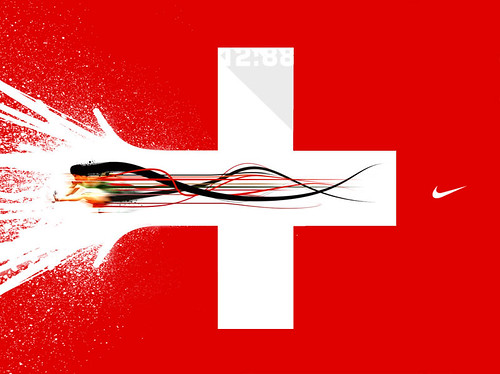
When digital media space is snapped up on a page by the same brand what usually happens is that two identical ads are shoehorned into their respective spaces after a bit of resizing. That's filling the space. In the Mac ad above the two spaces speak to each other in a meaningful way making the whole ad more engaging. That's using the space.
Posted by
Will
at
00:33
0
comments
Labels: communications, media
Friday, 13 June 2008
Digital is different
In this article in AdAge (Google cache version here), Robert Rosenthal, former president of TBWA/Chiat/Day Latin America, is highly skeptical of what "online advertising [is] actually delivering...." He notes that there is no proper Internet branding to speak of, "[c]an you think of even one "Just do it"...that came from advertising on the web?"
I think this makes the error of thinking about new media by the standards of the old media. It's the view that expects brands to be announcing what they are about the whole time, instead of, well, just doing it. Simply put, it's the expectation of messages where services are more appropriate (and appreciated).
So, there may not be a "Just do it" but there is a Nike+.
As the NYT says, "Behind the shift is a fundamental change in Nike’s view of the role of advertising. No longer are ads primarily meant to grab a person’s attention while they’re trying to do something else — like reading an article. Nike executives say that much of the company’s future advertising spending will take the form of services for consumers, like workout advice, online communities and local sports competitions.
"“We want to find a way to enhance the experience and services, rather than looking for a way to interrupt people from getting to where they want to go,” said Stefan Olander, global director for brand connections at Nike. “How can we provide a service that the consumer goes, ‘Wow, you really made this easier for me’?”"
TV may be the major place for yaddering on about brands and what they stand for but digital offers other ways of making businesses grow - and growth is what 'advertising' has to be aiming to engender.
Posted by
Will
at
23:32
0
comments
Labels: communications, digital
Thursday, 24 April 2008
Saturday, 19 April 2008
Now
I think technology should be about about manipulating space (by making it negligible - e.g., cars, planes etc) and time (by giving us more of it - e.g., microwaves, washing machines etc). In one sense, then, I admire Vodafone's newish strategy - to make the best use of your time - because mobile communication frees up otherwise dead time. This is the essence of their recent TV spot:As Judy Dench tells us it's "the hanging around time, the A-B time" that could be better spent.
Making the most of 'now' also means being in a permanent state of 'now'; time for reflection is suspended by the tyranny of being constantly 'on'. "The hours not really spent doing anything" are assumed to be bad in the ad. But the hours not really spent doing anything are important.
With the growth of hyper-connectivity the need for independence and quiet reflection amid this 'now' state are going to be every more important as technology (and thus bosses) encroach ever more on this time. We need may need digital holidays.
Posted by
Will
at
22:57
0
comments
Labels: communications, psychology
Friday, 18 April 2008
GTA Coke
This I like. Excellent work by Wieden + Kennedy and Nexus.
Posted by
Will
at
02:40
0
comments
Labels: communications, gaming